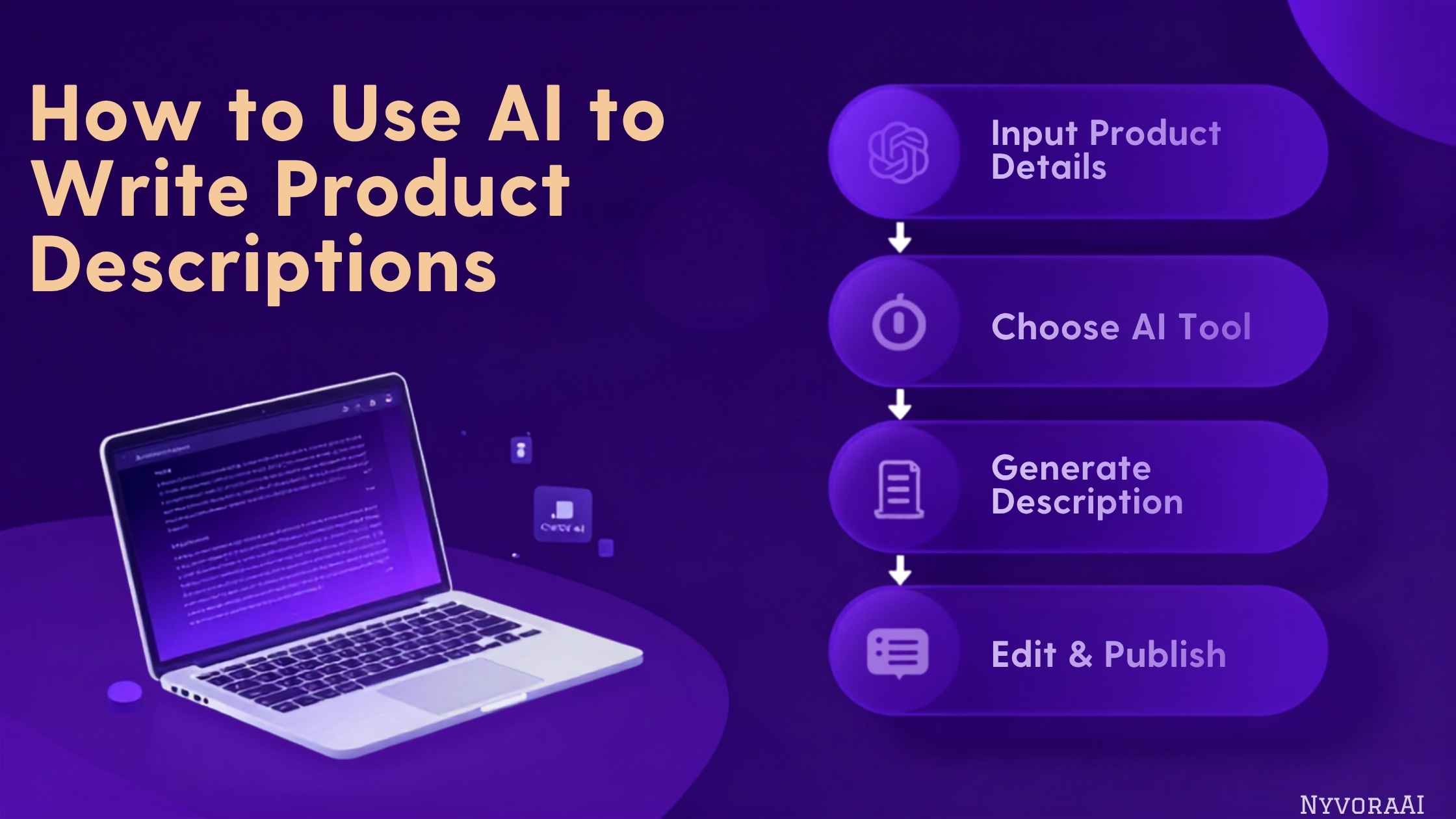
If you run an online store, you already know the problem: every new product needs a description, every description needs to sound like your brand, and there are never enough hours in the week to write them all from scratch. AI has genuinely changed this equation. It's not about pressing a button and getting a perfect finished description — it's about using AI to produce a strong first draft in seconds so a human only has to refine it, not write it from a blank page.
This guide covers the entire practical process: why AI is well suited to this specific writing task, which tools are worth using depending on your catalog size, exactly how to prompt for descriptions that don't sound generic, how to work in the keywords your customers actually search for, and how to edit the output so it reads like your brand wrote it. If you haven't yet explored using AI more broadly across your store's operations, our guide on how to set up an AI assistant for your business is a natural next step once this workflow is in place.
The stores getting the best results treat AI as a drafting tool, not a publishing tool.
- Feed it real product facts — specs, materials, sizing — never let AI guess details it doesn't know
- A detailed prompt beats a short one every time; brand tone and target customer matter as much as the product itself
- Generate 2-3 versions and pick the strongest, rather than accepting the first draft
- Always fact-check and edit before publishing — AI can sound confident about details it invented
- Work keywords in naturally instead of stuffing them, since Google ranks quality and usefulness either way
01Quick Answer
To use AI to write product descriptions, gather your product's real specs, materials, and unique selling points first, then give an AI tool like Claude or ChatGPT a detailed prompt that includes your brand's tone, your target customer, the product facts, and the keywords you want included. Ask for two or three variations, pick the strongest, and edit it for accuracy and voice before publishing. For large catalogs with hundreds of SKUs, a dedicated ecommerce copywriting tool with bulk generation will save considerably more time than doing it one product at a time in a chat window.
02Why AI Works So Well for Product Descriptions Specifically
Product descriptions are a genuinely good fit for AI writing because they follow a repeatable structure — a hook, a set of benefits, a list of specs, and a call to action — and that structure is exactly what large language models handle reliably when given clear inputs. Unlike a personal essay or an opinion piece, a product description doesn't need original ideas; it needs your real facts, organized clearly and written persuasively.
The time savings compound fast. A store with 200 products that used to take a week of writing can realistically get first drafts for the entire catalog in an afternoon, leaving the team's time for the part that actually needs human judgment: fact-checking, tone editing, and deciding what genuinely makes each product worth buying.
03What AI Can — and Can't — Do Here
That last point matters more than any other on this list. AI is confident by default, and it will write a plausible-sounding claim about material or fit even when it doesn't actually know. Treat every AI-generated description as a draft that needs a factual review, the same discipline that applies to any AI-assisted writing task, including using AI to improve a resume, where invented details are just as risky.
04Best AI Tools for Product Descriptions, Compared
| Tool | Best For | Strength | Catalog Size |
|---|---|---|---|
| Claude | Brand-voice-heavy copy | Strong tone control, follows detailed instructions well | Small–Medium |
| ChatGPT | Fast, flexible drafts | Quick iteration, widely available plugins | Small–Medium |
| Copy.ai | Ecommerce-specific templates | Built-in product description templates and bulk mode | Medium–Large |
| Jasper | Brand voice at scale | Brand voice training across a full team and catalog | Large |
| Writesonic | Bulk CSV product uploads | Upload a spreadsheet, get descriptions back in bulk | Large |
If you're a solo seller or run a small catalog under fifty products, a general assistant like Claude with a well-written prompt is genuinely enough — you don't need a dedicated platform. Once your catalog grows past a few hundred SKUs, the bulk-processing features on tools like Writesonic or Copy.ai start paying for themselves quickly in time saved.
05Step-by-Step: From Blank Product Page to Published Description
Collect the real product facts
Specs, dimensions, materials, care instructions, and what makes this product different from similar ones on your store or a competitor's.
Note your target customer
Who's actually buying this — a gift-shopper, a repeat customer, a first-time visitor comparing options? The tone should shift accordingly.
Write a detailed prompt
Include the facts, the customer, your brand tone, the target length, and any keywords you want naturally included.
Generate two or three variations
Ask for different lengths or angles — one benefit-led, one feature-led — and compare which fits your store best.
Fact-check every claim
Cross-check specs, sizing, and material claims against your actual product data before anything goes live.
Edit for brand voice, then publish
Remove generic phrases, adjust anything that doesn't sound like you, and publish with confidence.
06Write a Prompt That Actually Works
The single biggest difference between a generic AI product description and a genuinely good one is the quality of the prompt. A one-line request like "write a description for this candle" gives the AI almost nothing to work with, so it fills the gaps with clichés. A detailed prompt, on the other hand, gives it real material to shape into something specific.
Notice how nothing in that prompt asks the AI to invent anything — every fact came from the actual product. That's the difference that keeps AI-written descriptions accurate and specific instead of vague and interchangeable with every other candle description online. The same prompting discipline — real facts, clear format, no room for guessing — applies whether you're writing product copy or using AI for YouTube content to promote those same products.
07Optimizing AI-Written Descriptions for Search
A product description that sounds great but never ranks isn't doing its full job. Before you finalize your prompt, spend a few minutes finding out what your actual customers search for — not what you assume they search for. Our guide on how to use AI for SEO keyword research covers exactly how to do this, and it pairs directly with this workflow: research the keyword first, then hand it to the AI as part of the product description prompt.
Once you have a target keyword, work it into the product title, the opening line of the description, and at least one bullet point — naturally, not repeated four times in a row. Google has been clear that it evaluates content on usefulness and quality regardless of whether AI was involved in writing it, so a well-researched, well-edited AI description competes on equal footing with a human-written one. If you want to cross-check what competitors are ranking for before you write, tools like Perplexity AI compared to Google for research can speed up that competitive check considerably.
08Editing AI Output So It Sounds Human
This step is where most of the actual craft happens. AI drafts tend to lean on a familiar set of phrases — "elevate your," "perfect for any occasion," "you'll love this" — that show up across thousands of AI-generated product pages. Cutting these out and replacing them with something specific to your product is what makes a description feel like it was written by someone who's actually held the item.
- Read the draft out loud — anything that sounds stiff or overly formal gets rewritten
- Replace generic claims ("high quality," "amazing") with a specific, checkable detail
- Cut any sentence that could apply to literally any product in the same category
- Add one sensory or specific detail a human would actually notice — a texture, a sound, a smell
- Match sentence length to your brand's usual rhythm — short and punchy, or longer and descriptive
A Habit Worth Building
Keep a running list of AI-generated phrases you keep having to cut. After a few weeks, add that list directly into your prompt as things to avoid — the quality of your drafts improves noticeably once the AI stops reaching for the same clichés every time.
09Mistakes That Make AI Product Descriptions Fall Flat
- Publishing the first draft unedited. The fastest way to end up with generic, forgettable copy across your whole store is skipping the human editing pass entirely.
- Letting AI guess at facts you didn't provide. If you don't give it the material or care instructions, it will invent something plausible-sounding — and wrong.
- Using the exact same prompt for every product. A candle and a leather wallet don't need the same tone or structure; adjust the prompt per category, not per SKU.
- Keyword stuffing. Repeating the same search term unnaturally reads badly to customers and doesn't actually help rankings the way it once did.
- Skipping the brand voice check. A description that's technically accurate but doesn't sound like your store creates a disconnect customers notice, even if they can't say exactly why.
Always Fact-Check Before You Publish
Never publish an AI-written claim about materials, sizing, safety, or certifications without verifying it against your actual product data. A confident-sounding but incorrect claim about a product can lead to returns, complaints, and lost trust — the accuracy check is not optional.
Once your product description workflow is running smoothly, the same prompting and editing discipline extends naturally into other parts of running a store — from a free chatbot for your website that can answer sizing questions using the same product facts, to using AI for the broader content that drives traffic to those product pages in the first place.
10Frequently Asked Questions
Can AI really write good product descriptions?
Which AI tool is best for writing product descriptions?
Will Google penalize AI-written product descriptions?
How long should an AI-generated product description be?
Should I edit AI-written product descriptions before publishing?
11Conclusion
Using AI to write product descriptions isn't about replacing the person who knows the product — it's about removing the blank-page problem that makes writing fifty or five hundred descriptions feel impossible. Give the AI real facts, a clear brand tone, and a specific format, and it will consistently produce a strong first draft that a human can shape into something genuinely good in a fraction of the time it would take to write from scratch.
The stores that get this right treat every AI draft as exactly that — a draft. They fact-check it, cut the generic phrases, work in the keywords their customers actually search for, and make sure the final version sounds like it came from someone who genuinely knows and cares about the product. Skip that editing step, and AI-written copy blends into the same generic noise every other AI-assisted store is publishing. Do it properly, and it becomes one of the fastest, most reliable parts of running an online store.
Start with your five best-selling products, write one really strong prompt, and see how much time it saves before you roll it out across your whole catalog. Once it's working, this same approach — real input, clear instructions, human review — is the pattern worth applying to every other AI tool you bring into your business.

Written by Varun Lalwani
Varun writes practical, beginner-friendly guides on AI tools and business workflows for NyvoraAI. Updated July 2026 based on hands-on testing of AI copywriting tools across several ecommerce catalogs. Questions about your setup? Contact us — we're happy to help.