Imagine walking into a dark room for the first time. You don't have a map. You don't have GPS. Yet, within seconds, your brain constructs a mental map of the room. You know where the door is, you sense the proximity of the coffee table, and you can navigate around a sleeping dog without waking it up.
For decades, robots were blind and clumsy. They could only repeat pre-programmed movements in strictly controlled environments. Today, robots are walking through crowded hospitals, delivering packages in busy warehouses, and vacuuming homes filled with scattered toys. The shift didn't come from better wheels or stronger motors. It came from AI.
If you are wondering how does AI help robots navigate spaces, the answer lies in a complex symphony of sensors, machine learning algorithms, and real-time decision-making. In this guide, we will pull back the curtain on the technology that allows machines to move intelligently through our world.
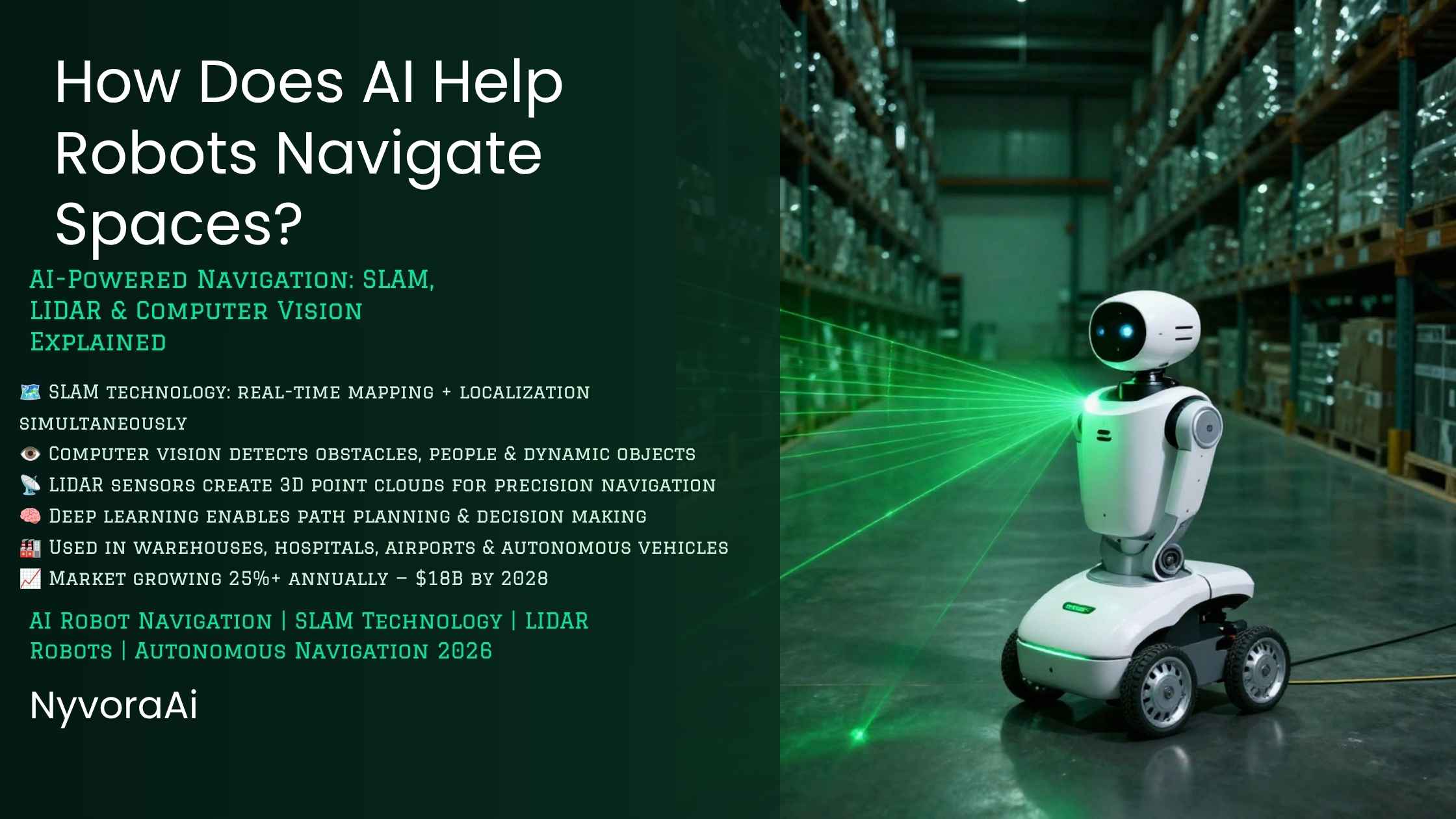
- Sensor Fusion: AI combines data from LiDAR (lasers), cameras (vision), and ultrasonic sensors to create a 360-degree understanding of the environment.
- SLAM: Simultaneous Localization and Mapping allows robots to build a map of an unknown space while simultaneously tracking their location within it.
- Semantic Understanding: AI doesn't just see "obstacles"; it recognizes "chairs," "people," and "glass doors," allowing for smarter, context-aware navigation.
- Predictive Pathfinding: Machine learning predicts where moving objects (like humans) will be in the next few seconds, preventing collisions before they happen.
01 The Eyes and Ears: How Robots "See"
Before AI can process anything, it needs raw data. Robots use a suite of sensors to gather information about their surroundings. But sensors alone are just data collectors; they don't understand what they are seeing.
02 The Brain: AI Sensor Fusion
If you rely only on LiDAR, you might crash into a glass window because lasers pass right through it. If you rely only on cameras, you might be blinded by a sudden change in lighting. This is where Sensor Fusion comes in.
AI algorithms take the noisy, imperfect data from all these different sensors and stitch them together into a single, coherent model of the world. It's a bit like how your own brain combines what you see, what you hear, and what you feel through your feet to understand a room. The AI filters out the "noise" (a shadow that looks like a hole) and confirms the "signal" (an actual, solid wall).
This isn't as simple as it sounds. Every sensor reports on a slightly different timescale, and a camera frame captured a few milliseconds before a LiDAR sweep can throw off the whole picture if the robot is moving quickly. Engineers solve this with tight time-synchronization and probabilistic models like Kalman filters, which weigh each sensor's input based on how much it can be trusted in that specific moment. A camera, for instance, becomes less trustworthy the second the lights flicker or the sun glares through a window, so the AI leans harder on LiDAR and the IMU until visual conditions stabilize again. This constant, second-by-second rebalancing is really what separates a robot that feels "smart" from one that keeps clipping doorframes.
03 What is SLAM? (The Magic Acronym)
You can't talk about robot navigation without mentioning SLAM: Simultaneous Localization and Mapping.
Imagine you are dropped into a maze blindfolded. You have to explore the maze to draw a map, but to draw the map, you need to know where you are. It's a paradox. SLAM solves this paradox mathematically. As the robot moves, it uses its sensors to estimate how far it has traveled (odometry) while simultaneously identifying landmarks (corners, doors, unique patterns). It constantly updates its internal map and its position on that map at the same time.
Modern AI-enhanced SLAM (often called Deep SLAM) uses neural networks to recognize these landmarks much faster and more accurately than traditional mathematical methods, even in environments that look very similar (like long, identical hotel hallways). You can see a real-world version of this playing out 140 million miles away: NASA's Perseverance rover uses a self-driving system called AutoNav to build 3D maps of Martian terrain and re-plan its route around rocks on the fly, all without waiting for instructions from Earth, according to NASA's Jet Propulsion Laboratory. If SLAM can work on an alien planet with a communication delay of several minutes, it's not hard to see why it works so well in a hotel hallway.
04 Semantic Navigation: Beyond "Obstacle Avoidance"
Old robots just saw "obstacles." If there was an object in the way, they stopped. AI allows for Semantic Navigation—understanding what the object is.
- Context Awareness: An AI robot knows that a "wall" is immutable, but a "chair" might be moved. It can wait for a human to move the chair, or gently nudge it if safe.
- Surface Recognition: AI can identify that a rug is slippery or a threshold is high, adjusting its motor speed and suspension to prevent getting stuck.
- Safety Zones: It can recognize a "pool edge" or a "staircase" and create a virtual invisible wall, never even approaching the edge.
This level of intelligence is what allows these machines to operate in complex human environments. To see how this technology is saving lives in critical care settings, check out our guide on how are AI robots used in hospitals, where they navigate crowded corridors without interrupting medical staff.
05 Avoiding the Unpredictable: Dynamic Obstacles
The hardest thing to navigate around is something that moves unpredictably: a human being, a pet, or a forklift. Traditional pathfinding algorithms (like A* or Dijkstra) plan a static route from A to B. If a human steps into that path, the robot stops.
AI changes the game with Predictive Modeling. Using Reinforcement Learning and computer vision, the robot tracks the velocity and trajectory of a moving person. It calculates a "probability cone" of where that person is likely to be in the next 2-3 seconds. Instead of stopping abruptly, the robot smoothly alters its path to glide behind the person, maintaining flow and efficiency.
This is the same core technology that powers autonomous vehicles. To understand the high-stakes version of this tech, read how do self-driving cars use AI.
06 Real-World Applications
How is this technology being deployed today?
1. Logistics and Warehousing
In massive fulfillment centers, thousands of Autonomous Mobile Robots (AMRs) navigate dynamically. They don't just follow lines on the floor; they communicate with each other (Swarm AI) to optimize traffic flow and avoid bottlenecks. The field has grown fast enough that the National Institute of Standards and Technology now runs dedicated research into performance and safety test methods for these mobile robots, precisely because so many of them are now sharing floor space with human workers. This physical automation is the backbone of modern what is robot process automation (RPA).
2. Domestic Helpers
Robot vacuums and mops are the most common navigation AI in our homes. They map our living rooms, remember where the "high traffic" areas are, and avoid "no-go zones" like pet bowls. But can they do more than just clean? We investigate the limits of domestic dexterity in can AI robots do household chores yet.
3. Security and Inspection
Robots patrol server farms, industrial sites, and perimeters. They use thermal cameras and gas sensors to navigate in total darkness or hazardous environments where humans cannot go, mapping leaks or structural faults in real-time.
07 Interactive: Which Navigation Tech is Right?
Different environments require different navigation "stacks." Use this tool to see which technology combination is best for a specific robotic use case.
Of course, adding advanced LiDAR and AI compute modules impacts the bottom line. To understand the financial side of these machines, read our breakdown of how much does an AI robot cost in 2026.
08 The Future: Neural Maps and Swarm Intelligence
We are moving beyond simple 2D maps. The next wave of navigation involves Neural Radiance Fields (NeRFs) and 3D Gaussian Splatting. These AI techniques let robots build photorealistic, 3D volumetric memories of a space. A robot won't just know "there is a wall there." It will remember the exact texture of the wallpaper and the reflection of the light on the floor, allowing for hyper-precise localization even if the lighting changes later.
Then there's Swarm Intelligence, which lets hundreds of robots share their mapping data instantly. If one robot explores a new floor of a building, every other robot in the fleet knows the layout a moment later. It's collective memory, at machine speed.
None of this means robot navigation is a solved problem. Reflective floors, fog, heavy rain, and rooms full of near-identical furniture can still confuse even well-tuned systems, and edge cases like a child suddenly darting out from behind a couch remain genuinely hard. Most navigation failures reported by manufacturers today trace back to these unusual, low-frequency situations rather than everyday hallways or living rooms, which is exactly why so much current research money is going toward predictive modeling and richer 3D scene understanding rather than better hardware alone.
If you are still trying to wrap your head around the hardware vs. software distinction in these machines, our guide on what is the difference between AI and a robot clears up the terminology.
09 Frequently Asked Questions
How does AI help robots navigate spaces?
What is SLAM in robotics?
Do robots need LiDAR to navigate?
How do robots avoid dynamic obstacles like humans?
Can robots navigate in the dark?
What happens if a robot gets "lost"?

Written by the NyvoraAI Team
We decode the complex world of robotics and AI to help you understand the machines of the future. This guide was updated in June 2026. Have questions about robot navigation? Contact our team or learn more about our mission.