Walk into almost any large hospital in 2026 and you'll see something that would've looked like science fiction a decade ago: a squat delivery robot waiting patiently for an elevator, a UV-emitting machine gliding into an empty patient room, and, somewhere behind a set of double doors, a surgeon guiding robotic arms through an incision smaller than a fingernail.
None of this happened overnight. Hospitals have been layering in automation piece by piece for years, and the pace has picked up noticeably since staffing shortages and rising costs forced administrators to look for help wherever they could find it. From the operating room to the pharmacy, from patient hallways to remote consultation booths, robots now work alongside doctors and nurses rather than replacing them. So if you've ever wondered how AI robots are used in hospitals, here's a real look at what's actually happening on hospital floors right now.
In this guide, we'll walk through the major categories of hospital robots, how they actually work day to day, what they cost, and where the technology is headed next. Along the way, we'll also touch on how these systems learn and improve over time — a topic we go deeper on in our piece about whether robots can learn from watching humans.
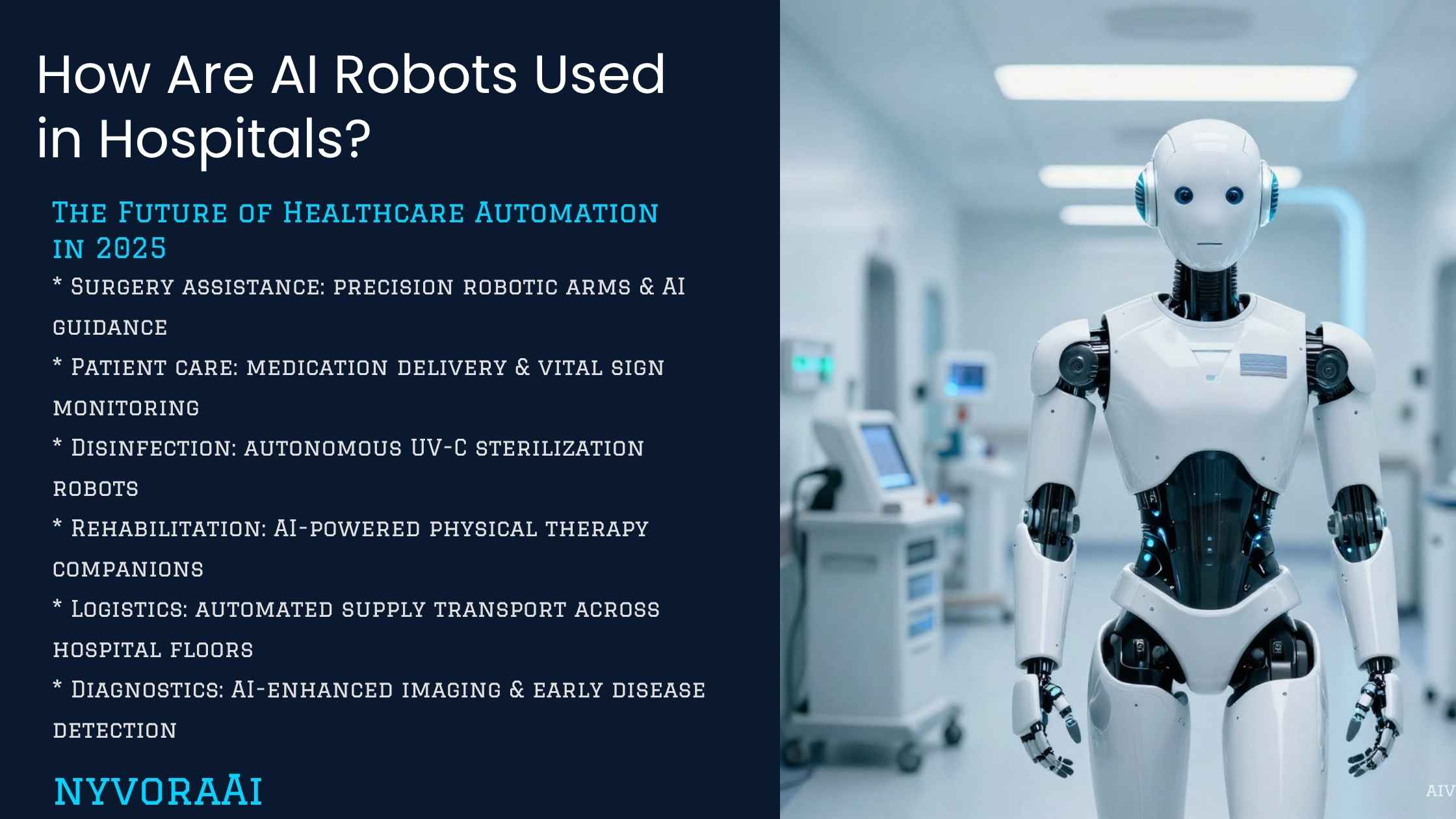
- Surgical Assistance: Robots like Intuitive Surgical's da Vinci system perform minimally invasive surgeries with enhanced precision and smaller incisions.
- Delivery & Logistics: Autonomous robots transport medications, supplies, and lab samples throughout hospitals 24/7.
- Disinfection: UV-C robots autonomously disinfect patient rooms and operating theaters, reducing infection rates.
- Patient Care: Companion robots assist elderly patients, monitor vitals, and provide medication reminders.
- Rehabilitation: Robotic exoskeletons help patients recover mobility after strokes or injuries.
01 The Rise of Hospital Robots: An Overview
Healthcare robotics has gone from a niche investment to a genuine budget line item at most large hospital systems. Analysts at Grand View Research put the global medical robotics market on track to pass $20 billion within the next few years, and hospitals are the single biggest driver of that growth.
Why Hospitals Are Embracing Robots
A handful of pressures are pushing adoption forward at once:
- Staff Shortages: The World Health Organization has repeatedly flagged the global shortage of health workers, and hospitals are being asked to do more with fewer hands.
- Precision Requirements: Surgical procedures demand sub-millimeter accuracy that robots can provide consistently.
- Infection Control: Robots can work in contaminated environments without risk, which matters a lot for infection prevention.
- 24/7 Operations: Unlike staff, robots don't need sleep, breaks, or time off.
- Data Integration: Modern robots log everything they do, so hospitals can spot patterns and keep improving performance over time.
Worth repeating: robots aren't taking healthcare jobs away — they're taking the tedious parts off people's plates. Picture them as very capable assistants that handle the repetitive, dangerous, or physically draining tasks, so nurses and doctors get more time for what actually needs a human touch: judgment calls, difficult conversations, and hands-on care.
02 Surgical Robots: Precision Beyond Human Capability
Surgical robots are probably the most visible and best-funded application of AI in hospitals today. It's worth being clear on one point up front: these machines don't operate on their own. A surgeon is always at the controls — the robot just gives them steadier hands and a better view.
Leading Surgical Robot Systems
The best-known name is Intuitive Surgical's da Vinci Surgical System, which by the company's own count has been used in well over 10 million procedures worldwide. Newer entrants are catching up fast, though — some of the companies pushing this space forward are covered in our roundup of the best AI robot companies in 2026.
How Surgical Robots Work
- Surgeon Control: The surgeon sits at a console and controls robotic arms with intuitive hand movements.
- Enhanced Vision: 3D high-definition cameras provide magnified views of the surgical site.
- Wristed Instruments: Robotic instruments have a greater range of motion than human hands, with 360-degree rotation.
- Tremor Filtration: The system filters out hand tremors, translating large movements into tiny, precise actions.
Applications in Surgery
- Urology: Prostatectomies, kidney surgeries
- Gynecology: Hysterectomies, myomectomies
- Cardiac Surgery: Valve repairs, bypass procedures
- General Surgery: Hernia repairs, gallbladder removal
- Orthopedics: Joint replacements with precise bone cutting
Benefits
- Smaller incisions and less blood loss
- Reduced pain and faster recovery times
- Lower risk of complications and infections
- Shorter hospital stays
- Better surgical outcomes
03 Delivery and Logistics Robots: The Hospital's Circulatory System
Hospitals never really stop moving. Medications, supplies, lab samples, meals, and linens all need to get from point A to point B constantly, and that logistical grind is exactly the kind of problem autonomous delivery robots are good at solving.
Types of Delivery Robots
Real-World Example: TUG Robots
Aethon's TUG robots are already running in hundreds of hospitals around the world, and it's easy to see why. These autonomous mobile robots can:
- Carry up to 1,000 pounds of supplies
- Navigate complex hospital environments
- Call elevators and open doors automatically
- Integrate with hospital information systems
- Operate safely around patients and staff
Benefits
- Time Savings: Nurses spend less time fetching supplies and more time with patients.
- Reduced Errors: Automated tracking ensures the right items reach the right destination.
- 24/7 Availability: Robots work nights, weekends, and holidays without fatigue.
- Staff Safety: Reduces physical strain from pushing heavy carts.
04 Disinfection Robots: Fighting Hospital-Acquired Infections
Hospital-acquired infections affect millions of patients every year and cost health systems billions of dollars, a problem the CDC has been tracking closely for decades. UV-C disinfection robots are one of the more effective tools hospitals have found for pushing those numbers down.
How UV Disinfection Robots Work
- Placement: Staff position the robot in a room after manual cleaning.
- Mapping: The robot maps the room and identifies high-touch surfaces.
- UV-C Emission: Powerful UV-C light (254nm wavelength) destroys bacteria, viruses, and spores at the DNA level.
- Autonomous Navigation: The robot moves to multiple positions to ensure complete coverage.
- Verification: Sensors confirm adequate UV dosage has been delivered to all surfaces.
Leading Systems
A few companies dominate this niche: Xenex, UVD Robots, and TRU-D SmartUVC all make hospital-grade disinfection robots, and independent testing has shown some of these systems can achieve up to a 99.99% reduction in pathogens — including drug-resistant superbugs like MRSA and C. diff.
Applications
- Patient room turnover
- Operating room preparation
- ICU disinfection
- Emergency department cleaning
- Isolation room decontamination
Benefits
- Reduced HAIs: Studies show 30-50% reduction in infection rates.
- Consistency: Robots don't get tired or skip steps.
- Speed: Rooms can be disinfected in 10-15 minutes.
- Safety: No chemical exposure for staff.
- Documentation: Automatic logging of disinfection cycles for compliance.
05 Patient Care and Companion Robots
Robots aren't just moving carts and disinfecting rooms behind the scenes — some of them interact with patients directly, offering companionship, keeping an eye on vitals, and lending a hand with day-to-day care.
Types of Patient Care Robots
Real-World Applications
- Dementia Care: Companion robots reduce agitation and improve mood in dementia patients.
- Pediatric Care: Child-friendly robots help explain procedures and reduce anxiety.
- Mental Health: Robots provide cognitive behavioral therapy exercises and emotional support.
- Post-Operative Care: Monitoring recovery and alerting staff to complications.
Benefits
- Reduced patient loneliness and anxiety
- Improved medication adherence
- Early detection of complications
- Enhanced patient satisfaction
- Reduced staff workload for routine monitoring
06 Rehabilitation and Physical Therapy Robots
Recovering from a stroke, a spinal injury, or major surgery often means weeks or months of repetitive physical therapy. That's tedious for patients and labor-intensive for therapists — which is exactly why robotic systems have found such a natural fit here.
Types of Rehabilitation Robots
How They Work
- Assessment: The robot assesses the patient's current capabilities.
- Personalized Program: AI creates a customized therapy plan.
- Guided Movement: The robot assists or resists movement as needed.
- Adaptive Difficulty: The system adjusts difficulty based on performance.
- Data Collection: Every movement is tracked and analyzed.
Benefits
- Consistency: Robots provide the same quality of therapy every session.
- Intensity: Patients can perform hundreds of repetitions per session.
- Objectivity: Precise measurements eliminate subjective assessments.
- Motivation: Gamification and immediate feedback keep patients engaged.
- Accessibility: Patients can practice more frequently with less therapist involvement.
07 Telepresence Robots: Bringing Specialists to Every Room
Telepresence robots let a doctor effectively "be" in several places at once, which does wonders for access to specialist care and how fast patients get seen.
Applications
- Remote Consultations: Specialists can examine patients from anywhere in the world.
- ICU Monitoring: Intensivists can check on multiple patients without physical travel.
- Rural Healthcare: Patients in remote areas access urban specialists.
- Infection Control: Doctors can examine infectious patients without exposure risk.
- After-Hours Coverage: On-call physicians can assess patients without coming to the hospital.
Features
- High-definition video and audio
- Remote-controlled navigation
- Electronic stethoscopes and otoscopes
- Integration with electronic health records
- Secure, HIPAA-compliant communication
08 Pharmacy Automation Robots
Hospital pharmacies have quietly become one of the most automated departments in the building, with robots handling dispensing, packaging, and inventory that used to eat up hours of a pharmacist's day.
Types of Pharmacy Robots
Benefits
- Accuracy: Near-zero medication errors
- Speed: Faster medication delivery to patients
- Safety: Reduced exposure to hazardous drugs
- Efficiency: Pharmacists focus on clinical tasks rather than dispensing
- Compliance: Automatic documentation and audit trails
09 Benefits and ROI of Hospital Robots
The upfront price tag on hospital robots is no small thing, but once you add up the returns across departments, the math usually works out in the hospital's favor.
Financial Benefits
- Reduced Labor Costs: Robots handle tasks that would otherwise require additional staff.
- Lower Infection Rates: Fewer HAIs mean shorter stays and lower costs.
- Reduced Errors: Medication and surgical errors are costly; robots minimize them.
- Increased Throughput: Faster procedures and room turnover mean more patients served.
- Extended Equipment Life: Robots can work continuously without wear-related downtime.
Clinical Benefits
- Better Outcomes: Improved surgical precision and consistency.
- Faster Recovery: Minimally invasive procedures mean quicker healing.
- Reduced Complications: Lower infection and error rates.
- Enhanced Patient Satisfaction: Faster service and better communication.
Staff Benefits
- Reduced Burnout: Robots handle repetitive, physically demanding tasks.
- Improved Safety: Less exposure to infections and hazardous materials.
- Professional Satisfaction: Staff focus on high-value, meaningful work.
- Better Work-Life Balance: Automation reduces overtime and weekend work.
10 Challenges and Considerations
None of this comes easy. Hospitals that have gone down this road will tell you the technology is only half the battle — here's what tends to trip people up.
1. High Initial Costs
Surgical robots can cost $1-2 million, and even delivery robots range from $50,000-$150,000 each. Hospitals must carefully evaluate ROI and consider leasing or Robotics-as-a-Service (RaaS) models.
2. Integration Complexity
Robots must integrate with existing hospital systems (EHR, pharmacy systems, elevators, doors). This requires significant IT infrastructure and coordination.
3. Staff Training and Acceptance
Healthcare workers need training to work alongside robots. Some staff may fear job displacement, requiring change management and clear communication about augmentation vs. replacement.
4. Maintenance and Downtime
Robots require regular maintenance, software updates, and occasional repairs. Hospitals need technical support and backup plans for when robots are offline.
5. Regulatory and Liability Issues
Who's responsible if a robot makes an error? The manufacturer, the hospital, or the supervising clinician? The FDA regulates robotically assisted surgical devices, but clear internal protocols and insurance coverage still matter just as much.
6. Patient Acceptance
Some patients may be uncomfortable with robot care, particularly elderly or technophobic individuals. Human oversight and the option for human-only care must be available.
7. Cybersecurity
Connected robots are potential entry points for cyberattacks. Robust security measures, regular updates, and network segmentation are critical.
11 The Future of AI Robots in Hospitals
Where does all this go next? A few trends are worth keeping an eye on:
Near Future (2026-2030)
- Enhanced AI: Better machine learning for adaptive behavior and decision support.
- Improved Dexterity: More sophisticated robotic hands for delicate tasks.
- Better Human-Robot Interaction: Natural language processing for intuitive communication.
- Swarm Robotics: Multiple robots coordinating for complex tasks.
- Lower Costs: Economies of scale making robots more accessible.
Medium Term (2030-2040)
- Autonomous Surgery: AI performing routine procedures with minimal human oversight.
- Nanobots: Microscopic robots for targeted drug delivery and internal diagnostics.
- Brain-Computer Interfaces: Surgeons controlling robots with thought.
- Predictive Maintenance: AI predicting robot failures before they occur.
- Emotional AI: Robots detecting and responding to patient emotions.
Long Term (2040+)
- Fully Autonomous Hospitals: Robots handling most routine operations.
- Biohybrid Robots: Combining biological and synthetic materials.
- Conscious AI: The philosophical and technical debate about robot consciousness.
- Universal Healthcare Access: Robots bringing specialist care to underserved areas globally.
12 Frequently Asked Questions
How are AI robots used in hospitals?
What types of robots work in hospitals?
Are hospital robots safe for patients?
Do robots replace healthcare workers?
How much do hospital robots cost?
Can robots perform surgery autonomously?
How do disinfection robots work?

Written by Varun Lalwani
We explore the intersection of AI and healthcare to help you understand the technologies transforming medicine. This guide was updated in June 2026. Have questions about hospital robots? Contact our team or learn more about our mission.