Picture a busy downtown street at rush hour. Cars are merging, a cyclist is weaving between lanes, a pedestrian steps off the curb without looking, and a traffic light just turned yellow. A human driver processes all of that almost without thinking, drawing on years of muscle memory and instinct. Now picture a car handling that same intersection with nobody touching the wheel. How does a machine even begin to pull that off?
The short answer is AI, but that's really just the starting point. Self-driving cars — autonomous vehicles, if you want the formal term — lean on a layered stack of sensors, cameras, radar, and machine learning models to figure out what's around them, decide what to do about it, and then actually do it, all in real time. In this guide we'll walk through how that stack actually works, piece by piece, starting with the sensors that act as the car's eyes and ending with the control systems that turn a decision into a turn of the wheel.
- Sensor Fusion: Self-driving cars use multiple sensors (cameras, LiDAR, radar, ultrasonic) to create a 360-degree view of their surroundings.
- Neural Networks: Deep learning algorithms process sensor data in real-time to identify objects, predict movements, and classify road features.
- Decision Making: AI algorithms make split-second decisions about steering, acceleration, and braking based on traffic rules and safety protocols.
- Continuous Learning: Autonomous vehicles learn from millions of miles of driving data to improve their performance in diverse scenarios.
- Safety First: Multiple redundant systems and conservative decision-making ensure the vehicle prioritizes safety above all else.
01 The Sensor Suite: The Car's Eyes and Ears
Before any decision gets made, the car first has to understand what's actually happening around it — that's the whole job of the sensor suite. Think of these as the vehicle's sensory organs, constantly feeding raw information about the world back to the AI. No single sensor type does the whole job well, so modern autonomous vehicles run several in parallel, each covering the others' blind spots.
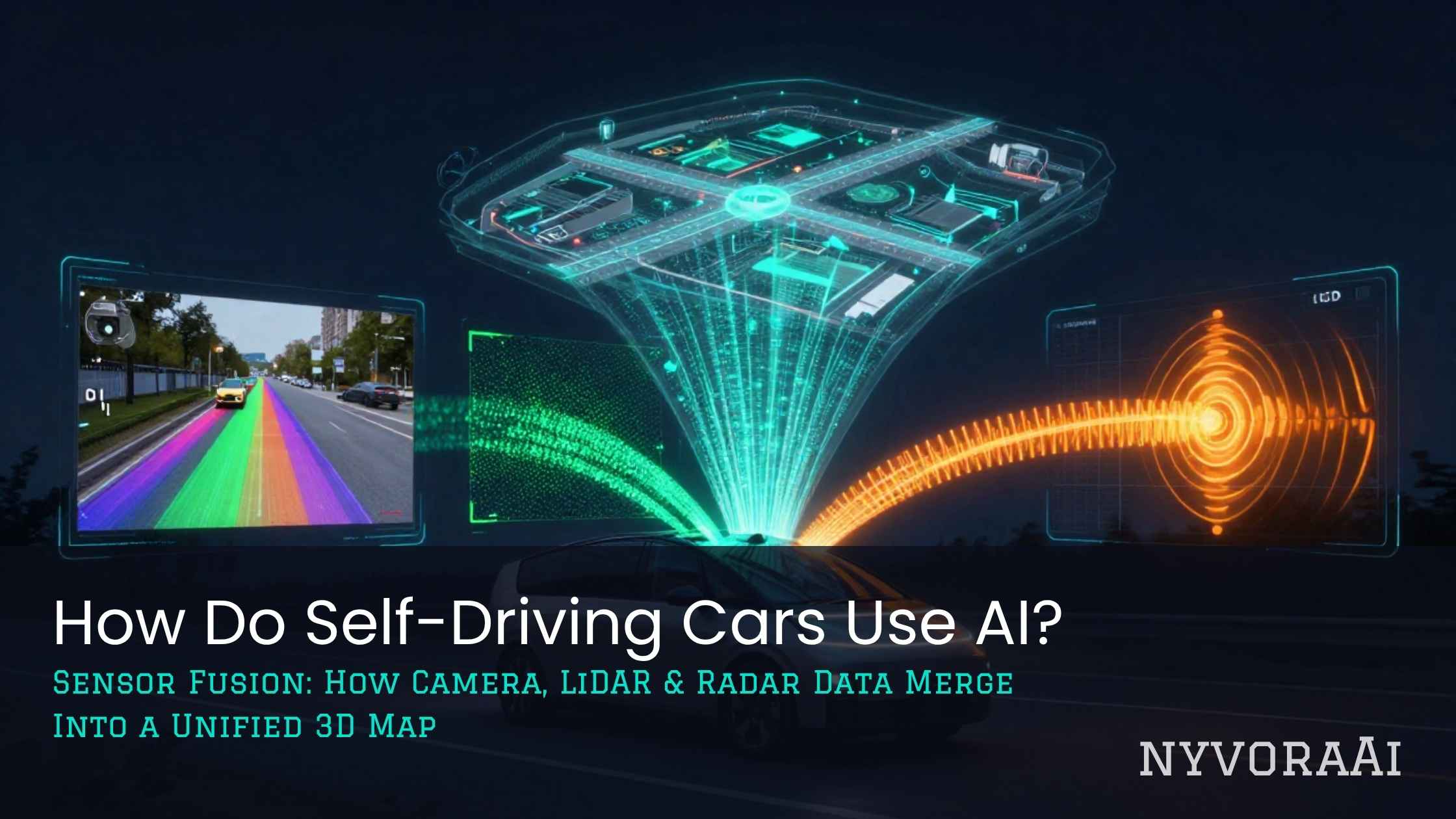
Here's the catch, though: once you've got four different sensor types all reporting data at once, you need some way to reconcile them into a single, coherent picture. That's sensor fusion. The AI takes input from every sensor and merges it into one unified model of the environment — a bit like taking statements from several witnesses to the same event and cross-referencing them until you land on the most reliable version of what actually happened.
02 Perception and Object Detection: Teaching the Car to See
Raw sensor data on its own is just noise until the AI makes sense of it. That's the perception stage — identifying and classifying everything the sensors picked up. This is really where deep learning earns its keep.
Convolutional Neural Networks (CNNs)
Self-driving cars lean on a specialized type of model called a Convolutional Neural Network, or CNN, to make sense of visual data. These networks are trained on millions of labeled images and gradually learn the patterns that separate a pedestrian from a lamppost, or a bicycle from a motorcycle — distinctions that seem obvious to us but take a huge amount of training data for a machine to pick up reliably.
When a camera captures a frame, the CNN runs it through several layers of processing. The early layers pick out simple features — edges, corners, contrast changes. Deeper layers start combining those into recognizable shapes, and by the final layers the network isn't just naming what it sees, it's also pinning down where the object sits, how big it is, and which way it's facing in 3D space.
Object Tracking and Prediction
Spotting an object is only half the job — the AI also has to track it over time and guess where it's headed next. This matters more than it might sound like. A pedestrian standing still at the curb is a non-issue; that same pedestrian mid-step into the road is a completely different problem.
To handle this, the system typically uses Kalman filtering, a technique that combines an object's current position with its velocity and acceleration to project where it'll likely be a few seconds out. That's what lets the car anticipate a hazard before it's already a hazard, rather than reacting after the fact.
Semantic Segmentation
Beyond spotting individual objects, the AI also needs to make sense of the road surface itself. Semantic segmentation handles this by classifying every single pixel in an image — road, sidewalk, building, sky, whatever it happens to be. That pixel-level read is what lets the car figure out where it's actually safe to drive, even when lane markings aren't much help.
This turns out to matter a lot in messy real-world scenarios like construction zones, where lane paint might be faded, temporary, or contradicted by cones. The AI can still work out the true drivable surface even when the usual visual cues are missing or confusing.
03 Decision Making: The Car's Brain
Once the car has a working picture of its surroundings, it has to decide what to actually do with that information. This is where the decision-making layer comes in, and it's juggling a few goals at once: get to the destination, follow the rules of the road, and — above everything else — keep everyone safe.
Path Planning
Path planning figures out the route from point A to point B, and it's more involved than just picking the shortest line on a map. The system has to weigh traffic conditions, closures, posted speed limits, and sometimes even fuel or battery efficiency.
Under the hood, this usually relies on graph search algorithms — A* and Dijkstra's algorithm are the classic examples — which evaluate a huge number of candidate routes against factors like distance, time, and safety margin. What comes out the other end is a planned trajectory, one that keeps getting quietly re-adjusted as conditions on the road change.
Behavioral Planning
Path planning tells the car where to go; behavioral planning figures out how to get there moment to moment. Change lanes now or wait? Yield to that merging car or hold position? Push through a yellow light or start braking?
These calls come from a blend of rule-based logic and machine learning. The rule-based side handles the non-negotiables: stop at red lights, keep a safe following distance, always yield to pedestrians. The learned models, trained on millions of miles of real human driving, pick up the softer judgment calls — giving extra space to a driver who's weaving, or slowing down early because the system recognizes a school zone.
Motion Planning
Once a behavioral decision is locked in, motion planning turns it into an actual physical maneuver: how far to turn the wheel, how hard to brake, how much throttle to apply.
Good motion planning produces smooth trajectories that respect what the car is physically capable of. Nobody wants a robotaxi that jerks the wheel or slams the brakes unnecessarily — the goal is a ride that feels natural, not like the car is fighting itself to stay on the road.
04 Control Systems: Executing the Plan
Last piece of the chain: the control system, which takes the AI's decisions and turns them into physical action by sending commands to the vehicle's actuators — the motors and mechanisms behind steering, acceleration, and braking.
PID Controllers
Most autonomous vehicles rely on PID (Proportional-Integral-Derivative) controllers to carry out precise movements. These constantly compare the car's actual state — position, speed, heading — against what the motion planner wants, and whenever there's a gap between the two, the controller works out the correction needed to close it.
Say the car starts drifting slightly right of its intended path. The PID controller calculates exactly how much left-steering correction is needed, and it's doing this recalculation hundreds of times a second, making tiny continuous adjustments rather than one big correction.
Redundancy and Safety
Safety isn't an afterthought here — it's baked into the architecture through redundancy. If the primary computer fails, a backup takes over immediately. If one sensor drops out, the others compensate. If the AI hits a scenario it genuinely can't resolve, there's a fallback protocol to pull over safely and stop.
That redundancy runs all the way down to the control systems too, with multiple independent systems watching the vehicle's actions and ready to step in the moment something looks off — not unlike having several co-pilots all keeping an eye on the road at once.
Estimates are directional and modeled off publicly reported crash-rate data from sources like NHTSA's automated vehicle safety program and IIHS driver-assistance research — treat them as a rough comparison, not a guarantee.
05 Levels of Autonomy: From Assistance to Full Autonomy
Not every "self-driving" car means the same thing. The Society of Automotive Engineers (SAE) publishes the industry-standard framework here: six levels of driving automation, running from Level 0 (no automation at all) up to Level 5 (full automation, no human needed, period).
Level 2: Partial Automation
Most of the "self-driving" features you'll actually find on cars today sit at Level 2. The system can manage steering and acceleration/braking together, but the driver still has to watch the road and be ready to take over instantly. Tesla's Autopilot and GM's Super Cruise are the two most familiar examples.
Level 3: Conditional Automation
Level 3 vehicles can take over every part of driving under specific conditions, like highway cruising. The driver can genuinely look away from the road, but has to be ready to step back in when the system asks. Honda's Legend, launched in Japan, was among the first Level 3 vehicles approved for public roads.
Level 4: High Automation
Level 4 vehicles operate with no human intervention, but only within a defined operational area or set of conditions — they might not be cleared for heavy snow or unmapped streets, for instance. Waymo's robotaxi fleet is the clearest real-world example of Level 4 running at scale today.
Level 5: Full Automation
Level 5 is the end goal everyone's chasing — a vehicle that can drive anywhere, in any conditions a competent human could handle, with no steering wheel or pedals required. Nobody's actually there yet, but Waymo, Cruise, and Tesla are all pushing hard in that direction.
Knowing these levels matters more than it might seem, mostly because it keeps expectations grounded. When a self-driving car makes headlines for a crash, the automation level involved changes the story completely — a Level 2 system assumes constant human supervision, while a Level 4 system is supposed to handle things on its own within its approved zone.
06 The Future: What's Next for Autonomous Vehicles?
This technology isn't standing still. A few developments worth keeping an eye on:
V2X Communication
Vehicle-to-Everything (V2X) communication lets cars talk to each other and to the infrastructure around them. Picture a car approaching an intersection and coordinating directly with the traffic light, or a sudden-stop warning broadcast instantly to every vehicle behind it. That kind of cooperative network could meaningfully improve both safety and traffic flow.
Edge Computing
Crunching that much sensor data takes serious compute power, and every millisecond of delay matters. Edge computing pushes that processing right onto the vehicle instead of round-tripping to a distant cloud server, which means faster, more dependable split-second decisions.
Simulation and Synthetic Data
Training a reliable model means covering rare edge cases too — freak accidents, extreme weather, the kind of scenario you'd never want to recreate on a real road. That's why companies lean heavily on simulation, generating millions of virtual driving miles that would be impractical or outright dangerous to capture for real.
Neuromorphic Computing
Conventional computers work through information step by step, while the human brain handles things in parallel. Neuromorphic chips try to mimic that parallel structure, and the hope is that it lets autonomous vehicles process sensor data more efficiently — and maybe make decisions in a way that feels a bit more human.
Getting to fully autonomous vehicles is still a long road, pun intended, but the upside is real: fewer accidents, smoother traffic, more mobility for people who can't drive themselves, and lower emissions. As the AI behind all this keeps improving, self-driving cars are edging from novelty toward something a lot more ordinary.
07 Frequently Asked Questions
How do self-driving cars use AI?
What sensors do autonomous vehicles use?
How accurate is AI in self-driving cars?
Can self-driving cars handle unexpected situations?
Are self-driving cars safer than human drivers?
How do self-driving cars learn to drive?

Written by Varun Lalwani
We break down complex AI technologies to help you understand the future of transportation. This guide was updated in June 2026 with the latest autonomous vehicle developments. Have questions? Contact our team or learn more about our mission.