Bring up "robots" at a dinner party and someone will inevitably start talking about artificial intelligence. Bring up "AI" and someone else will picture a metal humanoid walking around your house. Decades of movies have tangled these two words together in a way that doesn't really match how the technology actually works.
If you work in tech, study computer science, or just want to actually understand the machines showing up in the news, it's worth untangling them: AI and robots are not the same thing. They're different concepts that have only recently started merging in interesting ways — a point the ISO's formal robotics vocabulary standard is pretty explicit about, since it defines "robot" purely in terms of physical hardware, with no mention of intelligence required.
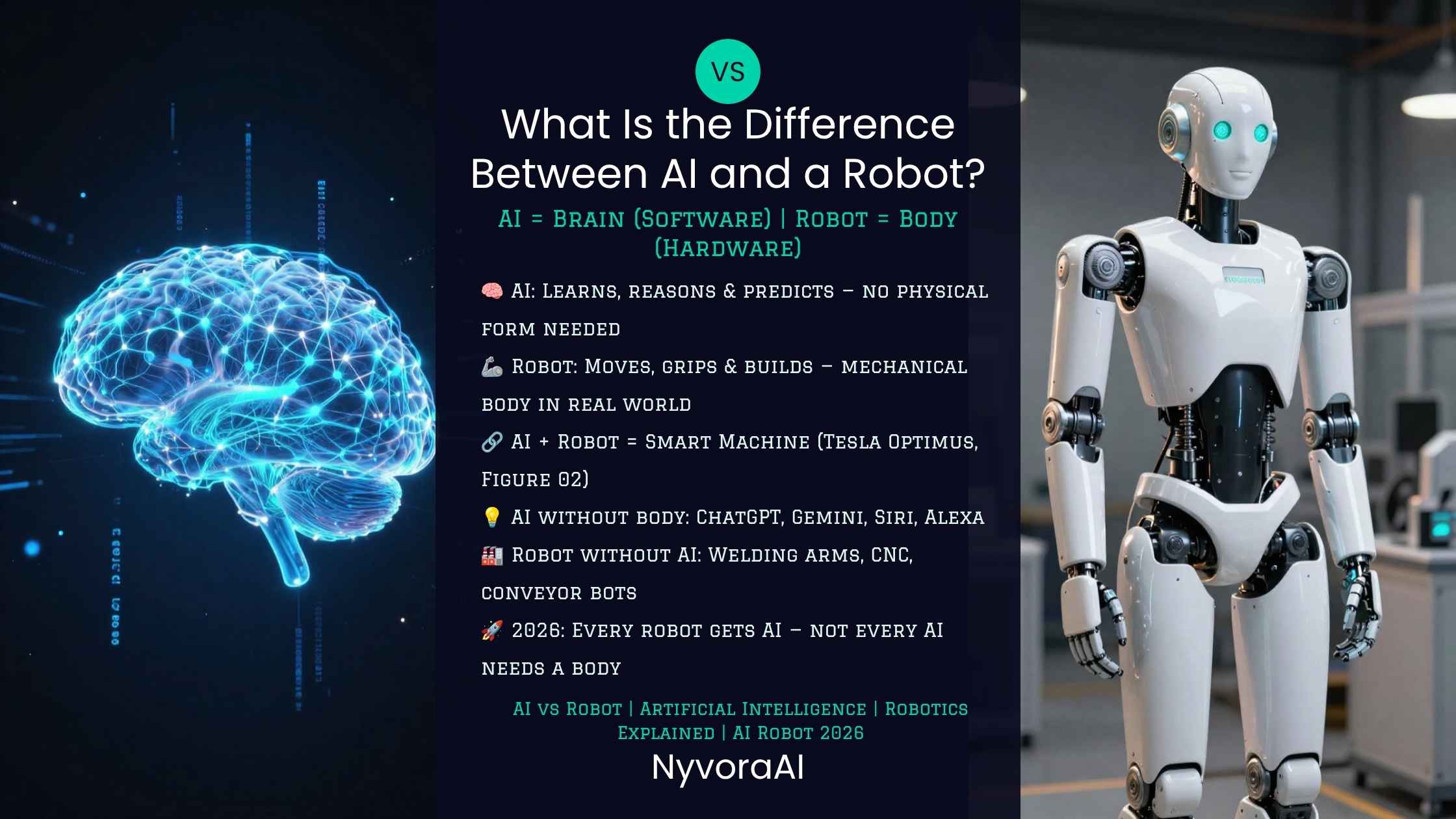
So, what is the difference between AI and a robot? The short version: AI is the brain (software), and a robot is the body (hardware). You can have a brain with no body, and a body with no brain. Put them together, though, and you get something new.
- AI (Artificial Intelligence): Software and algorithms that let machines learn, reason, and make decisions. No physical form.
- Robot: A physical machine with sensors and actuators that interacts with the real world. Can be "dumb" (pre-programmed) or "smart" (AI-powered).
- The Difference: AI is the code; a robot is the metal, plastic, and wires. Each can exist without the other.
- The Intersection: AI running inside a robot body is what researchers call "embodied AI" — a machine that can think, learn, and physically act.
01 What is AI? (The Brain)
Artificial intelligence is the branch of computer science concerned with building systems that can do things normally requiring human intelligence — recognizing patterns, understanding language, making decisions, solving problems. Britannica's overview of the field is a solid primer if you want the formal definition.
AI Lives in the Digital Realm
AI is pure software. It runs on servers, in the cloud, or on the chip inside your phone. It takes in data — numbers, text, images, audio — and uses mathematical models like neural networks to find patterns and make predictions.
Examples of AI Without a Robot
You run into AI constantly, and none of it has a body:
- Chatbots & LLMs: Tools like ChatGPT or Claude process text and generate responses.
- Recommendation engines: Netflix and Spotify use AI to guess what you'll want to watch or hear next.
- Financial algorithms: AI analyzes market data to execute trades in milliseconds.
- Medical diagnostics: AI models trained to flag anomalies in X-rays and scans, often as a second check alongside a radiologist.
Notice the pattern — AI is very good at processing information, but it has no way to physically touch the world. It can tell you how to fix a car engine, but it can't pick up a wrench.
02 What is a Robot? (The Body)
A robot is a physical machine built to carry out a set of movements or actions on its own. The word comes from the Czech robota, meaning forced labor or drudgery — coined for Karel Čapek's 1920 play R.U.R., where it originally described artificial workers, not necessarily anything resembling a modern robot. Historically, that's roughly what real robots were built for too: repetitive physical labor.
Robots Live in the Physical Realm
A robot is generally made up of three physical components:
- Sensors: the "eyes and ears" — cameras, microphones, touch sensors, LiDAR — that gather data from the environment.
- Actuators: the "muscles" — motors, hydraulics, servos — that let the robot move, lift, or manipulate things.
- Controller: the "nervous system" linking sensors to actuators.
Examples of Robots Without AI
Not every robot is "smart." Plenty of traditional robots are entirely rule-based, following fixed instructions with no ability to adapt:
- Industrial assembly arms: a robotic arm on a car line welds the same spot on every chassis, thousands of times a day. Shift the chassis two inches and it will weld the empty air without noticing.
- Early robotic vacuums: the original models just bumped into walls and changed direction. A body, but no real intelligence.
- Animatronics: theme park figures moving through a fixed, pre-recorded loop, with no way to see or react to a passerby.
03 The Intersection: When the Brain Meets the Body
This is usually where the confusion starts. Put an AI "brain" inside a robot "body" and you get something new, which researchers call embodied AI.
Software, Data, Algorithms
(Smart Robots)
Hardware, Sensors, Motors
Embodied AI is a robot that perceives its surroundings, decides what to do based on what it perceives, and acts physically toward a goal — rather than just following a fixed script, it adapts as conditions change. If you want to go deeper on this, our guide on what is embodied AI and how is it different covers it in more detail. Google DeepMind's RT-2 research is a good real-world example of embodied AI in action.
A modern robot vacuum, for instance, uses AI to map your house, notice a sock on the floor and steer around it, and work out the most efficient path to clean the room. The vacuum itself is the robot; the mapping and object-recognition software running on it is the AI.
04 Key Differences: AI vs. Robot
To spell it out plainly, here's the core contrast:
- Nature: AI is digital (code); a robot is physical (hardware).
- Function: AI processes information and makes decisions; a robot performs physical actions.
- Adaptability: AI can learn from new data and improve over time; a traditional (non-AI) robot only does what it was programmed to do.
- Environment: AI exists in servers and devices; a robot exists out in the physical world — factories, homes, hospitals.
05 Real-World Examples in 2026
A few current examples show how AI and robots show up separately — and together — in practice.
1. Self-Driving Cars (AI in a Vehicle)
Are self-driving cars robots? Technically, yes — they're autonomous machines. But the interesting part is entirely the AI. For the software side of this, see our breakdown of how do self-driving cars use AI. The car is the body; the AI is effectively the driver.
2. Tesla Optimus (Embodied AI)
Tesla's Optimus program is a clean example of the intersection: a physical, bipedal body (the robot) running on neural networks related to the ones behind Tesla's driving software (the AI). More on this specific machine in what is the Tesla Optimus robot.
3. Hospital Delivery Bots (Robots with Basic AI)
Many hospitals now use autonomous carts to ferry medications around. These are robots — wheels, motors, sensors to avoid walls — but with fairly basic intelligence; mostly they just follow a pre-mapped route. Compare that to surgical robots like Intuitive Surgical's da Vinci platform, which pairs precise hardware with far more advanced software assistance. See how are AI robots used in hospitals for the full range.
4. Household Chores (The Ultimate Test)
Everyone wants a robot that folds laundry. The physical dexterity that actually takes turns out to be immense — we cover where the technology really stands in can AI robots do household chores yet.
06 Interactive Quiz: AI, Robot, or Both?
Quick test — for each scenario below, decide whether it's AI, a robot, or both.
07 The Future: Blurring the Lines
Heading further into 2026 and beyond, the line between AI and robotics keeps thinning. Nearly all advanced robots being built now lean on AI, and AI increasingly needs a physical body to do anything useful in the real world.
Learning by Watching
One of the more interesting developments is robots learning physical tasks just by watching humans do them, rather than being explicitly programmed joint-by-joint. The AI observes a demonstration and tries to reproduce it. We get into the mechanics of this in can robots learn from humans watching.
The Rise of General-Purpose Humanoids
Several companies — Tesla, Figure AI, and Boston Dynamics among them — are racing to build humanoid robots that can work in ordinary human environments. These machines depend entirely on advanced AI to navigate unpredictable spaces, follow voice instructions, and handle a wide range of objects. The brain keeps getting smarter; the body keeps getting more capable.
08 Frequently Asked Questions
What is the difference between AI and a robot?
Can you have AI without a robot?
Can you have a robot without AI?
What is Embodied AI?
Is a self-driving car a robot or AI?
Will AI eventually replace all robots?

Written by the NyvoraAI Team
We try to explain complex tech concepts in plain language. This article was updated in June 2026. Questions about AI and robotics? Contact our team or learn more about what we do.