Five years ago, if you'd asked me how much a functional, AI-powered robot cost, I'd have told you to start saving for a second mortgage. "Robotics" back then meant million-dollar factory arms bolted to a warehouse floor, or clunky research prototypes that got stuck trying to navigate a doorway.
That's changed. Between the money pouring into autonomous vehicles, sensor prices falling off a cliff, and generative AI making it possible to actually plan and reason in real time, robots have quietly become consumer products. The catch is that the market is a mess of price tiers. You can buy something that vacuums your floor for the price of a mid-range phone, or you can wait a couple more years for a humanoid that costs as much as a car.
So, how much does an AI robot actually cost in 2026? It depends almost entirely on what you need it to do. Below, we've pulled together current prices across every major category, flagged the hidden costs vendors don't put on the box, and built a quick calculator so you can decide whether a robot is actually worth it for your situation.
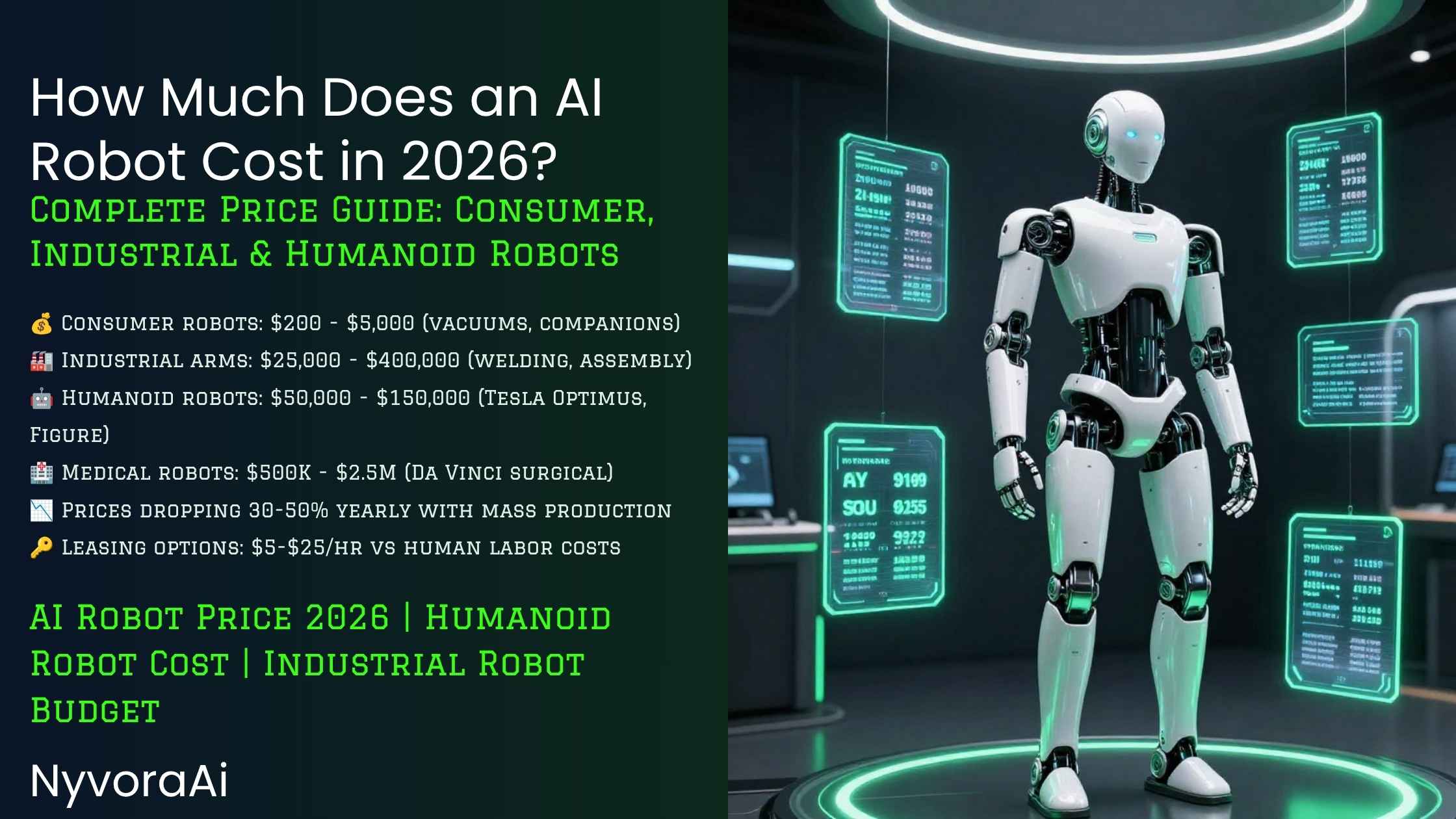
- Basic Domestic (Vacuums/Mops): $200 – $1,500
- Outdoor Domestic (Lawn/Pool): $800 – $3,500
- Companion/Educational: $300 – $2,500
- General-Purpose Humanoid: $20,000 – $150,000+ (Mostly B2B/Early Adopter)
- Industrial/Commercial: $50,000 – $500,000+
01 Domestic AI Robots: The Affordable Entry Point
For most people, the "AI robot" revolution already happened — it's just been sitting under the couch. Domestic robots are narrow specialists. No arms, no legs, but genuinely smart software: they map your home, learn to route around the dog's water bowl, and get better at cleaning the more they run.
Robot Vacuums & Mops
This category is the most mature. A budget bump-and-turn vacuum starts around $200, but the real AI shows up in the $600–$1,500 range. That's where you get LIDAR mapping, camera-based object recognition (good models can tell a sock from a charging cable), and self-emptying, self-washing docks. Independent testing from outlets like RTINGS' robot vacuum test bench and Consumer Reports' robot vacuum ratings are worth checking before you buy, since suction and navigation claims vary a lot between brands. For the practical side of things, we did a deep dive into can AI robots do household chores yet to see if they actually save you time.
Lawn Mowers & Pool Cleaners
Robotic mowers have mostly moved on from buried boundary wires. Newer AI-powered models use cameras and RTK GPS to build a map of your yard and steer around obstacles on their own — companies like Husqvarna and Mammotion have pushed this wire-free approach hard. Expect $1,000–$3,000 for a premium wire-free mower. AI pool cleaners that scrub walls and navigate around ladders and drains typically run $800–$2,000.
- AI Object Avoidance
- Auto-Empty & Wash Base
- Multi-Floor Mapping
- Voice App Control
- No Boundary Wires
- Camera & GPS Navigation
- Slope Handling
- Weather Adaptive
- Emotion Recognition
- Home Security Patrol
- Elderly Monitoring
- Kids Education
02 Humanoid AI Robots: The $20,000 Dream
When people picture "AI robot," they usually picture something walking on two legs, carrying groceries, folding laundry. That technology exists now, but it's still priced like a luxury item, not an appliance.
The best-known example is Tesla's Optimus. Elon Musk has repeatedly targeted a long-term consumer price under $20,000 once the robot reaches real volume production — a figure he's reiterated on Tesla's investor earnings calls. That target has slipped before, and it's worth treating as aspirational rather than a current shelf price. To understand the engineering behind that number, read our breakdown of what is the Tesla Optimus robot. Even at $20,000, it's a serious purchase for most households — cheaper than a car, but not by a huge margin.
Right now, humanoid robots from companies like Figure AI, Boston Dynamics, and Agility Robotics aren't sold to consumers at all. They're leased or sold directly to warehouses and manufacturing plants, and reported per-unit costs for these early-generation industrial humanoids land somewhere between $100,000 and $300,000+, according to industry coverage from outlets like Reuters' technology desk and IEEE Spectrum. The high cost comes down to custom actuators, dozens of degrees of freedom, and the onboard compute needed to run embodied AI in real time.
03 Commercial & Industrial AI Robots
For businesses, AI robots stopped being an experiment a while ago — they're a response to persistent labor shortages. Here, the sticker price matters less than the math on Return on Investment.
Warehouse & Logistics
Autonomous Mobile Robots (AMRs) that shuttle pallets and sort boxes typically cost $50,000–$150,000 per unit, though most facilities never buy outright. Vendors such as Locus Robotics mostly lease AMRs on a "robots-as-a-service" model, often in the $2,000–$4,000-per-robot-per-month range — frequently cheaper than the fully loaded cost of a human employee once benefits and turnover are factored in.
Security & Patrol
AI security robots that patrol campuses, read license plates, and flag thermal anomalies run $20,000–$80,000. They've become popular on large corporate campuses, solar farms, and construction sites where a fixed camera can't cover enough ground.
04 Interactive: AI Robot ROI Calculator
Is buying an AI robot actually worth the money? Use the calculator below to get a rough sense of savings and payback time over three years. These are simplified estimates meant to illustrate the shape of the math, not a substitute for your own numbers.
Select a robot type and your current spending to see how fast it pays for itself.
05 The Hidden Costs of Owning an AI Robot
The sticker price is just the opening bid. Budgeting for an AI robot in 2026 means accounting for the "ecosystem" costs that rarely make it into the marketing copy.
1. The Sensor Tax (LIDAR vs. Cameras)
The same underlying tech that lets self-driving cars use AI to navigate is what lets your vacuum navigate your living room. LIDAR sensors used to be prohibitively expensive; costs have come down a lot, but premium robots still lean on higher-end optical arrays. If one breaks after the warranty runs out, replacement can cost $150–$500.
2. Software Subscriptions & Cloud Fees
A growing chunk of "AI" features live behind a subscription. Your vacuum will probably still clean without an internet connection, but things like cloud-based mapping history, richer voice processing, or premium security integrations on companion robots often come with a $5–$15 monthly fee.
3. Training and Data Costs
Industrial humanoids don't show up ready to work. "Commissioning" — where engineers map your facility and fine-tune the robot's behavior on your specific workflows — can run into the thousands of dollars. That said, progress on robots that can learn by watching humans should shrink these training costs over the next few years.
4. Energy Consumption
A robot vacuum sips electricity, but a fleet of commercial AMRs or a standing humanoid needs real charging infrastructure. For businesses, upgrading electrical panels and adding fast-charging stations can tack on $5,000 or more to a deployment.
06 Are AI Robots Getting Cheaper? (2026-2030 Forecast)
Yes, and the pace is picking up. We're in something like the smartphone's early years — expensive, clunky, niche — right before it went mainstream. Robotics looks to be on a similar curve.
- Actuator Costs: Automakers-turned-robotics-companies are designing motors meant for mass production rather than one-off industrial arms, which should meaningfully cut hardware costs over the next few years as volumes ramp.
- Compute Efficiency: AI chips keep getting more efficient per dollar, which means the "brain" running on the robot can shrink without losing capability — good news for both cost and battery life.
- Shared Platforms: The line between an EV and a humanoid robot keeps blurring — a lot of people in the industry describe a robot as basically a self-driving car that learned to stand up. Sharing battery packs, chip designs, and training data across the automotive and robotics sides of a company cuts R&D costs for both.
Plenty of industry watchers expect a capable general-purpose humanoid to eventually cost about what a used economy car does today — somewhere in the $8,000–$12,000 range by the end of the decade. Treat that as an optimistic projection rather than a promise; humanoid robotics has a track record of missing its own timelines. At that price, though, robots would stop being industrial tools and start being household appliances.
07 Frequently Asked Questions
How much does an AI robot cost in 2026?
Are AI robots getting cheaper?
Is buying an AI robot worth the money?
Do AI robots require monthly subscriptions?
How much does it cost to repair an AI robot?
When will a humanoid robot cost under $10,000?

Written by the NyvoraAI Team
We track the real-world costs and ROI of AI technology so you can invest wisely. This pricing guide was updated in June 2026. Want to know more about the tech inside these machines? Contact our team or explore our latest AI News for daily updates.