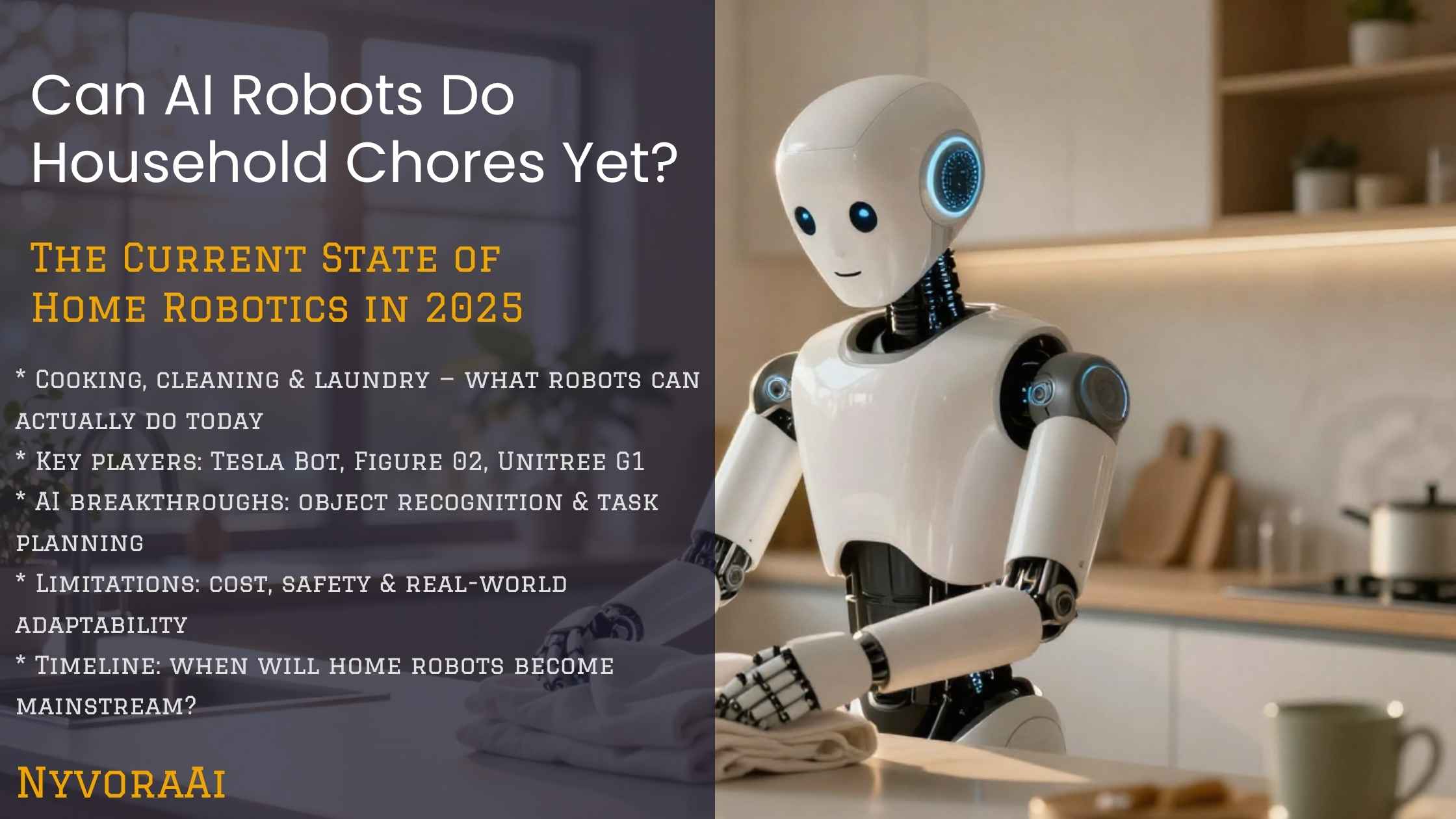
Remember Rosie the Robot from The Jetsons? She cooked, cleaned, did laundry, and still had time for witty banter. That was supposed to be our reality by now. Well, here we are in the actual year 2026, and while nobody's shipped us Rosie, we've ended up with something arguably more interesting: a whole ecosystem of specialized robots, each genuinely good at one narrow thing.
So, "can AI robots do household chores yet?" doesn't have a clean yes-or-no answer. It's closer to: "Yes, but not the way you're picturing, and definitely not all at once." Let's get into it.
We're living in the age of the specialist robot. You can buy something that vacuums your floors better than you ever could. Something else that mops. Another thing that mows your lawn or scrubs your windows. But a single humanoid that walks into your messy kitchen, loads the dishwasher, wipes the counters, takes out the trash, and starts dinner while folding laundry in the background? Not yet — though 2026 has brought that scenario noticeably closer than it was even a year ago.
- Yes, but specialized: AI robots excel at specific tasks like vacuuming, mopping, lawn mowing, and window cleaning
- No generalists yet: No single robot can do all household chores like The Jetsons' Rosie
- Best performers: Robot vacuums (Roomba, Roborock) are highly reliable; laundry-folding and cooking robots exist as pilots and prototypes but remain expensive and limited
- Cost range: $200-$1,500 for cleaning robots; $5,000-$20,000+ for advanced multi-purpose prototypes
- Coming soon: Tesla Optimus, Figure, and LG's CLOiD are all racing toward general-purpose household robots by 2028-2030
01 The Current State of Household Robots in 2026
Walk into an average home in 2026 and there's a good chance a robot is already at work somewhere. Most likely: a robot vacuum. Ownership of robotic cleaning devices has grown substantially since the early 2020s, according to market research from firms like Statista's household appliance outlook — though exact adoption figures vary by country and survey methodology, so treat any single percentage with a grain of salt.
What's actually changed is the intelligence behind them. These aren't the dumb, bump-and-turn robots from a decade ago. Modern AI-powered household robots use computer vision, machine learning, and real mapping algorithms to navigate a home with some understanding of what's actually in it. They build a floor plan, learn to avoid obstacles (including, mercifully, pet waste), and take scheduling instructions from an app.
The tech underneath all of this is embodied AI — artificial intelligence that lives in a physical body and has to deal with the real world instead of just text or pixels. That's a fundamentally harder problem than a chatbot or an image generator, because physical reality doesn't hold still and wait for you.
02 What AI Robots CAN Do Right Now
Let's get specific. Here's what you can genuinely buy today that will help with household chores — and where things get shakier:
Robot vacuums like iRobot's Roomba, Roborock, and Eufy can autonomously vacuum entire homes, empty their own dustbins, and even mop. They navigate using LIDAR and cameras, avoiding obstacles and mapping efficient cleaning paths.
✅ Widely AvailableRobotic window cleaners like Ecovacs' Winbot line use suction and onboard sensors to clean windows automatically. They're especially popular in high-rise apartments, where manual cleaning is genuinely risky.
✅ AvailableRobotic lawn mowers like Husqvarna's Automower and Worx Landroid maintain your lawn autonomously, steer around obstacles, and return to their dock to recharge without help.
✅ AvailablePool cleaners like Maytronics' Dolphin and Polaris scrub pool floors and walls, handle irregular pool shapes, and adjust cleaning patterns based on how often the pool's used.
✅ AvailableThis category has had real churn. FoldiMate, once the best-known name here, shut down in 2021 without ever shipping a consumer product. In 2026, the notable entrant is Weave's Isaac 0, an ~$8,000 folding station that still relies on remote human operators for part of the job — a reminder of how far "autonomous" folding still has to go for a consumer product.
⚠️ Limited/ExpensiveRobotic kitchen assistants like Moley Robotics can follow recipes and cook simple meals, but they require pre-prepped ingredients and run well into five figures. Not yet practical for the average kitchen.
⚠️ Prototype StageHumanoid robots are starting to show off genuinely impressive one-off skills — Figure's humanoid has demonstrated autonomous laundry folding, and LG's CLOiD was shown at CES 2026 attempting to load a washer and fold towels. These are still choreographed demos, not something you can buy and put to work in your kitchen today.
⚠️ Demo/ExperimentalScrubbing toilets, cleaning showers, and wiping mirrors require complex manipulation and handling liquids on uneven surfaces. Some prototypes exist, but nothing reliable or commercially available yet.
🔮 Years Away03 What AI Robots Still CAN'T Do (But You Wish They Could)
Here's where reality disappoints. Despite the demos and the headlines, plenty of household tasks still stump even the most advanced robots:
The "Last Mile" Problem
Robots are great at repetitive, predictable tasks in controlled environments. Homes are the opposite of that. Toys on the floor, pet hair everywhere, clothes draped over a chair — unpredictability is the enemy of robotics. A robot might vacuum your floor beautifully, but if there's a sock in its path, it may just get stuck or shove the sock around instead of picking it up.
Complex Manipulation
Human hands are absurdly capable. We can fold a fitted sheet (some of us, anyway), untangle a knot of cables, or set a fragile vase down without a second thought. Robots struggle here because it takes fine motor control, tactile feedback, and an understanding of how objects behave — all things AI is still catching up on.
This is exactly why research into robots learning from humans matters so much. Watching a person do a task, rather than being explicitly programmed for it, is how robots pick up the small techniques we take for granted.
Multi-Step Reasoning
Tell a robot "the house is a mess, please tidy up" and a person instantly knows what that means: pick up clothes, put away dishes, deal with clutter, maybe vacuum. A robot doesn't automatically know where to start. Today's AI still lacks the everyday common sense to turn a vague instruction into a concrete plan of action — though large language models are starting to close that gap for simpler cases.
04 Best AI Household Robots You Can Buy in 2026
If you're ready to bring some robot help into your home, here are solid picks across categories. Prices and models shift often in this market, so treat these as a starting point rather than gospel — check current listings before buying.
| Category | Example Model | Typical Price | Maturity | Best For |
|---|---|---|---|---|
| Vacuum & Mop | Roborock S8 Pro Ultra | ~$1,100 | ⭐⭐⭐⭐⭐ | Complete floor cleaning |
| Budget Vacuum | Eufy RoboVac line | ~$200-300 | ⭐⭐⭐⭐ | Affordable daily cleaning |
| Lawn Care | Husqvarna Automower 430XH | ~$2,500 | ⭐⭐⭐⭐⭐ | Large lawns up to 0.8 acres |
| Window Cleaning | Ecovacs Winbot W2 Pro | ~$450 | ⭐⭐⭐⭐ | High-rise apartments |
| Pool Cleaning | Dolphin Premier | ~$1,300 | ⭐⭐⭐⭐⭐ | All pool types |
| Laundry Folding | Weave Isaac 0 | ~$8,000 | ⭐⭐ | Bay Area early adopters only |
The Standout: Robot Vacuums
If you buy exactly one household robot, make it a good vacuum. This is the category that's actually matured. Modern models can:
- Map your entire home and clean room-by-room
- Avoid obstacles like shoes, cords, and pet waste
- Empty their own dustbins into a larger base station
- Mop floors with rotating pads
- Be controlled via voice (Alexa, Google Assistant)
- Schedule cleanings when you're not home
The time savings are real, even if exact numbers vary by household — most owners report the vacuum genuinely takes floor cleaning off their weekly to-do list rather than just supplementing it.
05 Pricing: What You'll Actually Pay
Household robots range from "impulse buy" to "small down payment." Here's roughly what to expect:
- Basic robot vacuums
- Simple window cleaners
- Limited AI features
- Good for small spaces
- Entry-level automation
- Advanced robot vacuums with mopping
- Smart lawn mowers
- AI navigation & mapping
- Self-emptying bases
- Best value for most homes
- Top-tier cleaning robots
- Advanced pool cleaners
- Multi-function devices
- Professional-grade performance
- Commercial applications
- Early laundry-folding stations
- Humanoid prototypes
- Cooking robots
- Multi-purpose assistants
- Early adopter territory
06 The Future: When Will We Get Rosie?
The dream of a true general-purpose household robot is still alive, and 2026 has been a genuinely active year for it. A few companies worth watching:
Tesla Optimus
Elon Musk's project aims for a humanoid that can perform a wide range of human tasks. Tesla Optimus is currently being trained on manufacturing tasks, with household applications planned for later. Musk has floated a price under $20,000, though that figure has been repeated — and pushed back — before, so it's worth treating as a target rather than a near-term reality.
Figure AI
Figure's humanoid robot is being developed for both industrial and home use, and the company has partnered with OpenAI to give it stronger natural-language understanding. In early 2026, Figure demonstrated its robot folding laundry fully autonomously using an end-to-end neural network — a genuinely notable technical milestone, even if it was a controlled demo rather than a shipped product.
LG CLOiD and the CES 2026 Crowd
At CES 2026, LG showed off CLOiD, a humanoid butler concept that attempted to load a washer, fold a dish towel, and fetch milk from the fridge — slowly, and with a fair bit of hesitation on stage. It's a useful reality check: even the flashiest demos are still deliberate and far from fast.
Boston Dynamics
Known for the eerily agile Atlas robot, Boston Dynamics has been shifting toward practical applications. What Boston Dynamics is doing with AI covers how their robots are learning to navigate complex environments and manipulate objects, though the near-term focus is still industrial rather than home use.
Realistic Timeline
- 2026-2027: Better specialized robots (cleaning, lawn care, etc.) and more humanoid demos, but few shipped consumer products
- 2028-2030: First generation of general-purpose household robots (expensive, limited)
- 2030-2035: More capable and more affordable general-purpose robots
- 2035+: Wider adoption of household humanoid robots, assuming the industry hits these targets — it has a track record of missing them
Are Household Robots Worth It?
The answer depends on your situation:
Yes, If:
- You hate vacuuming and mopping (robot vacuums are genuinely a game-changer)
- You have a large lawn (robotic mowers pay for themselves in time saved)
- You live in a high-rise (window-cleaning robots are safer than a ladder)
- You have mobility issues (robots can help maintain independence)
- You're tech-savvy and enjoy automation for its own sake
No, If:
- You expect a robot to handle everything (we're not there yet)
- You're on a tight budget (the good ones aren't cheap)
- Your home is very cluttered (robots struggle with chaos)
- You actually enjoy doing chores (some people genuinely find them meditative!)
07 Frequently Asked Questions
Can AI robots do household chores yet?
What household chores can robots do in 2026?
How much do household robots cost?
Are robot cleaners worth it?
Can robots fold laundry?
Will robots replace human housekeepers?
How do robot vacuums navigate?

Written by the NyvoraAI Team
We track AI robots so you don't have to gamble your money on gadgets that don't work. This guide was updated in June 2026 with the latest household robot capabilities. Curious how these robots actually work? Learn how self-driving cars use AI — a lot of the same navigation tech shows up in robot vacuums. Or contact us with your robot questions.