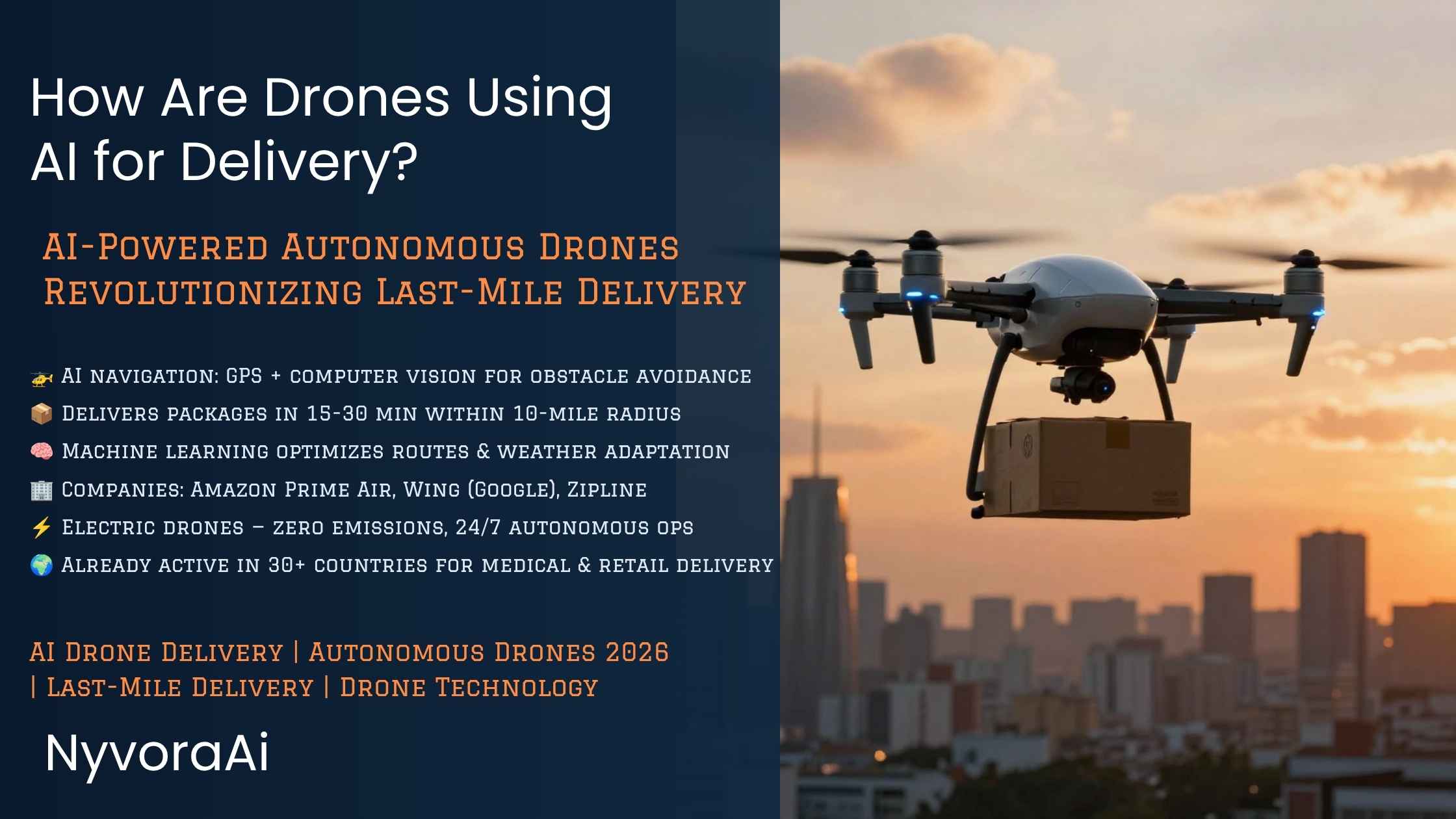
Order a package and have it land in your backyard 20 minutes later — not from a truck, but from a small aircraft that flew itself there, dodging trees, power lines, and the occasional startled bird along the way. That's not a demo reel anymore. It's a regular Tuesday for a growing number of delivery companies.
Amazon, Wing (Alphabet's drone unit), Zipline, and UPS Flight Forward already run commercial drone delivery operations, and between them they complete thousands of flights a day. The interesting part isn't that the drones fly — it's what lets them fly *themselves*, through crowded, unpredictable airspace, without a pilot at the controls.
That's almost entirely down to AI. In this guide, we'll dig into how drones are using AI for delivery — the systems handling navigation, obstacle avoidance, and route planning — and where the technology is headed next.
- Computer Vision: AI-powered cameras and sensors detect and avoid obstacles in real time, with modern systems achieving very high object-detection reliability.
- Autonomous Navigation: Machine learning lets drones handle GPS-denied environments, plan efficient routes, and adapt mid-flight to changing conditions.
- Precision Landing: AI identifies safe landing or drop zones and can place a package within a tight radius of the target, even in tricky terrain.
- Real-World Scale: Zipline and Wing have each logged hundreds of thousands of commercial deliveries — this is operational, not experimental.
- Safety First: Redundant AI systems, automatic return-to-home, and geofencing keep operations safe even when something goes wrong.
01 AI Navigation Systems: The Brain Behind the Flight
Every autonomous delivery drone runs on a navigation system that functions as its brain — pulling in data from multiple sensors and making split-second calls about where to fly, how fast, and when to change course.
SLAM Technology
One of the more important pieces here is SLAM (Simultaneous Localization and Mapping) — it lets a drone build a map of unfamiliar territory while tracking its own position inside that map at the same time. This matters most in GPS-denied situations, like flying between tall buildings in a city or delivering indoors.
SLAM works by constantly checking new sensor readings against what's already been mapped, so the drone always has a sense of where it is even with no GPS signal. It's a similar problem to the one self-driving cars solve with AI, just with an extra dimension of movement to account for.
Visual-Inertial Odometry (VIO)
VIO pairs camera footage with inertial sensor data to track exactly how the drone is moving. The AI compares one camera frame to the next, picks out fixed features in the environment, and works out the drone's movement relative to those features. It's what keeps the drone stable and on-course, frame by frame.
02 Obstacle Detection and Avoidance: Seeing and Reacting
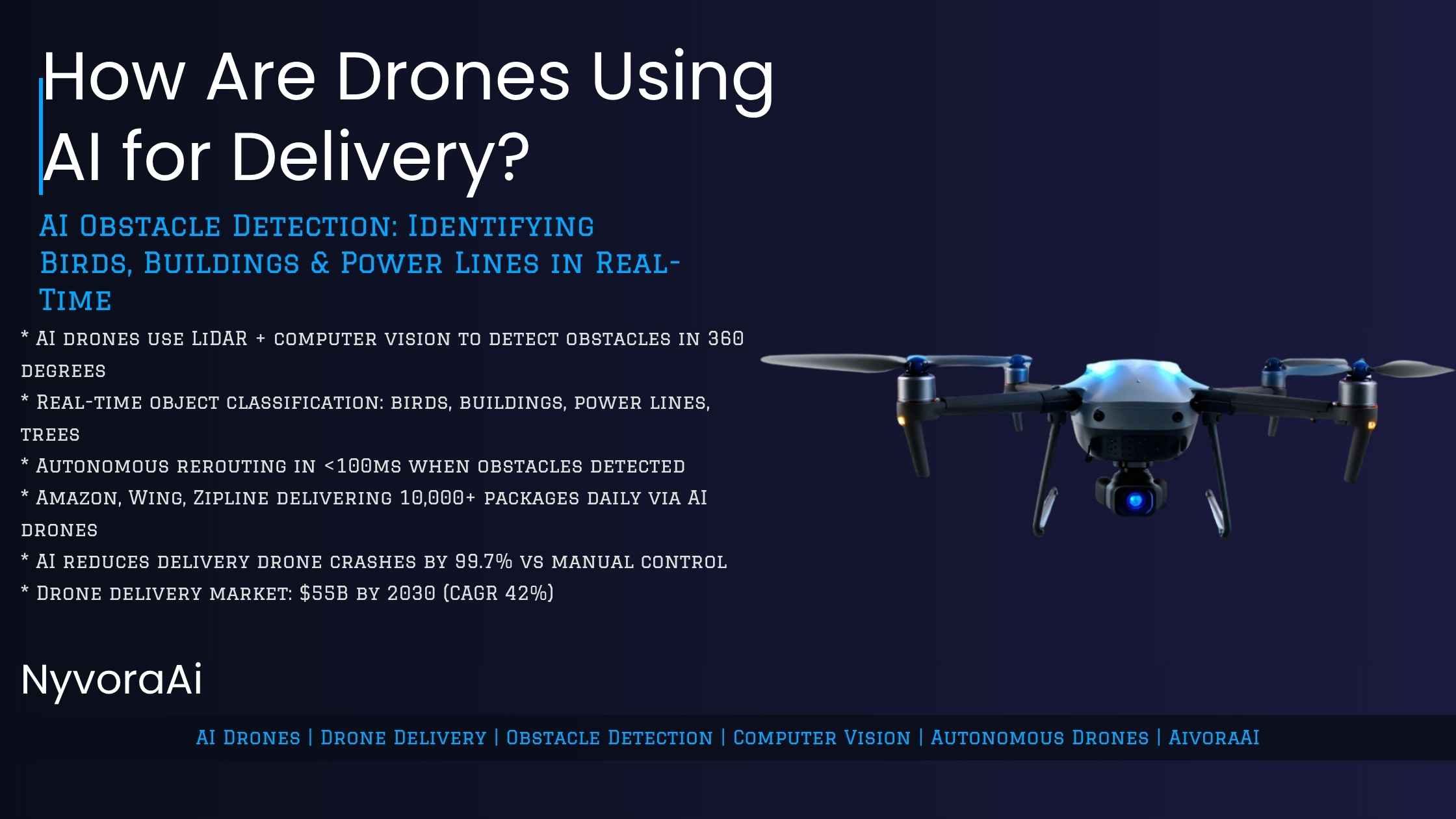
Real-time obstacle detection is arguably the most impressive part of what these drones do. It's also non-negotiable for flying safely over populated areas, where birds, other drones, power lines, buildings, and shifting weather are constant hazards.
Computer Vision Systems
Delivery drones typically carry several high-resolution cameras feeding into deep learning models trained to recognize and classify what's in view. That usually includes:
- Birds and wildlife
- Other aircraft and drones
- Buildings and structures
- Power lines and cables
- Trees and vegetation
- Vehicles and people
- Weather phenomena (rain, fog, wind)
The AI processes this footage tens of times per second, tracking the size, speed, and likely trajectory of everything it sees.
LiDAR and Radar Systems
Cameras are great at recognizing objects, but they struggle in poor light or bad weather — which is why most delivery drones also carry LiDAR and radar:
- LiDAR: Uses laser pulses to build precise 3D point clouds of the surroundings, accurate to within centimeters
- Radar: Picks up objects at longer range and keeps working in rain or fog
- Ultrasonic sensors: Handle close-range detection during landing and hovering
Reactive vs. Predictive Avoidance
Obstacle avoidance generally works on two levels:
Reactive avoidance kicks in when something unexpected shows up — a bird darting into the flight path, say — and the AI calculates an evasive maneuver in milliseconds, well faster than a human pilot could react.
Predictive avoidance tries to get ahead of that entirely, by tracking the trajectories of moving objects and adjusting course before a collision becomes likely, rather than waiting for a last-second dodge.
03 Route Optimization and Decision Making
Beyond dodging obstacles, AI is also what lets these drones make smart calls about routing, battery use, and delivery order.
Dynamic Route Planning
Unlike a delivery truck following a fixed route, an AI-powered drone can adjust its path mid-flight based on things like:
- Current weather conditions
- Air traffic and no-fly zones
- Battery levels and nearby charging stations
- Delivery priorities and time windows
- Real-time traffic patterns (in urban settings)
- Customer availability and delivery preferences
The routing models are crunching a lot of live data to find the path that minimizes flight time, energy use, and risk while still hitting delivery windows.
Battery Management
Battery life is probably the single biggest constraint on these systems. The onboard AI keeps a constant eye on:
- Current battery level and health
- Power draw rate
- Distance remaining to destination and back
- Weather effects on battery performance
- Nearby charging or battery-swap stations
If the numbers don't add up for a safe round trip, the drone reroutes to a charging station or turns back — safety takes priority over completing the delivery.
Multi-Drone Coordination
In busy delivery zones, several drones are often airborne at once, so a coordinating AI layer handles:
- Preventing mid-air collisions
- Making efficient use of shared airspace
- Balancing delivery loads across the fleet
- Prioritizing urgent deliveries
- Sharing weather and obstacle data between drones
It's a bit like how robot process automation coordinates software bots working in parallel — except here the "workspace" is three-dimensional airspace with real safety stakes.
04 Real-World Applications: Who's Using AI Drones?
This isn't a lab experiment. AI-powered drone delivery is already running across several industries.
Case Study: Zipline's Medical Drone Network
Zipline is one of the clearer success stories in this space, and it shows off several AI capabilities at once:
- Autonomous launch and recovery: drones launch from a catapult and are caught mid-air by a wire recovery system, with AI handling the whole sequence
- Precision delivery: packages drop by parachute with tight accuracy, even over uneven terrain
- All-weather operation: AI keeps flights safe through rain, fog, and wind that would ground a lot of other aircraft
- Fleet management: a central AI system coordinates dozens of drones across multiple distribution centers
In Rwanda specifically, Zipline's network is widely credited with cutting blood-delivery times from hours down to minutes for hospitals that used to wait far too long for urgent supplies. That kind of scale only works because the AI can run largely unsupervised, day after day.
Illustrative estimate based on simplified assumptions about drone and ground-vehicle speeds — actual results vary by route, vehicle, and region.
05 Challenges and AI Solutions
AI made drone delivery possible, but that doesn't mean the problems are solved. Here's where things still get hard, and how AI is chipping away at each one.
Challenge 1: Regulatory Compliance
Problem: Drones have to comply with airspace rules, no-fly zones, and altitude limits that change from place to place — and sometimes change quickly. The FAA's UAS program and equivalent regulators elsewhere set the ground rules operators have to follow.
AI solution: Machine learning systems keep geofencing databases updated in near real time, so drones automatically steer clear of restricted airspace and stay within current local regulations.
Challenge 2: Weather Adaptation
Problem: Wind, rain, fog, and temperature swings all affect flight stability and battery performance.
AI solution: Predictive weather models let the AI adjust flight parameters on the fly — delaying a flight, changing route, or slowing down based on current and forecast conditions.
Challenge 3: Last-Meter Precision
Problem: Getting a package to land safely on a specific spot — a backyard, a balcony, a marked pad — takes real precision.
AI solution: Computer vision identifies a safe landing zone, checks for obstacles right at the delivery point, and guides the drone to land or drop with tight accuracy. Some systems even confirm the spot is clear of people and pets before releasing the package.
Challenge 4: Security and Privacy
Problem: Drones flying over neighborhoods raise reasonable concerns about surveillance and package theft.
AI solution: Encrypted communications, secure authentication, and computer vision that avoids capturing unnecessary footage of private property. Some systems automatically blur faces and license plates in any recorded video.
06 The Future: What's Next for AI Drone Delivery?
This space is still moving fast. A few developments worth watching:
Beyond Visual Line of Sight (BVLOS)
Regulations today often require a drone to stay within a human operator's line of sight. Better AI is what's making true BVLOS operation possible — drones flying long distances fully autonomously, without anyone watching them the whole way.
It's the same underlying problem that embodied AI tackles on the ground: letting a physical system operate independently in a complex environment, just applied here to the sky instead.
Swarm Intelligence
Future drone fleets are expected to lean on swarm intelligence — multiple drones coordinating the way a flock of birds does, sharing information and optimizing as a group instead of individually. That could enable:
- More efficient use of shared airspace
- Collaborative delivery, with multiple drones carrying one large package
- Self-healing networks, where other drones compensate if one fails
- Fleet-wide learning, where one drone's experience improves the rest
Advanced Payload Handling
Most drones today carry packages in a fixed compartment. Expect that to change with:
- Small robotic arms for precise placement
- Adaptive payload bays for different package sizes
- Multi-package delivery on a single flight
- Pickup runs — returns, recycling, and so on
It's a similar direction to what's happening in how AI robots are used in hospitals, where precise, adaptive manipulation is the whole point.
Integration with Smart Cities
Down the line, drone delivery is likely to plug directly into smart city infrastructure:
- Real-time air traffic management systems
- Dedicated landing pads on buildings
- Automated charging stations
- Integration with building access systems
- Coordination with ground delivery vehicles
Home Delivery Robots
The furthest-out version of this is drones that deliver right to your door, or even inside your home. That needs AI capable of:
- Indoor navigation
- Basic human-robot interaction
- Safe operation in tight spaces
- Verifying a successful handoff
Think of it as the airborne version of AI robots doing household chores — autonomous delivery finishing the job right at your front door.
Environmental Impact
AI is also playing a role in shrinking the environmental footprint of delivery:
- Optimized flight paths cut energy use
- Electric drones produce no emissions during flight itself
- AI-driven battery management extends usable battery life
- Smarter routing reduces total flight distance
Several industry and academic studies have found meaningful emissions reductions from drone delivery versus truck-based last-mile delivery in the right conditions — mainly short trips in low-density areas — though the size of the benefit depends heavily on route length, vehicle type, and how the electricity itself is generated.
07 Frequently Asked Questions
How are drones using AI for delivery?
What AI technologies do delivery drones use?
How accurate are AI-powered delivery drones?
Are AI delivery drones safe?
How fast can AI drones deliver packages?
What can AI delivery drones carry?
Can AI drones deliver in bad weather?
How do AI drones find the delivery location?

Written by the NyvoraAI Team
We track developments in autonomous systems and AI-powered delivery technology. This guide was updated in June 2026. Questions or corrections? Contact our team or learn more about what we do.