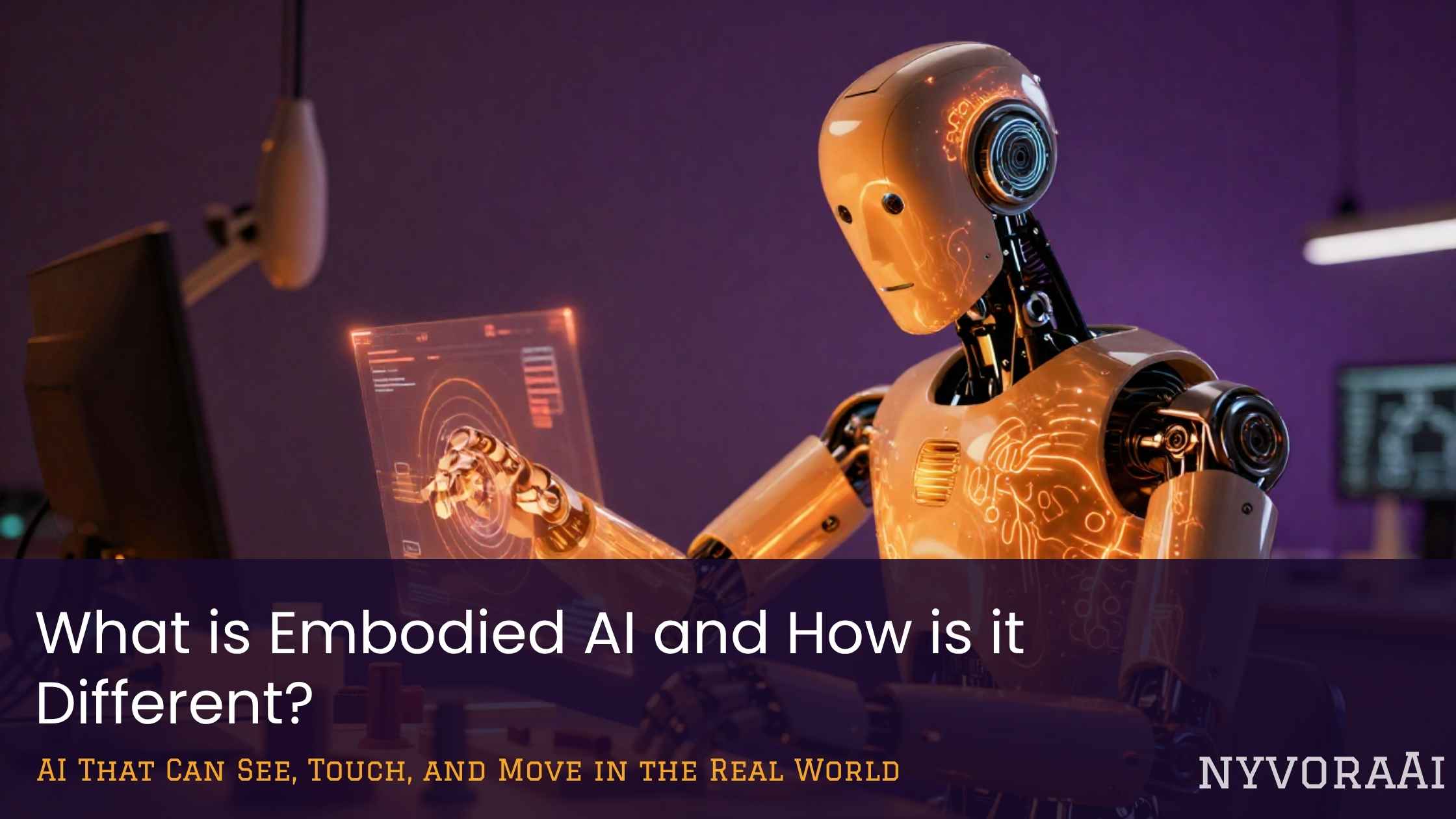
Picture two very different kinds of AI sitting side by side. One lives entirely inside a data center — it can write a poem, summarize a contract, or answer a question, but it has never touched anything and never will. The other has a body. It walks across a room, picks a mug up off a counter, and figures out how hard to grip it so it doesn't slip. The first is the AI most of us use every day. The second is embodied AI, and the gap between them is bigger than it looks.
That gap comes down to how each one learns. A conventional model absorbs patterns from text and images it will never physically encounter. An embodied system, by contrast, builds its understanding by moving through the world — seeing, touching, bumping into things, and adjusting — in something close to the way a toddler learns what a cup is by dropping a few. If you've been asking what is embodied AI and how is it different from the chatbots and assistants you already know, this is the distinction that matters most.
In this guide, we'll get into what embodied intelligence actually looks like in practice — from humanoids that learn by copying humans to self-driving cars reading a busy intersection — and why having a body changes what a machine can learn in the first place. For related background, our piece on what a humanoid robot is in simple terms is a good companion read.
- Embodied AI Definition: Artificial intelligence that exists within a physical body and learns through sensorimotor interaction with the real world.
- Key Difference: Traditional AI processes data digitally; embodied AI experiences the world physically through sensors and actuators.
- Learning Method: Embodied AI learns through physical experience, trial-and-error, and interaction with objects and environments.
- Real-World Examples: Humanoid robots (Tesla Optimus, Boston Dynamics Atlas), autonomous vehicles, warehouse robots, and robotic assistants.
01 What is Embodied AI? A Simple Explanation
Embodied AI is artificial intelligence with an actual physical presence — a body of some kind, whether that's a humanoid robot, a wheeled delivery vehicle, or a robotic arm bolted to a factory floor.
The Core Concept: Intelligence Through Interaction
The underlying idea is that intelligence doesn't emerge from a dataset alone — it emerges from the back-and-forth between an agent and its environment. A human baby doesn't learn about gravity by reading about it; it learns by dropping spoons off a highchair a hundred times. Embodied AI systems learn the same way, using cameras, microphones, and touch sensors to perceive, and motors and grippers to act.
That's a real departure from how most AI is trained today, which is on static datasets. An embodied system doesn't just recognize a photo of a chair — it navigates around real chairs, learns their weight by pushing one, and understands what a chair is for by actually sitting in it.
The Embodiment Hypothesis
This idea has roots in cognitive science's embodiment hypothesis, which argues that a mind can't really be separated from the body doing the experiencing — how we think is shaped by having a body that moves through and acts on the world. Embodied AI is, in a sense, an attempt to build that same principle into a machine.
02 Embodied AI vs Traditional AI: The Key Differences
Laid side by side, the two approaches diverge in some pretty specific ways.
Embodied AI: Learns through physical interaction, trial-and-error, and sensorimotor experiences in real-time.
Embodied AI: Operates in physical, real-world environments with all their complexity and unpredictability.
Embodied AI: Actively perceives the world through sensors, choosing where to look and what to focus on.
Embodied AI: Takes physical actions that change the real world (moving, manipulating, navigating).
Embodied AI: Receives immediate physical feedback (did the object fall? did I collide?).
Embodied AI: Develops spatial understanding through physical navigation and manipulation.
A Concrete Example
Take something as simple as a coffee cup. Two AIs are asked to "understand" it:
- Traditional AI: Trains on thousands of images labeled "cup," picks up on visual patterns, and can spot a cup in a new photo.
- Embodied AI: Picks one up, feels how heavy it gets when it's full, learns it tips over past a certain angle, figures out a grip that doesn't spill the coffee, and understands what the cup is for by actually drinking from it.
The embodied version ends up with a richer, messier, more useful understanding — because it's dealing with a physical object with real properties, not a flat image of one.
03 How Does Embodied AI Actually Work?
Under the hood, embodied AI stitches together several technologies to perceive, decide, and act in a physical space.
1. Sensing the Environment
These systems draw on a mix of sensors to build a picture of what's around them:
- Computer Vision: Cameras capture visual information about the environment.
- Depth Sensing: LiDAR, stereo cameras, or time-of-flight sensors measure distances and create 3D maps.
- Touch Sensors: Tactile sensors in hands and surfaces detect pressure, texture, and grip.
- Audio: Microphones capture sound for speech recognition and environmental awareness.
- Proprioception: Internal sensors track the robot's own body position and movement.
2. Processing and Decision Making
From there, a decision-making layer turns that sensor data into action:
- Neural Networks: Deep learning models process visual, auditory, and tactile information.
- Reinforcement Learning: The AI learns through trial-and-error, receiving rewards for successful actions.
- Imitation Learning: The AI learns by watching humans perform tasks (more on this below).
- Planning Algorithms: The system plans sequences of actions to achieve goals.
3. Acting on the World
Then the body actually carries the decision out:
- Actuators: Motors and servos move joints, wheels, and limbs.
- Manipulators: Robotic hands and grippers grasp and manipulate objects.
- Locomotion: Legs, wheels, or tracks enable movement through space.
4. Learning from Experience
And the loop keeps closing — the system is constantly updating based on:
- Success/Failure: Did the action achieve the goal?
- Physical Feedback: Did the object slip? Did I collide with something?
- Environmental Changes: How did my action change the world?
That constant cycle of perceiving, deciding, acting, and learning is really the whole story of what sets embodied AI apart.
04 Real-World Examples of Embodied AI
This isn't hypothetical — embodied AI is already showing up in factories, warehouses, and increasingly, on the road.
1. Humanoid Robots
Tesla's Optimus, Boston Dynamics' Atlas, and Figure AI are all racing to build humanoids that can walk, grip objects, and handle multi-step tasks, typically training in simulation before fine-tuning on real hardware. For a closer look at how these systems are actually built, see our guides on best AI robot companies in 2026 and how does Figure AI robot work.
2. Warehouse and Logistics Robots
Autonomous mobile robots (AMRs) navigate warehouses, picking and transporting items. They learn optimal routes, avoid obstacles, and adapt to changing environments in real-time.
3. Autonomous Vehicles
Self-driving cars are probably the embodied AI most people have actually ridden in. They read the road through cameras and sensors, make split-second calls, and physically steer, brake, and accelerate to avoid collisions.
4. Service and Care Robots
Robots in hospitals, hotels, and homes assist with tasks ranging from delivering medications to providing companionship. They must navigate human spaces safely and interact naturally with people.
5. Manufacturing and Industrial Robots
Advanced robotic arms with AI can adapt to variations in parts, learn new assembly tasks through demonstration, and work safely alongside human workers.
05 Learning Through Experience: The Power of Embodiment
Physical experience gives embodied AI a few learning tricks that a purely digital system just doesn't have access to:
1. Imitation Learning (Learning by Watching)
A robot can watch a person fold laundry or open a door, attempt the same motion, and get better at it through repetition and feedback — no line-by-line programming required.
This is one of the more powerful shortcuts in the field, since it sidesteps the need to hand-code every task. Our article on can robots learn from humans watching goes deeper into how it actually works.
2. Reinforcement Learning in the Real World
The robot tries different actions and receives feedback based on success or failure. For example, a robot learning to grasp objects might try different grip positions and learn which ones prevent the object from slipping.
3. Sim-to-Real Transfer
Many embodied AI systems first learn in simulated environments (digital twins) where they can practice millions of times without risk. Then, they transfer that knowledge to the real world, fine-tuning their skills through physical practice.
4. Physical Intuition
Enough repeated interaction and a robot starts to develop something close to physical intuition — a feel for how objects behave, how much force a task needs, how to move through a cluttered room. It's a strange thing to program directly, but it emerges naturally once the system has enough embodied experience.
06 Applications and Use Cases
Here's where embodied AI is already earning its keep:
Healthcare
- Surgical robots that assist doctors with precision operations
- Rehabilitation robots that guide patients through physical therapy
- Assistive robots that help elderly or disabled individuals with daily tasks
Manufacturing
- Adaptive assembly robots that can handle product variations
- Quality inspection robots that physically test products
- Collaborative robots (cobots) that work safely alongside humans
Logistics and Warehousing
- Autonomous picking robots that navigate warehouses
- Packing robots that optimize box filling
- Last-mile delivery robots and drones
Agriculture
- Autonomous harvesting robots that identify and pick ripe produce
- Weeding robots that distinguish crops from weeds
- Monitoring robots that assess crop health
Domestic and Service
- Home assistant robots for cleaning, cooking, and organization
- Customer service robots in retail and hospitality
- Educational robots that teach children through interaction
Search and Rescue
- Disaster response robots that navigate dangerous environments
- Search robots that locate survivors in collapsed buildings
- Hazardous material handling robots
07 Challenges and Limitations
None of this is solved yet. A few problems keep researchers up at night:
1. The Sim-to-Real Gap
What works perfectly in simulation often fails in the real world due to friction, lighting variations, sensor noise, and other physical realities. Bridging this gap remains a major research challenge.
2. Safety and Reliability
When AI controls physical systems, failures can cause real harm. Ensuring that embodied AI systems operate safely around humans is paramount but extremely difficult.
3. Computational Requirements
Processing sensor data, making decisions, and controlling actuators in real-time requires significant computational power, which can be challenging for mobile robots with limited battery life.
4. Generalization
A robot that's mastered one type of door handle can still get stumped by a different design. Getting a skill learned in one context to transfer cleanly to a new one is still one of the field's hardest open problems.
5. Cost and Accessibility
High-quality embodied AI systems with advanced sensors and actuators are expensive, limiting their accessibility to well-funded organizations.
6. Ethical and Social Concerns
As embodied AI becomes more capable, questions arise about:
- Job displacement and workforce impacts
- Privacy concerns with robots that perceive and record their environments
- Accountability when autonomous systems cause harm
- The psychological impact of human-robot relationships
08 The Future of Embodied AI
Where does this actually go from here? A few trends worth watching:
Near Future (2026-2030)
- Improved Learning Efficiency: Robots will learn new tasks with fewer demonstrations and less trial-and-error.
- Better Human-Robot Interaction: More natural communication through gesture, gaze, and contextual understanding.
- Specialized Applications: Domain-specific embodied AI systems for healthcare, manufacturing, and logistics.
- Enhanced Safety: Better collision avoidance and force control for safe human-robot collaboration.
Medium Term (2030-2040)
- General-Purpose Humanoids: Robots that can perform a wide variety of tasks in unstructured environments.
- Lifelong Learning: Systems that continuously learn and adapt throughout their operational lifetime.
- Social Integration: Embodied AI that seamlessly integrates into homes, workplaces, and public spaces.
- Swarm Intelligence: Multiple embodied AI systems coordinating to accomplish complex tasks.
Long Term (2040+)
- Human-Level Dexterity: Robots with manipulation capabilities matching or exceeding human hands.
- Conscious Embodiment: The philosophical and technical debate about whether embodied AI can develop consciousness or self-awareness.
- Symbiotic Relationships: Deep integration between human and embodied AI systems, potentially including brain-computer interfaces.
09 Frequently Asked Questions
What is embodied AI?
How is embodied AI different from traditional AI?
What are examples of embodied AI?
Why is embodied AI important?
Can embodied AI learn on its own?
What are the limitations of embodied AI?
How does embodied AI relate to humanoid robots?

Written by the NyvoraAI Team
We explore the frontiers of AI and robotics to help you understand the technologies shaping our future. This guide was updated in June 2026. Have questions about embodied AI? Contact our team or learn more about our mission.