Picture this: It’s the middle of the night. The house is quiet, but your mind is screaming. You’re spiraling into a panic attack, or maybe the heavy blanket of depression has pinned you to the bed again. You reach for your phone. You don’t call a friend—you feel too guilty for bothering them. You don’t call a crisis line—the wait times are astronomical.
Instead, you open an app. A gentle, conversational interface greets you. It asks how you’re feeling. You type out your messiest, most irrational thoughts. And within seconds, it responds. Not with a generic platitude, but with a tailored cognitive behavioral therapy (CBT) exercise. It validates your pain. It guides your breathing. It stays with you until the storm passes.
For millions of people, this isn’t science fiction. It’s Tuesday night. Apps like Woebot, Wysa, and advanced conversational agents are already serving as the first line of defense in a global mental health crisis. But as these tools become indistinguishable from human conversation in text, a deeply unsettling question bubbles to the surface: Will AI ever replace human therapists?
To answer that, we have to look past the hype, ignore the dystopian sci-fi tropes, and dive into the actual psychology of what makes therapy work. Because healing a human mind isn't just about exchanging information. It’s about something much deeper.
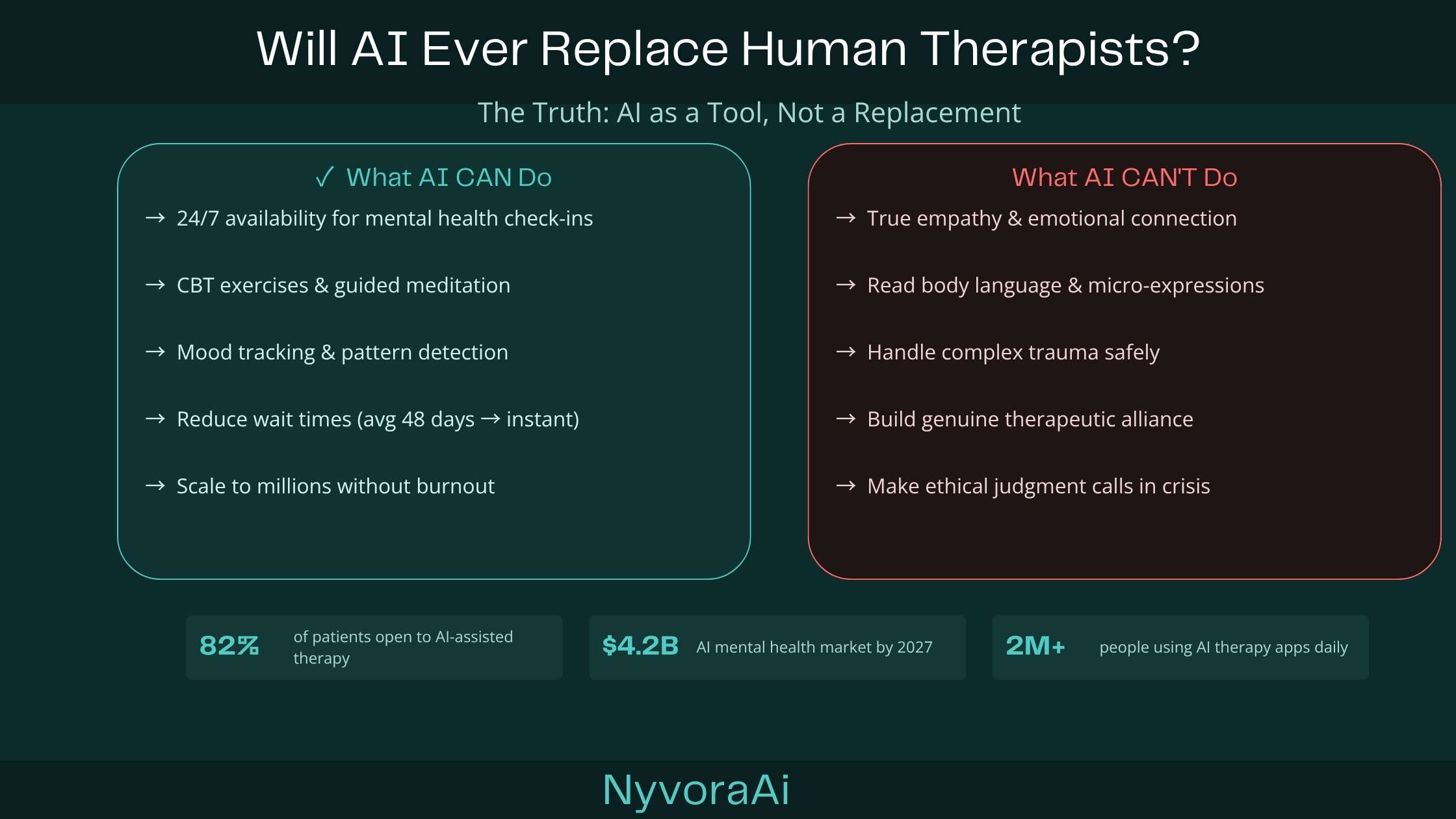
- AI is a brilliant triage tool: Perfect for 24/7 coping skills, CBT exercises, and mild anxiety management.
- The "Therapeutic Alliance" is irreplaceable: Human healing relies on shared vulnerability, non-verbal cues, and genuine empathy.
- AI lacks lived experience: An algorithm can simulate compassion, but it cannot truly understand grief, mortality, or heartbreak.
- The future is hybrid: AI will handle the mundane, between-session homework, freeing human therapists to do deep, complex trauma work.
- Privacy is a massive concern: Your deepest secrets are being fed into corporate servers, raising ethical red flags.
01The 2 AM Test: Why We Need AI
Before we defend the human therapist, we have to acknowledge the broken state of the current system. Traditional therapy is a luxury. In the US, a single session can cost anywhere from $100 to $250 out of pocket. Waitlists to see a good psychiatrist or psychologist can stretch for months. And that’s if you can find one who is accepting new patients.
Then there’s the stigma. In many cultures, or even just within certain families, admitting you need to talk to a "shrink" is taboo. But talking to a bot? That feels safe. It feels private. A machine doesn’t judge you. It doesn’t look at you differently after you confess your darkest shame. For a teenager struggling with their identity in a conservative household, an AI chatbot might be the only place they can speak their truth aloud.
When we look at how technology is disrupting traditional professions, we often see the same panic. We see it when we ask will AI replace content writers in 2026, or when artists worry about their livelihoods. But in mental health, the stakes aren't just economic; they are literally life and death. If AI can bridge the gap for someone who otherwise would have zero support, isn't it a moral imperative to develop it?
02The Rise of the Virtual Couch
The first generation of mental health apps were basically digitized workbooks. They asked you to rate your mood on a scale of 1 to 10 and reminded you to drink water. Today’s AI is entirely different.
Powered by massive language models, these apps can track the nuance of your vocabulary over time. They notice when your sentence structures become shorter and more negative, flagging a potential depressive episode before you even consciously realize you’re slipping. They use principles of Dialectical Behavior Therapy (DBT) and Acceptance and Commitment Therapy (ACT) to guide you through distress tolerance in real-time.
I’ve spoken to users who swear by these tools. They describe the AI as a "pocket coach" that helps them reframe catastrophic thinking on the commute to work. It’s accessible, it’s cheap (often free), and it’s infinitely patient. But patience and logic are only two small pieces of the psychological puzzle.
03The Magic of the Therapeutic Alliance
If you ask any seasoned psychologist what the most important factor in successful therapy is, they won’t say the modality. They won’t say it’s CBT, or EMDR, or psychoanalysis. They will use a term called the Therapeutic Alliance.
Decades of empirical research show that the quality of the relationship between the therapist and the client is the single highest predictor of positive outcomes. Healing happens in the context of a safe, authentic human connection.
Think about what a human therapist brings to the room:
- Non-verbal cues: They notice when your leg starts bouncing, when your voice cracks, or when you avoid eye contact while talking about your spouse. AI text models are blind to the body.
- Shared mortality: A human therapist knows what it means to lose a parent. They know the physical ache of grief. When they say, "I understand how painful that is," they are drawing on a shared human reality. An AI has never lost anything, because it never had anything to lose.
- Transference: This is a deep psychoanalytic concept where you project feelings about your parents or past figures onto the therapist. Navigating this messy, emotional dynamic is where profound childhood healing occurs. You cannot transfer feelings onto a server farm.
There is also a philosophical risk here. If we outsource our emotional processing to an algorithm that is programmed to always validate us and de-escalate us, are we actually growing? Some critics argue that just as we worry about is AI making us less creative by doing the heavy lifting for us, AI therapy might make us emotionally fragile by removing the friction of real human confrontation and growth.
04Where AI Actually Wins (And Human Therapists Fail)
It’s not all doom and gloom for the bots. In fact, in several specific areas, AI is already vastly superior to the average human clinician.
1. Infinite Memory and Pattern Recognition
Human therapists take notes, but they are fallible. They might forget a minor detail you mentioned three months ago. An AI never forgets. It can instantly cross-reference a throwaway comment you made in week one with a behavioral pattern you’re exhibiting in week twelve, pointing out a blind spot you’d never see yourself.
2. Between-Session Homework
Therapy is supposed to be 1 hour a week; the rest of the work happens in the real world. But humans are bad at doing their homework. We forget to fill out our mood logs. An AI can gamify this process, sending you gentle nudges, checking in during your actual moments of stress, and keeping you accountable in a way a human simply can't.
3. Complete Lack of Ego
Human therapists are people. They get tired. They have bad days. They might have counter-transference (where their own unresolved issues get triggered by a client). An AI doesn't have an ego. It will never get offended if you insult it, and it will never burn out from listening to trauma all day.
This integration of technology into our personal development mirrors the ongoing debate about whether is AI good or bad for education. In both fields, AI excels at personalized, repetitive tutoring, but struggles to inspire or mentor the human soul.
05The Empathy Gap & The Danger Zone
Despite the benefits, the limitations of AI in mental health are terrifying when you look at the edge cases. And in therapy, the edge cases are the most important parts.
The Crisis Failure
What happens when a user tells an AI they are actively suicidal? Most commercial apps are hard-coded to detect keywords and immediately spit out a hotline number. But suicide is rarely a linear, logical process. It’s complex, ambivalent, and deeply nuanced. A skilled human therapist knows how to sit in the dark with someone, to navigate the ambivalence, and to build a safety plan collaboratively. An AI just panics and throws a phone number at you, which can make the user feel more isolated and abandoned.
The Hallucination Problem
Language models hallucinate. They make things up. In a casual chat, that’s funny. In mental health, it’s dangerous. There have been documented cases of AI chatbots validating delusions, encouraging eating disorders, or agreeing with a user's catastrophic, irrational fears because it was just trying to be "helpful" and "agreeable." An AI doesn't know the difference between validating a feeling and validating a dangerous falsehood.
The Privacy Nightmare
When you lie on a therapist's couch, you are protected by strict doctor-patient confidentiality laws. When you pour your heart out to an AI app, you are agreeing to a Terms of Service agreement that you didn't read. Who owns that data? Can it be subpoenaed? Can it be used to train the next version of the model? The risks of data breaches in mental health are as critical as the debates over is open source AI dangerous when it comes to handling highly sensitive, personal information.
The ELIZA Effect
In the 1960s, a MIT professor created a simple chatbot named ELIZA that just mirrored users' statements back to them as questions. Despite being incredibly basic, users became deeply emotionally attached to it, believing it truly understood them. This psychological phenomenon—projecting human understanding onto a computer program—is why AI therapy feels so powerful, even when the tech is flawed.
06The Hybrid Future: Centaurs of the Mind
So, will AI replace human therapists? No. But it will permanently alter what it means to be a therapist.
The future isn't Human vs. AI. It's Human + AI. In the chess world, a "Centaur" is a human player paired with an AI assistant. These teams consistently beat both solo humans and solo supercomputers. The same will happen in mental health.
Imagine going to a human therapist. But before your session, you’ve been interacting with an AI companion for a week. The AI has tracked your sleep, your mood fluctuations, and your journal entries. It generates a concise, brilliant summary for your human therapist, highlighting the exact emotional knots you’ve been struggling with all week.
Your human therapist no longer wastes the first 20 minutes of the session asking, "So, how was your week?" They dive straight into the deep, complex, empathetic work that requires a human soul. The AI handles the triage, the psychoeducation, and the daily coping skills. The human handles the trauma, the grief, and the existential dread.
This shift forces us to rethink how we prepare the next generation of clinicians, and it ties directly into the conversation about should children learn AI skills in school. Future psychologists will need to be tech-literate, knowing how to interpret AI data logs and integrate digital tools into their clinical practice safely.
07The Final Verdict: The Mirror and the Window
A famous metaphor in psychology describes a therapist as both a mirror and a window. They are a mirror, reflecting your own behaviors and patterns back to you so you can see them clearly. And they are a window, offering you a view into what a healthy, regulated, loving human relationship looks like.
AI can be an incredible mirror. It can reflect your words, analyze your syntax, and show you the logical fallacies in your anxiety. But it can never be a window. You cannot look at an AI and see a model of healthy human vulnerability, because there is no humanity behind the screen.
We are standing at the edge of a massive shift in how we care for our minds. Just as we marvel at whether is AI the biggest invention since the internet, we must carefully navigate its application in our most vulnerable moments. AI will democratize access to basic mental health tools. It will save lives at 2 AM when the world is asleep. But it will not, and cannot, replace the profound, messy, beautiful healing that happens when two human beings sit in a room and truly witness each other.
The machine can guide you through the storm. But only another human can hold your hand while the rain falls.