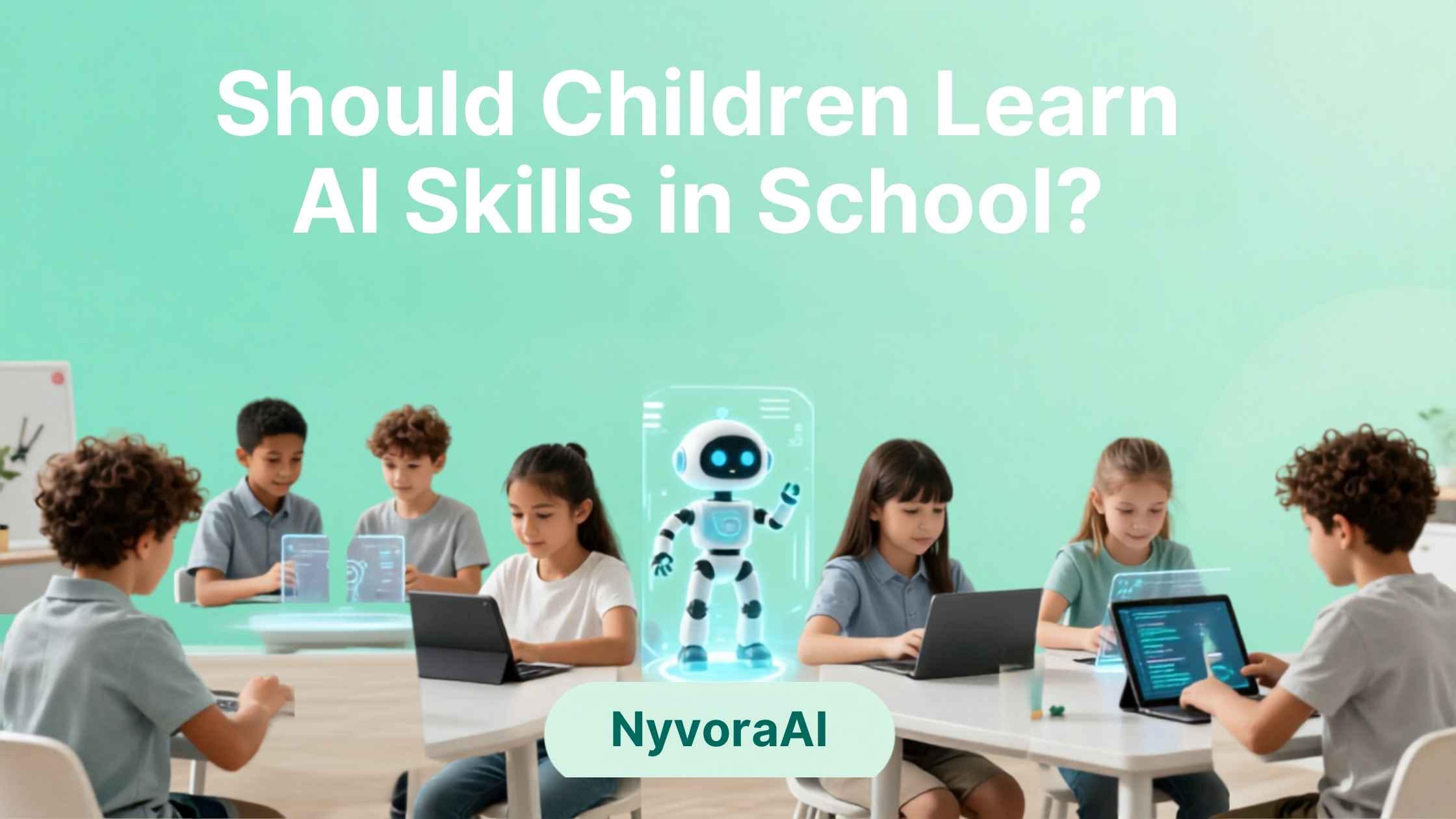
Picture this: It’s a Tuesday evening, and your 10-year-old is sitting at the kitchen table. They aren’t just playing a game on their tablet; they are actively tweaking the parameters of an AI model to generate a custom comic book. They understand concepts like "prompt iteration," "bias in training data," and "hallucinations."
Ten years ago, this sounded like science fiction. Today, it’s happening in living rooms across the world. But while kids are naturally adopting these tools, the formal education system is lagging behind. This brings us to one of the most fiercely debated questions in modern parenting and education: Should children learn AI skills in school?
As an educator and a parent, I’ve sat through countless town halls where this exact topic sparks shouting matches. On one side, you have tech evangelists arguing that AI literacy is the new reading and writing. On the other, you have traditionalists worried about the death of childhood creativity and the glorification of screen time.
Both sides have valid points. To figure out the right path forward for our kids, we need to strip away the hype, look at the actual mechanics of what "AI education" means, and decide what skills will actually serve them in a world where AI is arguably the biggest invention since the internet.
- AI education isn't just about coding; it's about critical thinking, ethics, and data literacy.
- Kids need to learn how to evaluate AI outputs, not just how to generate them.
- Foundational skills (reading, math, empathy) are more important than ever in an AI world.
- Schools must teach AI ethics to combat deepfakes, bias, and misinformation early on.
- Parents can start fostering "AI literacy" at home through collaborative, screen-balanced activities.
01The Great Education Debate: Tool vs. Crutch
To understand why this debate is so heated, we have to look at how we historically approach new technology in schools. When calculators became cheap in the 1980s, math teachers panicked. They argued that kids would lose the ability to do mental math. When the internet arrived in the late 90s, educators worried that students would stop memorizing facts and just "copy-paste" from Wikipedia.
In both cases, the panic was partially right, but ultimately misplaced. Calculators didn't kill math; they allowed students to tackle more complex, real-world problems instead of getting bogged down in long division. The internet didn't kill learning; it shifted the focus from rote memorization to information synthesis.
AI is the next iteration of this cycle, but it's fundamentally different. A calculator computes; the internet retrieves. AI generates and reasons. When a student uses AI to write an essay, they aren't just copying information—they are outsourcing the cognitive struggle of organizing thoughts, structuring arguments, and finding the right words. This is why the question of whether children should learn AI skills in school is so urgent. We aren't just deciding if they should use a tool; we are deciding how their brains will develop.
02The Case FOR AI in Schools: Future-Proofing Minds
Let’s start with the argument for integration. The world our children are graduating into will be fundamentally reshaped by artificial intelligence. By 2035, AI will be embedded in almost every industry, from healthcare to agriculture to the arts.
1. Demystifying the "Magic"
Right now, to most kids (and many adults), AI feels like magic. You type words, and an image or an essay appears. When things feel like magic, we become passive consumers. By teaching kids how large language models and neural networks actually work—the math, the data, the probabilities—we turn them from passive consumers into active, informed directors of the technology. They learn that AI isn't an omniscient oracle; it's a statistical engine that can be wrong.
2. The New "Prompt Engineering" Literacy
Communicating with machines is becoming a core skill. Learning how to ask the right questions, provide context, and iterate on outputs (often called prompt engineering) requires immense clarity of thought. To get a good result from an AI, a child must first know exactly what they want, understand the nuances of language, and be able to critically evaluate the result. That is a high-level cognitive exercise.
3. Supercharging Creativity
Critics say AI kills creativity. I argue it changes it. A child who wants to make a video game but doesn't know how to code can now use AI to write the basic scripts, allowing them to focus on game design, storytelling, and art. AI removes the technical friction, allowing kids to focus on the idea. It acts as a tireless brainstorming partner, helping them overcome the dreaded "blank page" syndrome.
Global Context
Countries like China, the UK, and Singapore have already mandated AI literacy in their primary school curricula. They aren't waiting for the debate to settle; they are treating AI fluency as a matter of national economic security. The global race for AI talent is already underway.
03The Valid Fears: Why We Must Proceed with Caution
However, we cannot ignore the very real dangers of shoving AI into classrooms without guardrails. The concerns from educators and parents aren't just Luddite panic; they are based on observable psychological and developmental risks.
The Atrophy of Foundational Skills
If a child never struggles to write a paragraph, do they ever learn how to structure a logical argument? If an AI instantly solves a complex physics equation, does the child understand the underlying principles, or just the final answer? The fear is that by outsourcing the "struggle" of learning, we rob children of the neural pathways built through effort and frustration. This ties directly into the ongoing cultural conversation about whether AI is making us less creative and intellectually lazy.
The Epistemic Crisis
Kids are already struggling to differentiate between reality and fiction on social media. Now, add AI-generated deepfakes, hyper-realistic fake news articles, and persuasive but entirely fabricated historical events. If schools introduce AI without heavily emphasizing media literacy and source verification, we are handing children a machine that can perfectly lie to them.
The Digital Divide 2.0
There is also a massive equity issue. Wealthy school districts will teach kids how to build, code, and ethically manage AI systems. Underfunded districts might only have the budget to buy cheap AI tutoring software that essentially acts as a glorified multiple-choice quiz generator. We risk creating a two-tier society: the AI architects, and the AI dependent.
04What Should They Actually Learn? (It's Not Just Coding)
Here is where most adults get it wrong. When we say "teach kids AI," we usually picture 12-year-olds staring at Python code. While computer science is vital, true AI literacy for the general student body looks very different.
Data Literacy & Statistics
AI is just math and data. Kids need to understand how data is collected, how biases creep into datasets, and how statistics can be manipulated. If they understand data, they understand AI.
Ethical Reasoning & Philosophy
Should an AI be allowed to write a college admissions essay? Who is responsible if a self-driving car crashes? Students need to debate the moral implications of automation, privacy, and algorithmic bias.
Critical Verification (The "Trust but Verify" Rule)
Students must be trained to treat AI outputs as a "first draft" from an unreliable intern. They need to learn how to cross-reference AI claims with primary sources and identify hallucinations.
Human-Centric Skills
As AI takes over technical and routine cognitive tasks, the most valuable human skills will be empathy, complex problem-solving, leadership, and physical dexterity. Schools must double down on these.
05Myth vs. Fact: Clearing the Air
Let’s rapidly fire through some of the most common misconceptions holding back AI education.
"Teaching AI means kids will stop learning to write and read."
AI requires more reading and writing. Students must read to verify AI outputs, and write highly detailed, nuanced prompts to get good results. The medium changes, but literacy is more critical than ever.
"Only kids interested in tech need to learn AI skills."
AI will impact law, medicine, art, and agriculture. Every child needs a baseline understanding of how these systems make decisions, regardless of their chosen career path.
"AI will replace teachers entirely."
AI can tutor and grade, but it cannot mentor, inspire, or manage the social-emotional development of a child. The teacher's role will evolve from 'lecturer' to 'learning facilitator'.
06A Parent's Survival Guide: What to Do at Home
You can't wait for the school board to figure this out. By the time curriculum committees agree on a textbook, the technology will have evolved three times. Here is how you can foster healthy AI literacy at home right now.
Play "AI Auditor"
Sit down with your child and ask an AI to explain a complex topic, like the water cycle or a historical event. Then, challenge your child to find three things the AI got wrong, missed, or explained poorly. This builds the critical muscle of verification and shows them that AI is fallible.
Co-Create, Don't Just Consume
Instead of letting them use AI passively, use it together. Bake a cake and ask AI to help you invent a completely new, weird flavor profile. Build a birdhouse and ask AI to generate the cutting list. Show them that AI is a tool for action in the physical world, not just a chatbot for homework.
Discuss the "Human in the Loop"
When they ask if AI will take over jobs, have an honest conversation. Explain that while AI might automate tasks, it takes a human to decide which tasks are worth doing. If you are worried about their future career prospects, it's worth exploring the data on whether AI will replace content writers in 2026 and other professions to ground the conversation in reality, not sci-fi fear.
07The Final Verdict: Yes, But With Guardrails
So, should children learn AI skills in school? The answer is an unequivocal yes. But we must radically redefine what "AI skills" means.
We are not talking about turning every elementary school into a coding bootcamp. We are talking about teaching children how to navigate, evaluate, and direct the most powerful cognitive tool humanity has ever created. We are teaching them how to remain human in a world increasingly mediated by machines.
If we ban AI from schools out of fear, we don't protect our children; we leave them defenseless against it. They will learn about it anyway, from unregulated YouTube tutorials and unfiltered internet forums. It is far better that they learn about it in a classroom, guided by educators who emphasize ethics, critical thinking, and the irreplaceable value of human creativity.
The goal of education has never been to prepare kids for the world that exists today. It’s to prepare them for the world that will exist tomorrow. And tomorrow, undeniably, belongs to those who understand the machine.