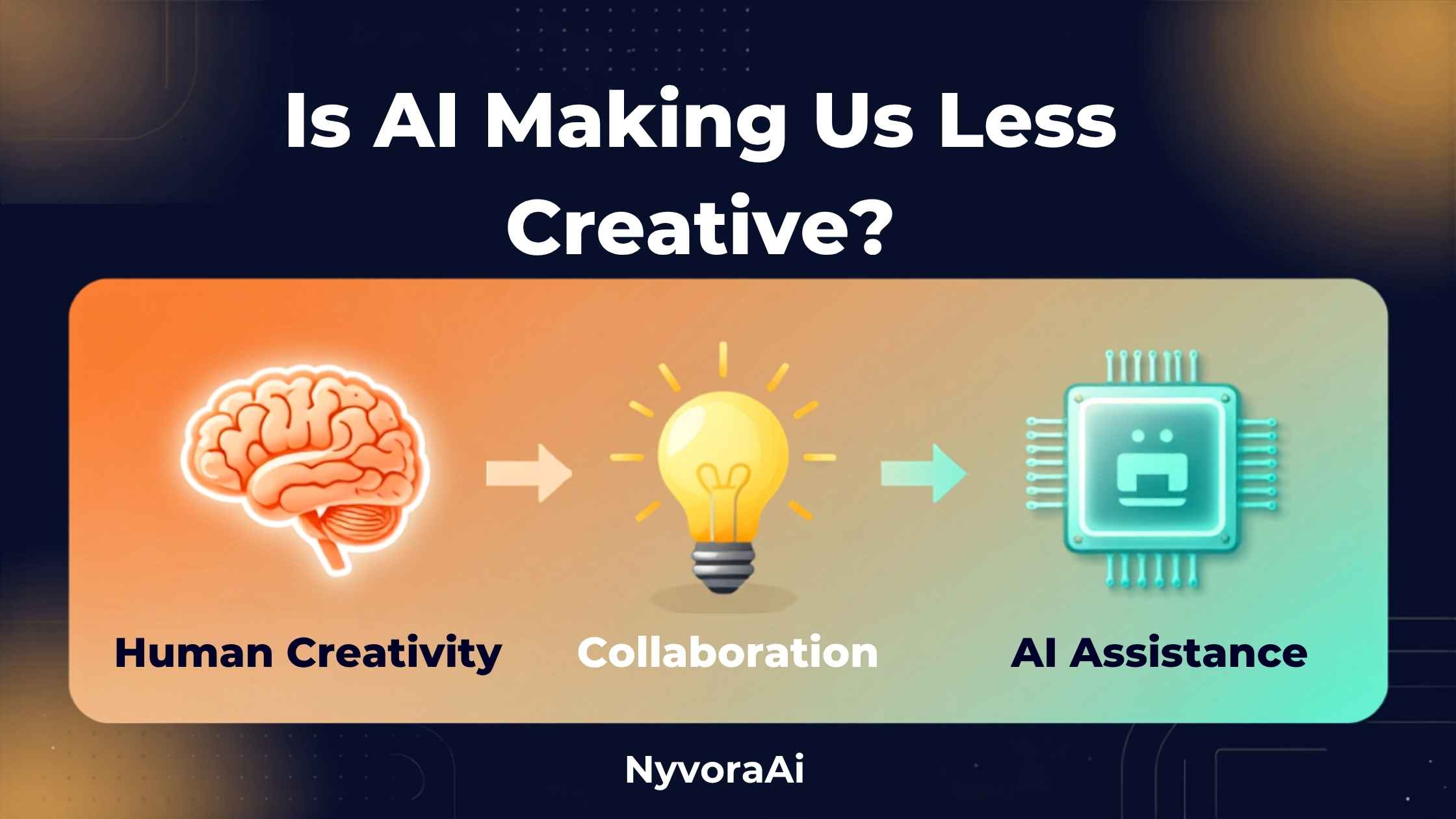
Somewhere in the last two years, creativity became a contested thing. Designers who used to sketch ideas out by hand now prompt a model instead. Writers who used to sit with an idea for a week before writing a word now generate ten drafts in an hour and pick the least bad one. Musicians are making albums with AI instruments they couldn't physically play. From the outside, it looks like more output. From the inside, a lot of creators aren't sure it feels like more creativity.
The people worried about this aren't technophobes. Most of them are the same people enthusiastically adopting AI tools — precisely because they can see up close what changes when you hand a significant part of the creative process to something else. The concern isn't that AI exists. It's about what happens to a creative skill, and a creative identity, when it stops being practiced regularly.
The answer depends less on AI itself and more on how deliberately you use it — and what you keep doing without it.
- AI can reduce creative engagement when used to avoid the hard parts of thinking
- AI can expand creative range when used to handle execution rather than ideation
- The blank page problem is real — but so is the risk of never sitting with one
- Skill atrophy is a genuine concern for anyone who stops practicing creative decisions
- The most important creative skill — having something worth saying — AI cannot provide
01Short Answer First
AI is not making creativity disappear. But it is changing which creative muscles get exercised, and that matters. The concern isn't theoretical — there's genuine cognitive science behind the idea that skills not practiced atrophy, and creative thinking is a skill. When AI consistently handles the parts of a task that require creative decision-making, the person using it makes fewer creative decisions. Over time, that changes something.
At the same time, there are real creators doing genuinely interesting, original work with AI tools — work they couldn't have produced without them. Both things are true simultaneously, which is why the "is AI killing creativity" framing tends to produce unhelpful debates. The more useful question is: which parts of the creative process is AI doing for you, and which parts are you still doing yourself?
02What Creativity Actually Is — Before We Debate It
A lot of conversations about AI and creativity go in circles because they're working from different definitions of what creativity is. If creativity means "producing something new," AI clearly does that. If creativity means "expressing something authentic about human experience," that's much harder to attribute to a model trained on human text and images. The answer to "is AI creative" depends entirely on which definition you're using.
For the purpose of this piece, let's define creativity the way most cognitive scientists and artists would: it's the capacity to form original ideas, make unexpected connections, and express something that reflects genuine personal perspective or experience. Not just novelty for its own sake — that's random. Creativity is purposeful novelty, shaped by taste, judgment, and a reason to say something.
Under that definition, AI doesn't create. It generates statistically likely outputs based on patterns in its training data. The outputs can be genuinely surprising and occasionally beautiful, but they're not creative in the sense of being purposeful and driven by a perspective. What matters for this discussion isn't whether AI is creative — it's whether using AI changes whether humans are.
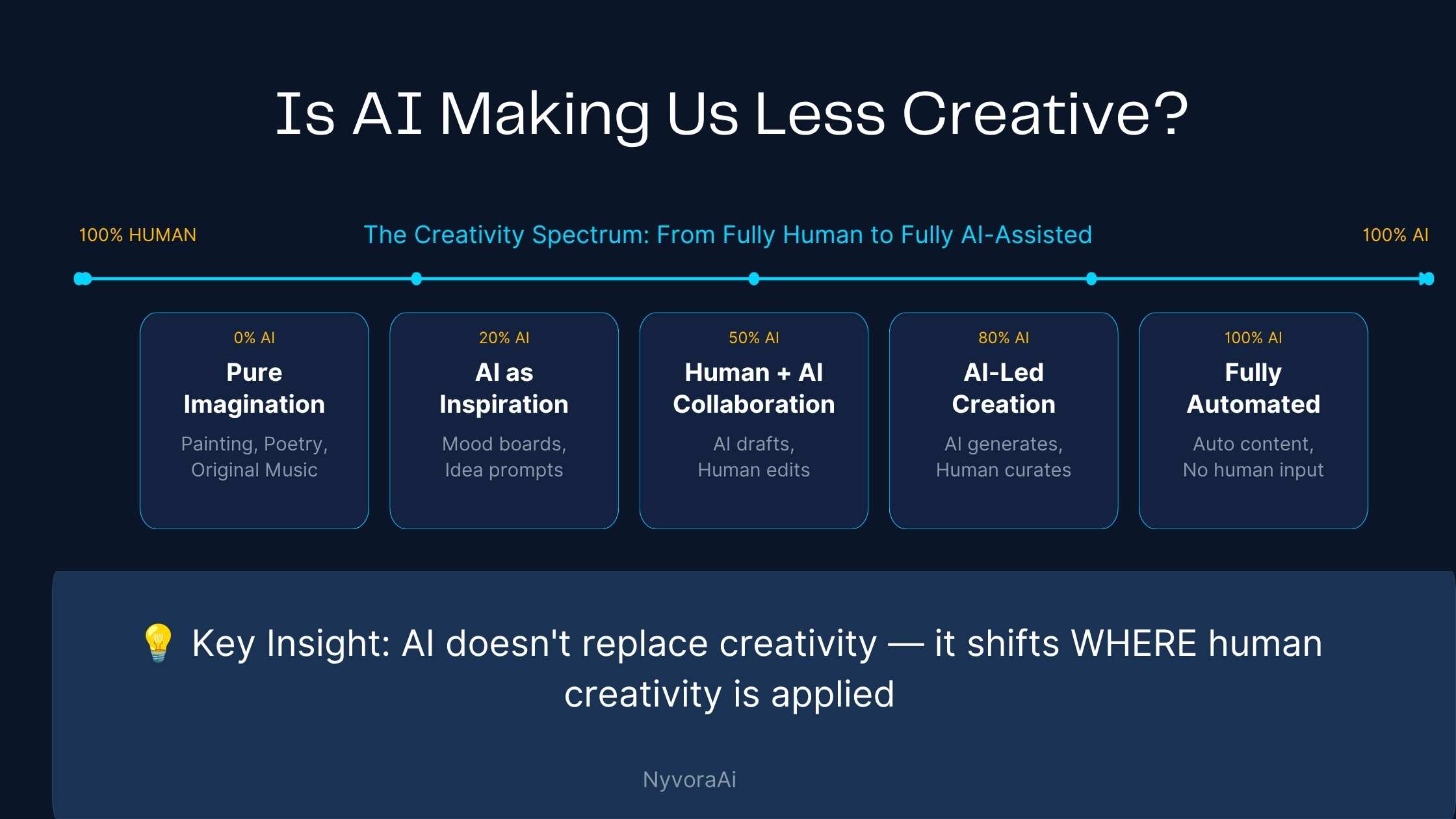
03The Case for Yes — When AI Does Reduce Creativity
Let's take the uncomfortable side of this argument seriously. There are specific patterns of AI use that demonstrably reduce creative engagement, and pretending otherwise doesn't serve anyone.
- Outsourcing ideation before you've tried to think through the problem yourself
- Accepting the first AI output without developing your own judgment about what makes it good or bad
- Using AI to avoid the discomfort of not knowing what to make next
- Losing the practice of sitting with an idea until it develops naturally
- Building a creative identity around prompting skill rather than a distinctive perspective
- Producing volume without the friction that develops taste and discrimination
- Handling execution so the creative decision-making stays with the human
- Lowering the barrier to trying more experiments and iterations quickly
- Making it possible to work in mediums previously inaccessible due to skill or cost
- Generating unexpected variations that spark new directions a human wouldn't have thought of alone
- Freeing mental bandwidth from routine tasks toward more ambitious creative problems
- Making collaboration faster and more fluid across creative disciplines
The pattern that genuinely concerns cognitive scientists is what happens when AI consistently takes over the parts of work that require effort, struggle, and decision-making. There is a well-documented connection between the difficulty of creative production and the development of creative skill. Struggling with a problem — even unproductively — builds something. The person who writes ten bad paragraphs before one good one has practiced judgment. The person who generates fifty AI paragraphs and picks the least bad one hasn't practiced the same thing.
04The Case for No — When AI Genuinely Expands Creative Range
The opposite side of this argument is also genuinely true. There are creators doing things right now that weren't previously possible — not because AI lowers the bar, but because it removes barriers that had nothing to do with creative ability and everything to do with technical skill, time, or resources.
A novelist who has always thought visually but couldn't draw can now illustrate their world. A musician who composes on paper can hear the full orchestration without hiring an orchestra. A designer who had ideas for animation but couldn't code can prototype moving concepts for the first time. In each of those cases, the creativity — the idea, the vision, the intent — is entirely human. AI is handling a technical execution gap, not the creative decision-making.
"The question isn't whether the tool thinks for you. The question is whether you stop thinking because the tool is there."
— The distinction that matters in the creativity debateThe strongest argument against "AI makes us less creative" is the historical one. Every major productivity tool was predicted to diminish the skills it assisted. Word processors were going to make writers worse. Calculators were going to make mathematicians worse. Photography was going to kill painting. In each case, the concern was real but the outcome was more complex — the tools changed what skills mattered and freed practitioners to work at a different level of abstraction. Something similar is likely happening now.
05The Blank Page Problem — And Why It Actually Matters
One of the most popular things to say about AI creative tools is that they "solve the blank page problem." You no longer have to sit there not knowing what to write or make — you can generate something and react to it instead. This is true, and for many people genuinely useful. But it's worth being honest about what that blank page was actually doing.
The blank page is uncomfortable. It's also where a specific kind of creative thinking happens — the period of sitting with an idea before it has form, when your mind is working through connections and possibilities without external input. Some of the most important creative thinking — the kind that produces genuinely surprising work — happens in that uncomfortable gap before the first draft. When AI eliminates that gap consistently, it's not obvious that nothing is lost.
The habit of staring at a blank page and pushing through to something is itself a skill. Writers who do it develop a specific capacity to generate from internal resources, to trust their own instincts, and to tolerate the uncertainty of not having an answer yet. Whether that capacity matters in a world where AI can fill the gap instantly is a genuinely open question — but it seems worth thinking about carefully before deciding it doesn't.
06Skill Atrophy — Is It Real or Overstated?
The concept of cognitive offloading — letting external tools handle mental tasks you used to do yourself — is well established. GPS navigation has demonstrably reduced spatial memory in people who use it constantly. Spellcheck has changed how people engage with spelling. These are not catastrophic losses, but they are real ones. The question for AI is whether similar dynamics apply to creative cognition.
The honest answer is we don't have long-term data yet. AI creative tools at this scale are genuinely new. The concern that consistently outsourcing creative decisions will reduce the capacity to make them independently is plausible based on everything we know about skill and practice — but it's currently more of a well-grounded concern than a demonstrated fact. Anyone who tells you the evidence is clear in either direction is ahead of the research.
Worth Thinking About
The skills most at risk from cognitive offloading are the ones you practice the least. If you regularly write, draw, or compose without AI assistance — even imperfectly — those capacities stay sharp. The risk of skill atrophy is specifically for people who stop practicing the un-assisted version entirely. That's a choice, not an inevitability.
07What AI Genuinely Cannot Do Creatively
There is a specific thing that makes creative work worth making, and AI doesn't have it: a reason to say something. The most enduring creative work comes from people who have something they urgently need to express — a perspective that feels distinctive, an experience that demands to be processed, an observation about the world that won't leave them alone. AI has no experience, no urgency, no inner life that wants expression.
This is why AI-generated creative work, even at its most technically impressive, tends to feel slightly hollow. It is statistically skilled. It knows the patterns of what works. But it doesn't have anything at stake. The distinctive voice that makes creative work worth reading or looking at or listening to comes from a specific human being who has lived something, thought something, felt something. No amount of prompt engineering produces that.
What this means practically is that the creative skills most worth developing in a world with AI tools are the ones AI cannot replace: having a distinctive perspective, developing genuine taste through wide and critical engagement with creative work, building the judgment to know what is good and what merely looks good, and finding a reason to make things that is entirely your own. Those skills don't atrophy from AI use — they're simply not what AI does. The question of whether the people in the best position to do that kind of work are spending enough time developing it is a different question, and a more personal one.
08How to Use AI Without Losing Yourself in It
For most creators, the goal isn't to reject AI tools or to use them uncritically — it's to find the integration that keeps the creative work genuinely yours. A few practical principles that hold up across different creative fields:
- Make creative decisions before prompting. Know what you're trying to achieve before asking AI to help achieve it. If the AI is generating the idea and you're selecting from its options, that's a different cognitive activity than if you're using AI to execute an idea you've already formed.
- Maintain a practice that doesn't use AI. Keep writing by hand sometimes. Sketch without generating. Compose the first version without assistance. Not because AI is bad, but because the un-assisted version exercises something the assisted version doesn't.
- Develop your taste deliberately. Read widely, look at work you admire, build genuine opinions about what is good and why. Taste is what distinguishes creative judgment from aesthetic randomness, and AI cannot develop it for you.
- Be honest about what the AI is doing. When AI generates the concept and the execution, and you select and publish — what creative contribution did you make? Sometimes the answer is "curation and direction," which is a legitimate creative role. But knowing which it is matters for your development as a creative person.
The question of how AI is changing what creative work looks like professionally — which jobs are being affected and in which directions — connects directly to the broader employment picture in creative fields. Our analysis of whether AI will replace content writers in 2026 covers the economic and professional dimension of this same question in more detail, which is worth reading alongside this piece for the full picture.
09The Real Risk Nobody Talks About Enough
Here is the creative risk that gets less attention than skill atrophy, and which I think is more immediate: the homogenisation of creative output. When many people are using the same AI tools, trained on the same data, with broadly similar prompting habits, the outputs start to converge. The aesthetic signatures of AI-generated images are already recognisable to anyone who looks at enough of them. The sentence structures favoured by AI writing tools are increasingly distinctive. The musical patterns of AI-generated tracks have fingerprints.
This is not a criticism of any individual creator using these tools well. It's a structural observation: when creative production runs through a small number of highly capable AI systems, the diversity of creative output across the culture tends to narrow. The long tail of idiosyncratic, difficult-to-categorise, deeply weird human creative work — the stuff that comes from a specific person's specific mind in a specific moment — faces a different competitive landscape when polished, technically capable AI output is available instantly and cheaply.
The Question Worth Sitting With
Not "is AI making me less creative" — but "is what I am making distinctively mine?" The answer to that question doesn't require avoiding AI. It requires knowing what you actually think, what you actually have to say, and making sure those things are present in the work — whether or not AI helped you produce it.
10Frequently Asked Questions
Is AI making us less creative?
Does using AI tools reduce creativity over time?
Can AI and human creativity work well together?
What is lost when AI generates creative work for you?
Will AI replace human creativity entirely?
11Conclusion
The honest answer to "is AI making us less creative" is that it depends — and that answer isn't a cop-out. It depends on which parts of the creative process you've handed over, how often you practice creating without AI assistance, whether you're developing genuine taste and perspective, and whether the things you make still have something distinctively yours in them. Those are questions about individual practice and habit, not about the existence of the tools.
What seems clear is that the creative skills most worth protecting are the ones AI cannot replicate: the accumulated experience that gives you something worth saying, the taste that tells you what is genuinely good versus what merely passes, and the willingness to sit with difficulty long enough for something original to emerge. Those aren't threatened by AI tools. But they do require deliberate cultivation in a landscape where the easier path is always available at the click of a prompt. Whether people choose that deliberate cultivation is, perhaps appropriately, a deeply human creative decision.

Written by Varun Lalwani
Varun writes about AI, creativity, and the ways technology shapes how we think and work for NyvoraAI. This piece was written in June 2026 based on ongoing observation of creative communities navigating AI adoption. Have thoughts on this question? Contact us — it's a conversation worth having.