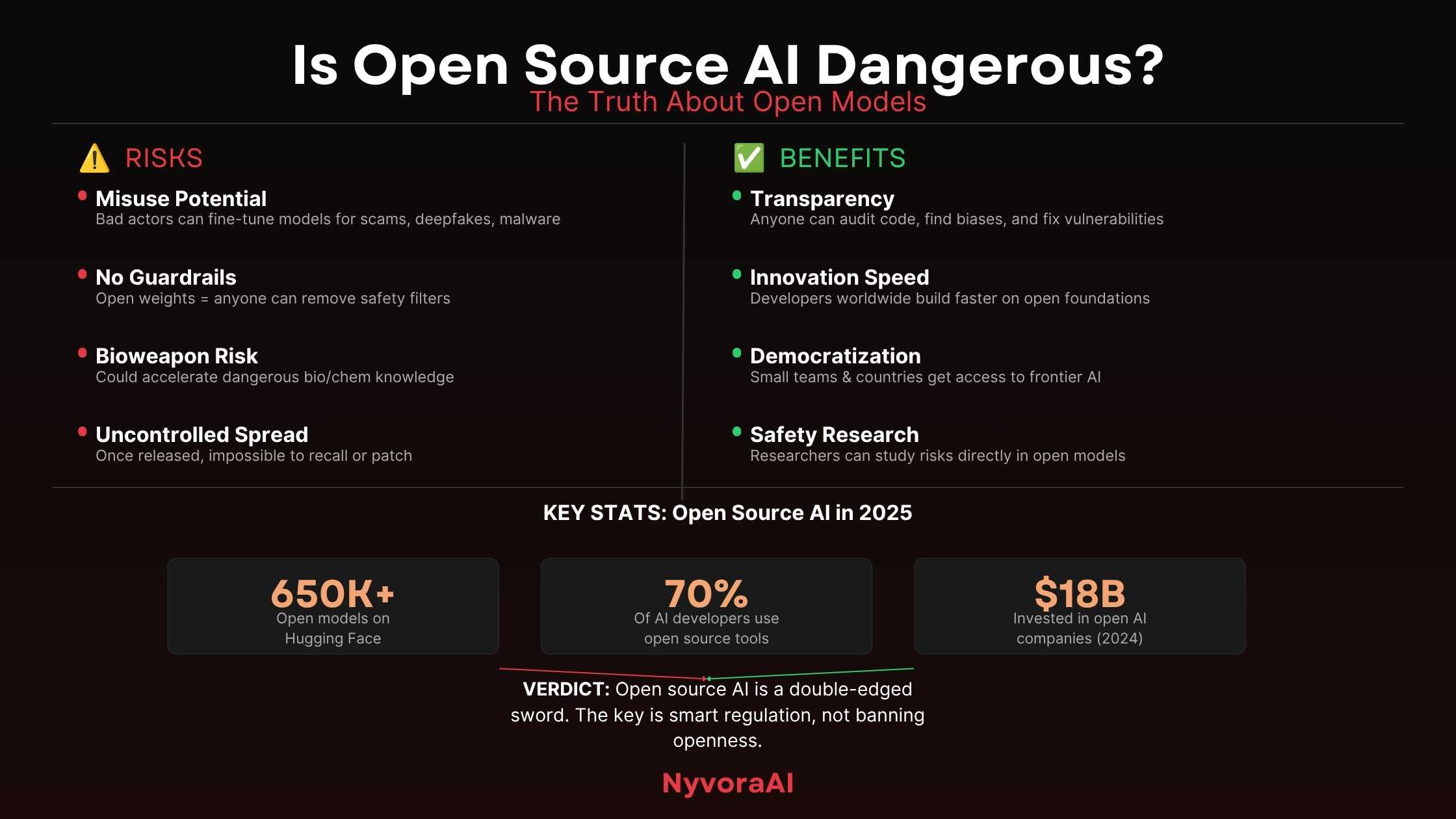
Last week, I found myself in a heated debate with a friend who works in cybersecurity. We were arguing about the latest release of a massive, open-weight language model. He was practically pulling his hair out, arguing that releasing this level of intelligence to the public was akin to handing out uranium to hobbyists. I, on the other hand, was playing devil’s advocate for the open-source community.
This isn't just an academic argument happening in university labs anymore. It’s a multi-billion-dollar turf war that will define the next decade of human technological progress. On one side, you have the "e/acc" (effective acceleration) crowd and open-source purists who believe that locking away AI is an existential threat to human freedom. On the other side, you have the "doomers" and corporate executives who argue that open source AI is dangerous and could literally lead to the collapse of society.
So, who is right? Is open source AI a ticking time bomb, or is it the only thing keeping us from being ruled by a handful of tech monopolies? Grab a coffee. We’re going deep into the most controversial topic in artificial intelligence.
- The "Dual-Use" Dilemma: Open models can be used for incredible good (medical research) or catastrophic harm (bio-weapons, cyberattacks).
- Open Weights ≠ Open Source: Most "open" AI today (like Llama) is actually just "open weights." The training data remains a closely guarded secret.
- The Monopoly Argument: Closed-source advocates argue safety requires control; open-source advocates argue safety requires transparency and community auditing.
- The Genie is Out: Once model weights are on the internet, they cannot be deleted. Regulation must focus on compute and hardware, not just code.
- Everyday Impact: Open source is the only reason small businesses and indie devs can afford to use advanced AI without paying API tolls to tech giants.
01The Great AI Schism: Freedom vs. Safety
To understand why this debate is so toxic, you have to realize that both sides are looking at the exact same technology and seeing completely opposite futures.
For the open-source camp, AI is the ultimate democratizer. It’s the printing press of the 21st century. They argue that if a brilliant teenager in a developing nation has the same access to a state-of-the-art reasoning model as a senior engineer at Silicon Valley, we will solve climate change, cure diseases, and eradicate poverty at an unprecedented pace. To them, restricting AI is just a way for Big Tech to maintain their moats.
For the safety camp, AI is a loaded weapon. They argue that unlike software bugs or social media algorithms, a sufficiently advanced AI could autonomously design a novel pathogen or orchestrate a crippling cyberattack on the power grid. If you release the "blueprint" for that intelligence to the world, you can't control who builds it.
It's the same reason people argued that AI is the biggest invention since the internet—it's a foundational shift that amplifies both human brilliance and human malice.
02Wait, What Does "Open Source" Even Mean in AI?
Here is where the media and the tech bros get it wrong 90% of the time. When Meta releases Llama, or Mistral releases their latest model, the headlines scream "Open Source AI!"
But purists will tell you that’s a lie. True open-source software (like Linux) means you have access to the source code, the build tools, and the training data. You can reproduce the entire thing from scratch.
What companies are actually releasing is "open weights." They are giving you the final, trained neural network (the billions of parameters), but they are keeping the training data and the exact training recipe secret. Why? Because the training data is worth billions of dollars, and it's often scraped from copyrighted or private sources.
"Open source AI means anyone can download the code and train their own model for free."
"Open weights" just means you can run the model or fine-tune it. Training a frontier model from scratch still requires tens of millions of dollars in compute and proprietary data.
03The Real Dangers: Why the "Doomers" Are Panicking
Let’s not sugarcoat it. There are very real, terrifying risks associated with putting powerful AI models on Hugging Face for anyone to download. The cybersecurity community calls this the "dual-use dilemma."
1. The Removal of Guardrails
When you use a closed API like ChatGPT or Claude, the company has spent millions on "RLHF" (Reinforcement Learning from Human Feedback) to make the model refuse to do bad things. It won't tell you how to build a bomb, and it won't write racist manifestos.
When you download an open-weight model, you can strip those guardrails away in minutes. This is known as "jailbreaking" at the architecture level. Bad actors can fine-tune a model specifically to be helpful, harmless, and honest... except when it's being asked to generate phishing kits, automate ransomware, or synthesize illegal content.
2. The Proliferation of Deepfakes
We are already drowning in AI-generated slop and deepfakes. Open-source image and video models (like Stable Diffusion and its successors) are the reason why. Because they run locally on consumer GPUs, no central authority can moderate what people create. This directly feeds into the cultural anxiety about is AI making us less creative, as the internet becomes flooded with synthetic, unoriginal, and often deceptive media.
3. The "Lone Wolf" Threat
Historically, executing a massive cyberattack or designing a biological weapon required a state actor or a large terrorist cell. It required logistics, manpower, and specialized labs. The fear is that open-source AI acts as a force multiplier for the "lone wolf." A single individual with a laptop and a downloaded model could theoretically orchestrate attacks that previously required an army.
04Why We Need Open AI Anyway (The Counter-Argument)
If open AI is so dangerous, why do thousands of brilliant researchers fight tooth and nail to keep it open? Because the alternative is arguably worse.
1. Security Through Transparency
In cybersecurity, there is a golden rule: "Security through obscurity is not security." If only three companies in the world have the most advanced AI models, and they keep the code secret, how do we know they are safe? How do we know the models aren't harboring hidden biases, backdoors, or catastrophic failure modes?
Open source allows the global community of researchers to audit the models. When a vulnerability is found in an open model, thousands of independent developers can patch it. When a vulnerability is found in a closed model, it stays hidden until a whistleblower leaks it or a disaster occurs.
2. Preventing the AI Monopoly
Imagine a world where only two or three corporations control the foundational intelligence of the global economy. They dictate what information you see, what code gets written, and what scientific research gets prioritized. They can turn off the AI for entire countries if they disagree with their politics.
Open source is the only check on this power. It ensures that AI remains a public utility rather than a private fiefdom. It allows startups, universities, and independent creators to build on the bleeding edge without paying a "tax" to the tech giants.
3. Accelerating Scientific Discovery
Closed models are optimized for consumer chat and enterprise SaaS. Open models are optimized for science. Researchers are using open-source AI to predict protein folding, discover new materials for batteries, and model climate change. If this tech was locked behind a paywall, the pace of scientific discovery would grind to a halt.
The Nuclear Analogy
Critics often compare open-source AI to nuclear energy. The same physics that powers a city can level it. But we didn't ban physics textbooks to prevent nuclear bombs. We created international treaties, regulatory bodies, and safety protocols. The open-source community argues we need the same approach for AI: robust governance, not blanket bans.
05The Closed Source Illusion
Here is the uncomfortable truth that the "safety" lobbyists don't want you to focus on: Closed source does not equal safe.
We have seen time and time again that closed systems leak. Source code gets stolen by hackers. Employees take USB drives home. Models get reverse-engineered through API scraping. The idea that a frontier AI model can be kept in a vault forever is a fantasy.
Furthermore, the "safety" argument is often just a Trojan horse for regulatory capture. By convincing governments that open source is too dangerous, closed-source companies can pass laws that make it illegal for anyone else to compete with them. They aren't trying to save the world; they are trying to kill their competition under the guise of "public safety."
06How This Affects Everyday Users
You might be thinking, "This is a philosophical debate for billionaires and academics. How does this affect me?" The answer is: profoundly.
If open source AI gets regulated out of existence, the cost of using AI will skyrocket. You will be forced to pay per-query to a monopoly. If you are a freelancer, a small business owner, or a creator, your margins will be squeezed by API costs. This is exactly why people are so worried about will AI replace content writers in 2026—if only massive corporations can afford the best AI, the little guy gets crushed.
On the flip side, because open source exists, you can run a highly capable AI model locally on your own laptop. Your data never leaves your machine. You have total privacy. You can use it to organize your life, write your code, or manage your finances without a corporate overlord watching your every move.
This is also why the debate over should children learn AI skills in school is so critical. If we want the next generation to be the architects of AI rather than just its consumers, they need access to open models to tinker, break, and learn how the technology actually works under the hood.
07The Middle Ground: Responsible Release
So, is open source AI dangerous? Yes. But so is fire, electricity, and the internet. The question isn't whether it's dangerous; it's whether the benefits outweigh the risks, and how we mitigate those risks.
The industry is slowly moving toward a "Responsible Release" framework. This involves:
Gradual Release
Instead of dropping the most powerful model in the world on day one, companies release slightly smaller, safer versions first, monitoring the ecosystem for misuse before releasing the full-power variant.
Compute Thresholds
Regulators are focusing on the physical hardware. If you want to train a massive model, you have to register your GPU clusters with the government. This tracks the "birth" of a model before it ever gets open-sourced.
Open-Source Safety Evaluations
Before a model is released, it must pass rigorous, standardized "red-teaming" tests conducted by independent third parties to ensure it cannot easily generate CBRN (Chemical, Biological, Radiological, and Nuclear) threats.
Community Watermarking
Developing universal standards for embedding invisible watermarks in AI-generated text, code, and media, making it easier to track the origin of open-source model outputs.
08The Final Verdict: The Genie is Already Out
Is open source AI dangerous? Absolutely. It lowers the barrier to entry for cybercriminals, it accelerates the deepfake crisis, and it removes the corporate guardrails that keep the average user safe from their own worst impulses.
But here is the reality check: The genie is already out of the bottle.
You cannot un-invent the transformer architecture. You cannot un-publish the weights of Llama, Mistral, or Stable Diffusion. They are on thousands of hard drives, mirrored on blockchains, and distributed across the globe. Banning open source now wouldn't make us safer; it would just ensure that only the governments and the black market have access to the technology, while law-abiding citizens and ethical researchers are left in the dark.
The only way forward is through radical transparency, robust community auditing, and international cooperation. We have to build the immune system of the internet in real-time, while the virus is already in the bloodstream. It’s messy, it’s dangerous, and it’s terrifying.
But if history is any guide, open collaboration always beats closed secrecy in the long run. The internet survived the worms, the viruses, and the trolls. Open source AI will survive its growing pains too. We just have to be smart about how we handle it.