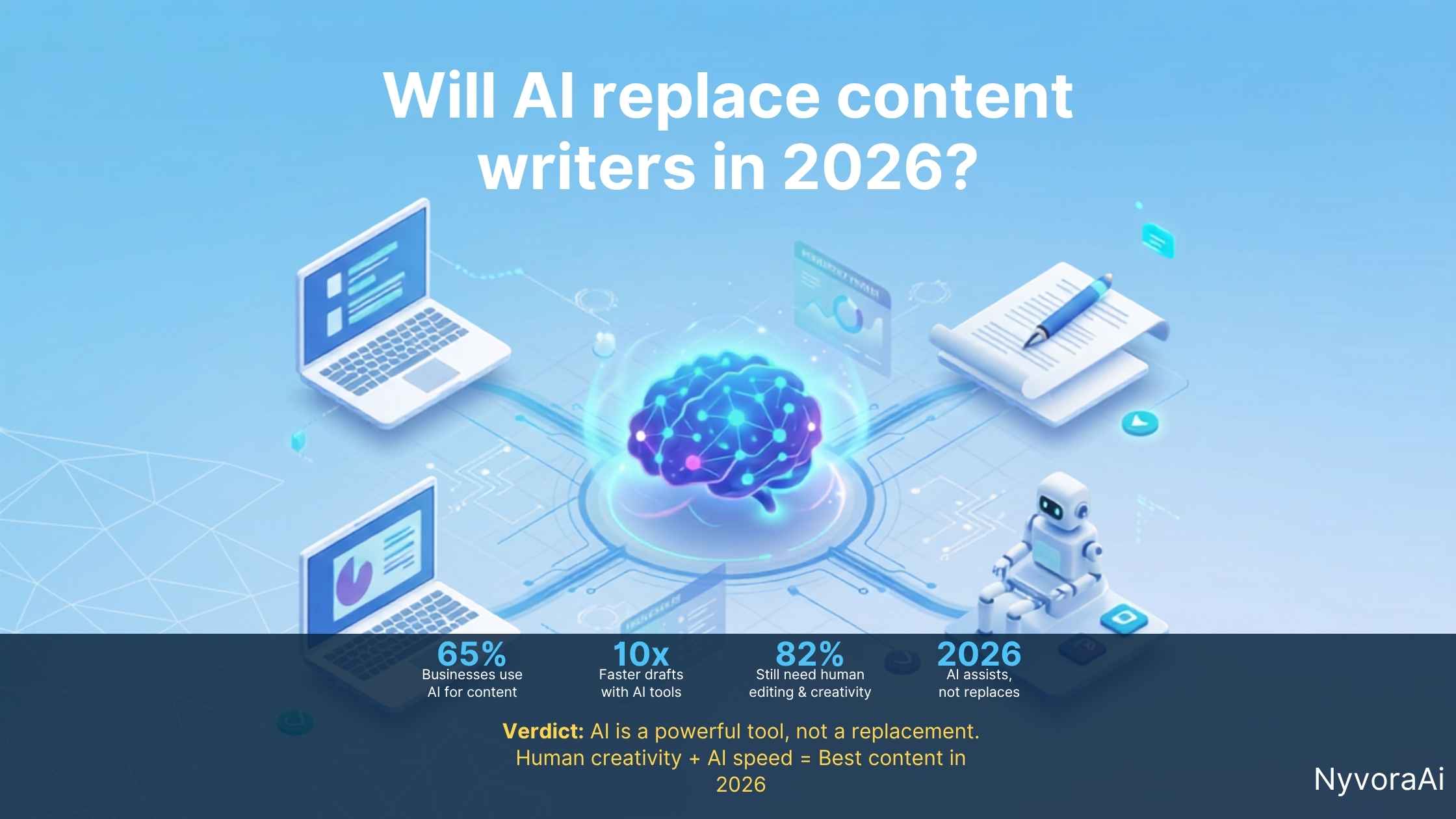
Every few months, a headline declares content writing dead, followed almost immediately by another headline about a company hiring an "AI Content Strategist" at a higher salary than the writer role it replaced. Both headlines are describing the same shift from two different angles. The volume-based, templated end of content writing really is shrinking. The strategic, expertise-driven end of it is holding steady or growing. Treating "content writing" as one single job with one single fate is where most of the confusion in this conversation comes from.
AI isn't replacing content writers as a category — it's splitting the category in two.
- Routine, templated writing is genuinely shrinking — generic SEO articles, basic product copy, formulaic social captions
- Strategic and expertise-driven writing is growing — editorial direction, original research, brand voice, niche authority
- Google explicitly rewards originality and first-hand expertise over how content was produced
- Most content marketers now use AI as a tool, not a replacement — mainly for ideation, outlining, and first drafts
- The safest career move is specialization, not competing with AI on raw drafting speed
01Quick Answer
No, AI is not fully replacing content writers in 2026, but it is significantly displacing a specific slice of the job: high-volume, templated, low-differentiation writing that doesn't require original research, a distinct point of view, or first-hand expertise. Writers focused on editorial strategy, brand voice, original reporting, and subject-matter authority are seeing steady or growing demand, while purely execution-focused writers competing on volume against AI tools are facing real, measurable pressure. The honest framing isn't "will AI replace writers" — it's "which parts of this job is AI already doing, and which parts still need a human."
02What's Actually Happening in Content Writing Right Now
The data tells a genuinely two-sided story, and it's worth sitting with both halves instead of picking the one that confirms what you already believed. On one side, freelance writing job postings have dropped substantially since generative AI tools went mainstream, and industry analyses have projected meaningful declines in digital marketing content-writer and reporter roles over the rest of the decade. Surveys of digital marketers show a large majority believe AI puts writing jobs at risk, and that anxiety isn't unfounded — it's a rational response to a real shift in how commodity content gets produced.
On the other side, broader labor-market research paints a less dramatic picture for the profession as a whole. Analyses of content marketing specifically note that demand is bounded less by whether AI can write and more by marketing budgets and strategic priorities — and that audience fragmentation is actually pushing brands to need more targeted content, not less, even as AI makes production faster. Roles like AI Content Strategist and Documentation Engineer are appearing in job postings at a fast clip, suggesting the field is restructuring around AI rather than simply disappearing. Most surveys of working content marketers back this up: the majority use AI for ideation, outlining, and first drafts, but only a small fraction say their work is now fully AI-generated.
03What Actually Determines Whether a Writing Job Is at Risk
Weigh your own writing work against these four factors honestly. A role built entirely around producing high volumes of interchangeable articles sits in a very different position than a role built around a specific audience's trust in your judgment and expertise.
04Content Writing Tasks, Ranked by AI Exposure
| Task Type | AI Exposure | Why | 2026 Outlook |
|---|---|---|---|
| Generic SEO listicles | High risk | Highly templated, low originality requirement | Shrinking demand for pure execution |
| Basic product descriptions | High risk | Formulaic structure, repeated across catalogs | Increasingly automated at scale |
| Social media captions | Moderate risk | Templated but benefits from brand-specific tone | AI-assisted, human-reviewed workflows growing |
| Original reporting & interviews | Low risk | Requires first-hand access and judgment | Steady to growing demand |
| Editorial strategy & brand voice | Low risk | Requires audience judgment, not just drafting | Growing, including new AI-oversight roles |
The pattern across nearly every serious analysis of this shift is consistent: routine, automation-prone writing openings have fallen since generative AI went mainstream, while demand for analytical, strategic, and clearly differentiated creative work has grown over the same period. That's not a promise that any individual job is safe — but it is a meaningfully more specific answer than a simple yes-or-no about the whole profession.
05Future-Proof Your Writing Career in Five Steps
Audit which parts of your work are templated
Be honest about how much of your output follows a repeatable formula versus requiring real judgment.
Build a specific area of expertise
Deep knowledge of one industry or topic is harder to commoditize than general-purpose writing ability.
Learn to direct and edit AI output well
Prompting, evaluating, and reshaping AI drafts is becoming its own valuable, in-demand skill.
Add original research to your work
Interviews, first-hand testing, and proprietary data make your writing something AI genuinely can't replicate.
Develop a recognizable voice
A distinct point of view is one of the strongest defenses against being interchangeable with generic AI output.
06Where AI Still Falls Short as a Writer
- It can't originate first-hand experience. AI can describe a product review; it can't have actually used the product the way a human tester can.
- It struggles with a consistent, distinctive voice at scale. Output tends to converge toward a generic middle ground unless heavily directed.
- It doesn't carry real accountability. A human byline implies responsibility for accuracy and judgment that AI output alone doesn't provide.
- It can't make strategic calls about what not to say. Editorial judgment about audience, timing, and tone still requires human decision-making.
- Search engines are increasingly built to detect commodity content. Undifferentiated AI writing tends to underperform against original, expertise-backed work over time.
Google Judges Content by Quality, Not Origin
Google has stated its ranking systems focus on whether content is genuinely helpful, not on whether AI was involved in producing it. But purely AI-generated content without originality or first-hand expertise still tends to struggle against differentiated, human-reviewed work in competitive search results.
07What This Means for Readers and Businesses
If you're a business owner rather than a writer, this shift changes what "good content" should mean for your team. The volume-first approach — publishing as many articles as possible as cheaply as possible — is exactly the strategy AI has made least defensible, since anyone can now produce that same volume just as easily. What's becoming more valuable is content that reflects real expertise, original testing, and a distinct editorial point of view, which is the same principle NyvoraAI has built its own content approach around from the start.
If you want to keep track of how this shift continues to play out — new tools, labor-market data, and platform policy changes as they happen — our AI News — Latest Artificial Intelligence Headlines | NyvoraAI page tracks these developments as they're reported, rather than waiting for an annual roundup. The honest reality is that this is a moving target, and the writers and businesses paying close attention to how it evolves are the ones adapting fastest.
A Useful Framing to Remember
Industry researchers sometimes describe an informal "30% rule": AI tools can now competently handle a large share of repetitive, rule-based writing work, but a meaningful portion should still go through human review, creative judgment, and personal expertise. Treating that as a floor rather than a ceiling tends to produce far more durable content careers.
08Mistakes Writers and Businesses Make Right Now
- Competing with AI on raw drafting speed. That's a race no human writer can win, and it's the wrong metric to optimize for.
- Publishing unedited AI content at scale. Undifferentiated, unreviewed AI output tends to underperform in search and erode reader trust over time.
- Ignoring AI entirely out of principle. Refusing to use AI for ideation or first drafts often just means working slower for no real competitive advantage.
- Assuming every writing job is equally at risk. Templated execution work and strategic, expertise-driven work face very different realities right now.
- Waiting to specialize until it's urgent. Building expertise and a distinct voice takes time — starting early is a genuine advantage.
09Frequently Asked Questions
Will AI replace content writers in 2026?
What kind of content writing is most at risk from AI?
What content writing skills are safe from AI?
Should I still become a content writer in 2026?
How is Google responding to AI-generated content?
10Conclusion
So, will AI replace content writers in 2026? Not as a whole profession — but it has already replaced a specific, sizable slice of it, and pretending otherwise doesn't help anyone plan around it. Templated, volume-first writing is genuinely under pressure, while strategic, expertise-driven, original writing is holding its ground and in some cases growing precisely because AI has made generic content so easy to produce that differentiation is now the scarce resource.
The most useful question isn't "will I be replaced" but "which parts of my work look like the templated end of this spectrum, and which parts look like the strategic end." Move deliberately toward the second one — original research, real expertise, a recognizable voice, and sound editorial judgment — and the data suggests you're building a career AI genuinely struggles to automate, rather than one it's already quietly absorbing.

Written by Varun Lalwani
Varun writes practical, beginner-friendly guides on AI tools and business workflows for NyvoraAI. Updated July 2026 based on hands-on research into current labor-market data and industry analysis. Questions about your setup? Contact us — we're happy to help.