If you scroll through tech Twitter or listen to any podcast featuring a venture capitalist these days, you'll hear the same phrase repeated like a mantra: "AI is the biggest thing since the internet."
It’s a catchy soundbite. It makes sense to our brains because the internet is the only technological revolution most of us have personally lived through. It completely rewired how we communicate, work, and entertain ourselves. So, comparing Artificial Intelligence to the internet is the ultimate shorthand for saying, "This is going to change everything."
But as someone who spends way too much time analyzing tech trends, I often wonder if we're doing a disservice to both technologies by lumping them together. Are we just dealing with another platform shift, or is AI the biggest invention since the internet—or maybe even since the printing press?
To answer that, we need to stop looking at the hype and start looking at the mechanics of how these two revolutions actually changed human behavior. Grab a coffee. We're going deep.
- The Internet was an infrastructure of connection. It democratized access to information.
- AI is an infrastructure of intelligence. It democratizes the ability to process and create information.
- AI adoption is happening exponentially faster than internet adoption did.
- AI isn't replacing the internet; it's evolving it into an "Intelligent Web."
- The risks of AI (misinformation, job displacement) are fundamentally different from the risks of the internet (privacy loss, digital divides).
01The Internet's Legacy: What Did It Actually Do?
Before we can crown AI as the successor, we have to respect what the internet pulled off. It’s easy to take it for granted now, but the internet is arguably the most important invention of the 20th century.
Prior to the 1990s, if you wanted to know something, you had to go to a library, ask an expert, or wait for the evening news. Information was gated by geography, wealth, and institutional access. The internet didn't just digitize encyclopedias; it collapsed the cost of distributing information to essentially zero.
It created the digital economy. It gave rise to e-commerce, remote work, social media, and cloud computing. It connected 5 billion people. But here is the crucial part: the internet is fundamentally a pipe. It moves bits and bytes from point A to point B. It doesn't understand what those bits mean. It requires a human on the other end to read, interpret, and act on the information.
02The AI Paradigm Shift: From Pipes to Brains
This is where the comparison gets interesting. If the internet is the ultimate set of pipes, AI is the water flowing through them—except the water can think.
Artificial Intelligence, specifically the generative and reasoning models we have today, doesn't just retrieve information. It synthesizes it. It understands context. It can write code, diagnose diseases from X-rays, translate languages in real-time, and generate photorealistic art.
When you ask a search engine a question, it gives you ten links. You still have to click them, read the articles, and piece the answer together yourself. When you ask an AI a question, it reads the links for you, digests the concepts, and hands you a customized, synthesized answer. It shifts the burden of cognitive labor from the human to the machine.
Think About It
The internet outsourced our memory (we don't memorize phone numbers or facts anymore). AI is now outsourcing our reasoning and execution (we don't draft emails from scratch or write basic code anymore). That is a massive psychological and economic shift.
03Head-to-Head: Internet vs. AI
Let's put them in the same room and see how they stack up across a few key metrics.
- Core Function: Connects people and data
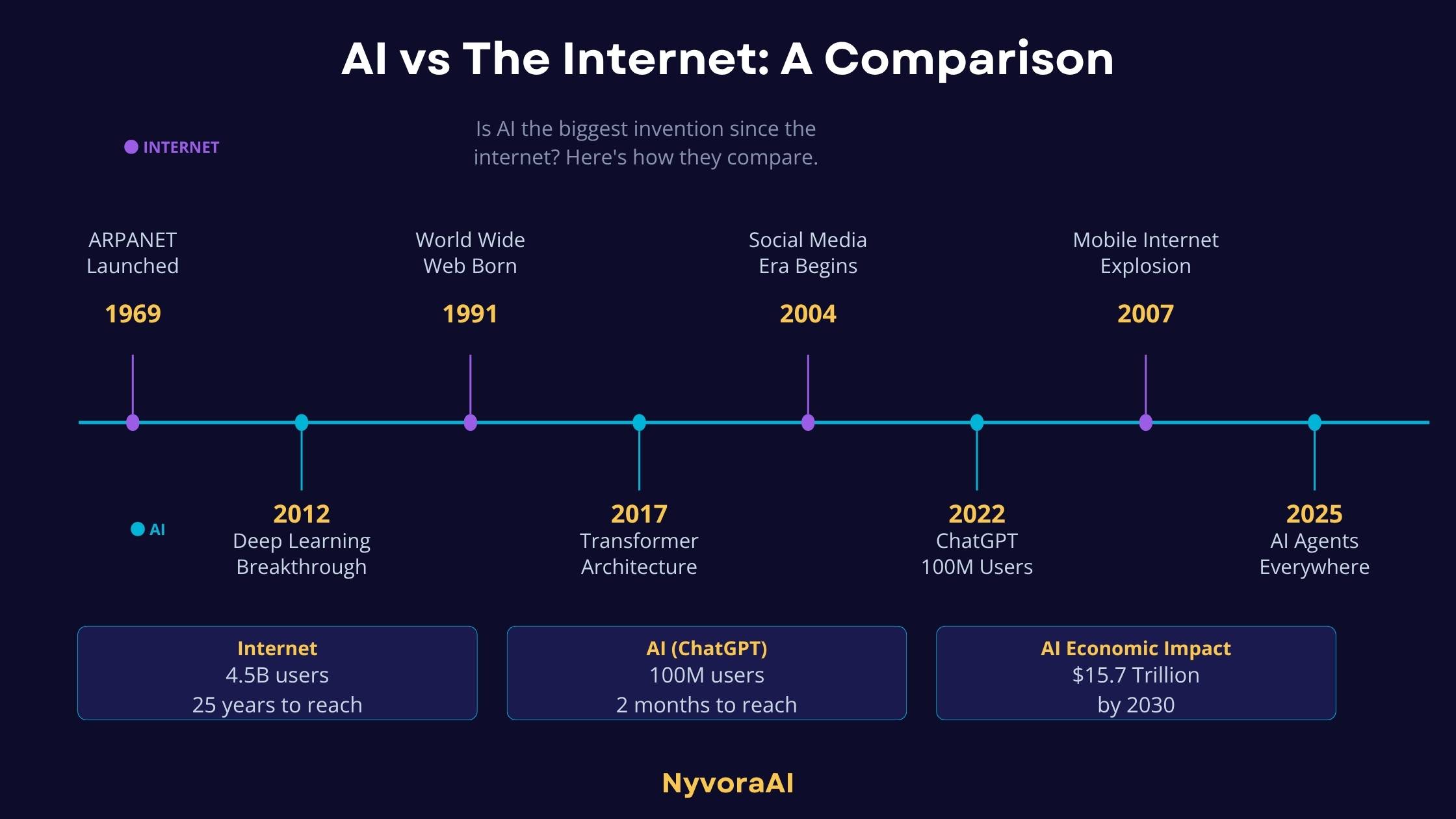
- Adoption Speed: ~20 years to reach mass market
- Primary Impact: Communication & Commerce
- Barrier to Entry: Required physical infrastructure (cables, cell towers)
- Human Role: Creator and consumer of content
- Core Function: Processes data and generates action
- Adoption Speed: ~2 years to reach 100M+ users
- Primary Impact: Cognition, Automation & Creation
- Barrier to Entry: Requires massive compute & data (already built)
- Human Role: Director and editor of AI output
Look at the adoption speed. ChatGPT hit 100 million monthly active users in two months. It took the internet over a decade to reach that kind of penetration. The velocity of AI adoption is terrifying and exhilarating in equal measure.
04Why AI Could Actually Be Bigger
So, why do so many researchers argue that AI eclipses the internet? It comes down to the ceiling of what the internet can achieve versus what AI can achieve.
1. Solving the "Unsolvable" Problems
The internet helped us share scientific research faster. AI is actually doing the research. AlphaFold predicting the 3D structures of nearly all known proteins is a feat that would have taken human biologists millions of years. AI is currently modeling climate change solutions, designing new battery chemistries, and discovering novel antibiotics. The internet gave us the library; AI is the scientist reading the books and making the breakthroughs.
2. The Democratization of Expertise
The internet gave everyone access to the same information, but it didn't give everyone the same skills. If you wanted to build a website in 2005, you had to learn HTML and CSS. If you wanted to analyze a massive dataset, you had to learn Python and SQL.
AI flattens that learning curve to almost zero. Now, you just tell the AI what you want in plain English. This is fundamentally disrupting the job market. If you're a professional wondering about the future of your career, you've probably already asked yourself: will AI replace content writers in 2026? The answer applies to coders, analysts, and designers too. AI doesn't just give you information; it gives you the ability to execute at a professional level.
3. Physical World Integration
The internet largely stayed on screens. AI is stepping into the physical world. Autonomous vehicles, robotic surgery, smart grids, and humanoid robots are all powered by AI. The internet connected our minds; AI is going to augment our physical reality.
05The Counter-Argument: Why the Internet Still Holds the Crown
Hold on. Before we hand the trophy to AI, let's play devil's advocate. There is a very strong argument that the internet remains the undisputed champion of technological revolutions.
Here is the reality check: AI does not exist without the internet.
Modern AI models are trained on the internet. Every parameter in a large language model was tuned using the collective text, images, and code uploaded to the web over the last thirty years. The internet is the foundational layer. AI is just the most complex application running on top of it. Saying AI is bigger than the internet is like saying the engine of a car is more important than the wheels. Sure, it's the power source, but without the wheels, you aren't going anywhere.
Furthermore, the internet fundamentally altered human sociology in a way AI hasn't yet. The internet created global communities, sparked political revolutions (the Arab Spring), changed how we date, and redefined celebrity. It rewired our dopamine receptors through social media. AI is currently changing our economy, but the internet changed our soul.
06The Dark Side: The Risks of the AI Boom
Every massive technological leap comes with a shadow. The internet brought us cyberbullying, identity theft, echo chambers, and the collapse of local journalism. But the risks associated with AI are arguably more complex because they challenge our concept of truth and human agency.
When the internet spread misinformation, it was usually humans lying to other humans. When AI spreads misinformation, it can generate millions of unique, highly persuasive, photorealistic deepfakes in seconds, tailored specifically to your psychological profile. The epistemic crisis we are facing—where we can no longer trust our own eyes and ears—is a direct result of AI.
There is also the philosophical risk. If we offload all our writing, thinking, and problem-solving to algorithms, what happens to human cognition? Some critics are already raising the alarm, asking if AI is making us less creative. If we never struggle through the blank page, do we lose the ability to innovate? These are questions the internet never forced us to ask.
The Epistemic Risk
AI can generate infinite, persuasive falsehoods. We are entering a "zero-trust" digital environment where verifying reality requires cryptographic proof.
The Economic Risk
Unlike the internet, which created more jobs than it destroyed in the long run, AI threatens to replace cognitive labor entirely. The transition period could be socially devastating.
The Alignment Risk
As AI systems become more autonomous, ensuring their goals remain aligned with human values (the "alignment problem") is the biggest technical challenge of our era.
07The Final Verdict: A Symbiotic Evolution
So, is AI the biggest invention since the internet? The question itself is slightly flawed, because it assumes they are competing in the same category.
The internet was the greatest communication invention in history. AI is the greatest cognitive invention in history.
We are not moving from the internet era to the AI era. We are moving into the Intelligent Internet era. In the near future, you won't "use AI" as a separate tool. AI will be the invisible layer powering the internet. Your browser will be an AI agent. Your operating system will be an AI agent. The internet will no longer be a place you visit; it will be a nervous system that acts on your behalf.
If the internet was the invention that connected the world's knowledge, AI is the invention that finally allows us to understand and utilize it. In that sense, yes. AI might just be the most important thing to happen to humanity since we first learned to share our stories around a fire.