Let’s be real for a second. The moment you start using AI to write, you cross an invisible psychological threshold. Suddenly, you aren't just a writer, a student, or a marketer. You’re a director. A prompt engineer. An editor of synthetic thought.
And with that shift comes a heavy dose of imposter syndrome. You look at the beautifully structured article in front of you and wonder: If I don't tell them I used AI, am I lying? If I do tell them, will they think I'm lazy?
This is the defining ethical dilemma of the 2020s. The question of should you tell people when you use AI to write isn't just about following rules; it's about the fundamental nature of trust on the internet. When someone reads your words, they are entering into a silent contract with you. They are trusting that your perspective is human, your experiences are real, and your conclusions are earned.
So, where do we draw the line? Is AI just a fancy spellchecker, or is it a ghostwriter that demands a byline? Let’s cut through the noise and figure out exactly when, why, and how you should disclose your AI usage.
- Context is everything: Disclosing AI is mandatory in journalism, academia, and advice-giving. It's optional (but often smart) in marketing and casual blogging.
- Google doesn't care: Search engines reward quality, not the origin of the text. They penalize spam, not AI.
- The "Grammarly Defense": If you use AI for outlining, brainstorming, or editing, you are using it as a tool, not a replacement for human thought.
- Transparency builds trust: In an internet flooded with synthetic slop, proudly declaring your human oversight is a massive competitive advantage.
- When in doubt, disclose: A simple footnote costs nothing and protects your reputation forever.
01The Transparency Dilemma: Why Do We Care?
To understand why this debate is so heated, we have to look at what we value in writing. Historically, we’ve valued the struggle. We read a memoir because we want to know how a specific human survived a specific tragedy. We read an opinion piece because we want to understand how a specific human mind processes a complex issue.
AI removes the struggle. It can generate a 2,000-word essay on the history of Rome in four seconds. But it has no skin in the game. It hasn't lived, it hasn't failed, and it doesn't care if it's right or wrong.
When you publish AI-generated content without disclosure, you are essentially asking the reader to assume a human burden that wasn't actually carried. You are letting them believe they are connecting with a person, when in reality, they are interacting with a statistical model. For many, that feels like a bait-and-switch. It’s the digital equivalent of wearing a mask to a first date.
02Where Disclosure is Absolutely Non-Negotiable
Let’s start with the hard lines. There are certain arenas where hiding your AI usage isn't just frowned upon; it's professional suicide or an ethical violation.
Journalism and News
If you are reporting facts, interviewing sources, or analyzing current events, you must disclose AI usage. Why? Because AI hallucinates. It makes things up. If you use an LLM to summarize a 50-page court document and you don't verify it, you are gambling with the truth. Major publications now have strict policies: AI can be used for transcription or minor editing, but never for generating core reporting. If you use it to draft a news story, you must label it.
Academia and Education
This is the battlefield of the decade. Students are using AI to write essays, and professors are using AI to catch them. But the reality is shifting. We are moving past the "ban it" phase and into the "integrate it" phase. This is exactly why the debate over is AI good or bad for education is so critical. If a student uses AI to brainstorm thesis statements or outline a paper, that's a valid study aid. But if they pass off raw AI output as their own original thought, that's plagiarism. In academia, disclosure isn't just polite; it's the difference between a passing grade and expulsion.
Medical, Legal, and Financial Advice
If you are writing a blog post about how to manage diabetes, structure a trust, or invest in crypto, and you used AI to generate the core advice, you have a moral (and potentially legal) obligation to disclose it. AI is not a doctor, a lawyer, or a fiduciary. If a reader makes a life-altering decision based on an algorithmic hallucination, and they find out you hid the machine's involvement, the backlash will be severe.
03The Gray Areas of Content Creation
Now let’s step out of the high-stakes zones and into the messy reality of everyday content creation. Marketing copy, SEO blog posts, social media captions, and YouTube scripts. Do you need to slap a disclaimer on every product description you write?
Probably not. Here’s why.
When a user reads a blog post about "The 10 Best productivity Apps," they don't care if a human agonized over the introduction. They care if the list is accurate, if the formatting is clean, and if the advice actually helps them get things done. The utility of the content outweighs the romance of its creation.
This is the exact same anxiety we see in the professional writing world. When we ask will AI replace content writers in 2026, the answer usually hinges on this distinction: AI will replace the commodity writers who just churn out generic fluff. But it won't replace the writers who inject strategy, brand voice, and human insight into the final product.
If you use AI to generate a first draft, and then you spend two hours rewriting it, adding your own anecdotes, fact-checking the claims, and injecting your unique voice, the final product is yours. The AI was just your research assistant. You don't need to disclose that you used a calculator to balance your budget, and you don't need to disclose that you used an LLM to beat writer's block.
The "Grammarly" Threshold
Think about Grammarly or spellcheck. They use AI to predict what word you want to type next and fix your syntax. Nobody puts a disclaimer on their email saying, "This sentence was corrected by AI." At what point does an AI tool cross the line from "assistant" to "author"? For most utility content, that line is crossed only when the human stops editing and verifying.
04The "Human-in-the-Loop" Reality
The biggest myth in the AI writing debate is that it’s a binary choice: either a human wrote it, or a robot wrote it. In reality, the best content in 2026 is a cyborg. It’s a symbiotic relationship.
I use AI constantly. I use it to outline complex articles. I use it to suggest alternative phrasing when I’m stuck in a rut. I use it to play devil’s advocate and poke holes in my arguments. But I would never, ever hit "publish" on something I haven't thoroughly rewritten and verified.
If you are using AI to bypass the cognitive friction of thinking, you are producing slop. But if you are using it to amplify your own expertise, you are producing leverage. This ties directly into the cultural fear that is AI making us less creative. If you let the machine do the dreaming, yes, your creative muscles will atrophy. But if you force the machine to do the heavy lifting of structuring data so you can focus on the art of storytelling, you are actually becoming more creative.
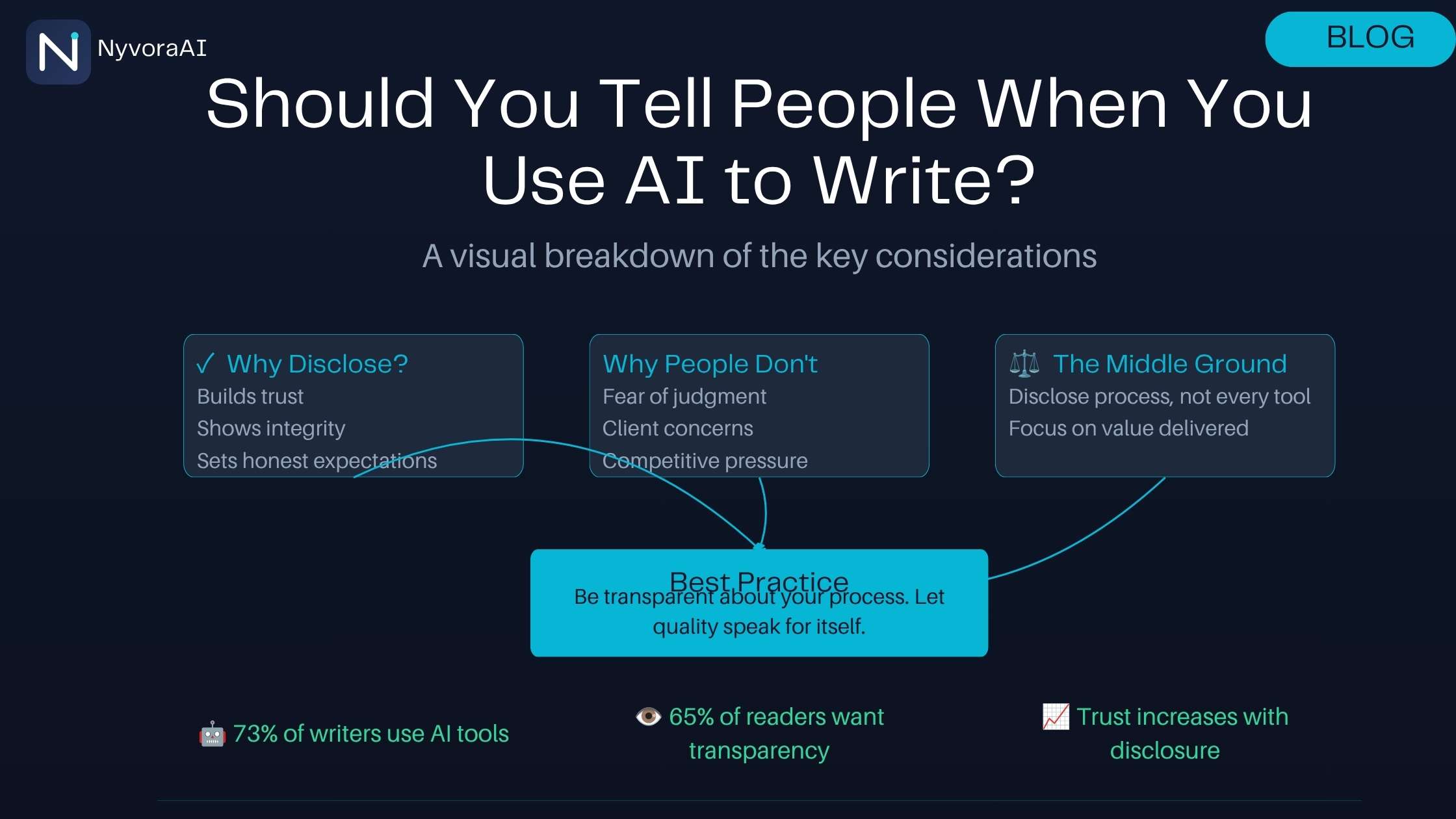
So, should you disclose this? If your process is "Human insight + AI structuring + Human editing," a simple footnote is usually enough to satisfy the curious without alienating the casual reader.
05The Legal and Platform Rules
Ethics are great, but what about the law? And what about the platforms that host your content?
The FTC and Deceptive Practices
In the US, the Federal Trade Commission (FTC) has made it clear that if you use AI to generate fake reviews, fake testimonials, or deceptive endorsements, you are breaking the law. You cannot use AI to create a fake persona that praises your product. That’s fraud. But if you use AI to write your company's blog posts? Totally legal.
Platform Terms of Service
Every major platform is scrambling to update its rules. Medium, Substack, and LinkedIn generally allow AI-assisted content, provided it doesn't violate their spam policies. However, some niche platforms or academic journals are starting to require mandatory AI disclosure tags. It’s a fragmented landscape, similar to the wild west debates over is open source AI dangerous when it comes to unregulated model outputs. The burden of compliance currently falls on the creator.
Copyright and Ownership
Here’s a fun fact: Under current US Copyright Office guidance, you cannot copyright purely AI-generated content. If you just prompt an AI and copy-paste the result, you don't own it. Anyone can steal it. To claim copyright, you must prove that a human contributed "significant" creative input. So, in a weird twist, disclosing that you heavily edited and shaped the AI output is actually a way of protecting your legal ownership of the work.
06How to Disclose Without Sounding Like a Robot
If you decide to disclose, how do you do it without sounding like a legal disclaimer? You don't need to apologize. You just need to be transparent. Here are a few ways to handle it gracefully.
The "Editor's Note" (Best for Blogs)
Place a small, italicized note at the top or bottom of the article. Example: "Editor's Note: This article was researched and drafted with the assistance of AI tools, and thoroughly edited and fact-checked by our human team."
The "Process" Confession (Best for Newsletters)
Make it part of your brand voice. Example: "Full disclosure: I used AI to help me outline the 50 resources in this week's newsletter, but every single description and opinion is my own hard-won take."
The "Methodology" Section (Best for Data/Research)
If you used AI to analyze data or summarize papers, explain it in a methodology section. Example: "We utilized LLMs to perform initial sentiment analysis on 10,000 tweets, which was then manually verified by our research team."
Notice a pattern here? The key is to emphasize the human oversight. You aren't just saying "A robot wrote this." You are saying "A robot helped me, but I am the one standing behind this work."
07The Future of Authenticity
We are heading toward a bifurcated internet. On one side, you have the "Synthetic Web"—cheap, infinite, AI-generated content designed to capture search traffic and ad revenue. On the other side, you have the "Proof of Human" Web.
Readers are getting exhausted. They can smell AI slop. They are tired of reading articles that start with "In the rapidly evolving landscape of..." and end with "Only time will tell." They are craving friction. They want typos, strong opinions, weird metaphors, and lived experience.
In the future, disclosing your AI usage won't be a liability; it will be a filter. By being honest about your process, you signal to the reader: I respect you enough to tell you how this was made. This shift in consumer trust is part of the massive cultural realization that is AI the biggest invention since the internet—it forces us to re-evaluate what we actually value in human connection.
Furthermore, as we consider should children learn AI skills in school, we have to teach them that AI literacy isn't just about prompting; it's about the ethics of attribution. The next generation of creators will likely view AI disclosure as naturally as we view citing sources in a research paper today.
08The Final Verdict: To Tell or Not to Tell?
So, should you tell people when you use AI to write? Here is my final, unfiltered take.
If the content relies on human trust, experience, or authority (Journalism, Memoir, Advice, Academia): YES. Absolutely. Disclose it. Explain how you used it. Prove that you verified it. Your reputation is the only thing that protects you in a sea of synthetic noise.
If the content is purely utility-driven (Marketing, SEO, Coding Tutorials, Recipes): NO, you don't need a disclaimer. But you DO need to edit it. If you publish raw AI output, you aren't just being lazy; you're publishing mediocre, unverified garbage that hurts your brand.
The machine is a mirror. It reflects the effort you put into it. If you use it to hide, your writing will feel hollow. If you use it to amplify your own voice, your writing will soar. Just remember: the reader is always looking for the human behind the screen. Don't make them guess if you're there.