Imagine you are the bouncer at the world’s most chaotic nightclub. The club never closes. The doors are wide open. And every single second, 50,000 people try to squeeze through the entrance. Some are carrying gifts. Some are carrying weapons. Most are just shouting over each other, trying to be heard.
Now, imagine you are forced to make a split-second decision on every single person: Do they belong inside, or do they threaten the safety of the party? If you get it wrong, you either let in a dangerous extremist, or you throw out a marginalized voice just trying to share their story.
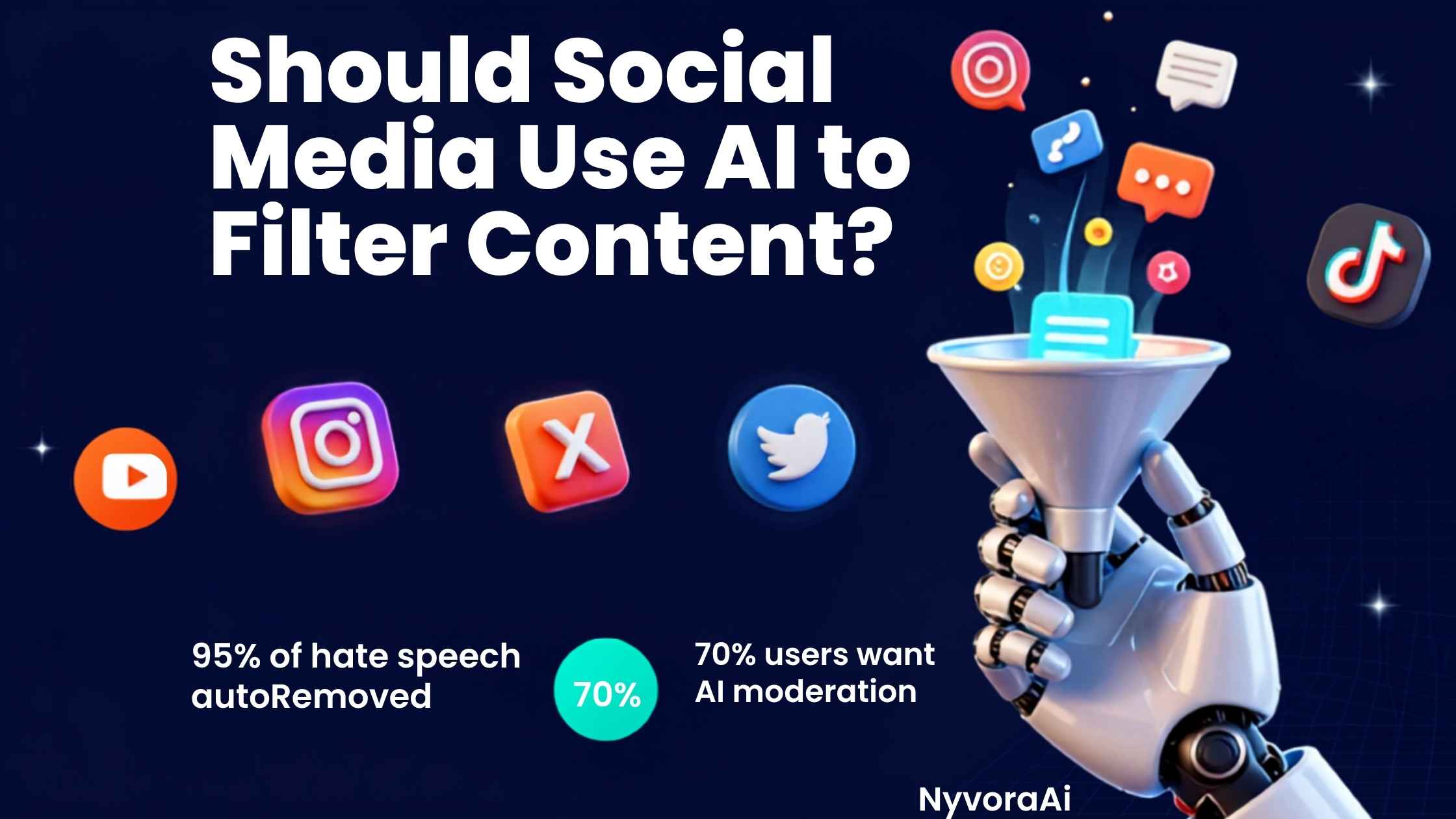
This is the impossible job that social media platforms have quietly handed over to Artificial Intelligence. As the volume of user-generated content scales beyond human comprehension, the debate over should social media use AI to filter content has moved from niche tech ethics forums to the center of global democratic discourse. Are we building a safer internet, or are we automating censorship?
Let’s rip open the black box and look at the mechanics, the failures, and the future of algorithmic gatekeeping.
- Scale Demands Automation: Humans physically cannot review the billions of posts generated daily. AI is a mathematical necessity.
- Context is the Achilles Heel: AI struggles massively with sarcasm, reclaimed slurs, and educational discussions about violence.
- The Shadowban Effect: Algorithms silently suppress content to protect advertiser revenue, often silencing political dissent.
- Human PTSD: AI acts as a crucial shield, protecting human moderators from the psychological trauma of viewing the internet's darkest corners.
- The Solution: We need transparent, user-adjustable moderation sliders, not opaque corporate black boxes.
01The Firehose Problem: Why Humans Can't Do It
To understand why AI moderation exists, you have to respect the sheer, terrifying scale of the modern internet. YouTube users upload over 500 hours of video every single minute. Twitter (X) sees hundreds of millions of tweets daily. TikTok processes an unfathomable stream of short-form video.
If a platform relied solely on human moderators, the backlog would be infinite. Harmful content—like live-streamed violence, child exploitation material, or coordinated terrorist recruitment—would remain visible for days, causing irreparable real-world damage before a human ever flagged it.
In this context, AI isn't just a convenience; it's a digital triage nurse. It uses computer vision to detect gore, natural language processing to flag hate speech, and pattern recognition to identify bot networks. As we debate how platforms manage this firehose of data, we also have to ask if the very way we find this content is changing, and if we are heading toward a world where traditional search is dead, or if we should ask will AI make search engines obsolete. The same algorithms deciding what you see in your feed are fundamentally altering how humanity discovers information.
02The Case for AI: Speed, Scale, and Shielding
The strongest argument for AI moderation isn't about censorship; it's about human psychology. In the early days of social media, platforms relied heavily on human trust and safety teams. These were people paid to scroll through the absolute worst of human behavior.
They reviewed beheadings, animal abuse, and relentless harassment. The result? An epidemic of PTSD among tech workers. Studies showed that human moderators suffered from psychological trauma comparable to first responders at disaster zones.
AI steps in as a vital shield. By filtering out the most egregious, undeniable violations at the edge—before a human ever has to look at them—AI protects the mental health of the remaining human workforce. It allows humans to focus only on the nuanced, borderline cases that require empathy and context.
03The Context Trap: Where the Machine Fails
If AI is so great at scale, why do users constantly complain about being unfairly banned? Because AI lacks a soul. It lacks lived experience. It doesn't understand the difference between a threat and a joke.
Consider the word "kill." If a gamer says, "I'm going to kill that boss in Elden Ring," the AI might flag it as violent. If a marginalized community reclaims a historical slur to strip it of its power, the AI might flag it as hate speech. If a historian posts archival photos of a war to educate the public, the AI's computer vision might flag it as gratuitous gore.
This is the "Context Trap." Language and culture are fluid, messy, and deeply tied to human nuance. When a user posts a highly persuasive, emotionally manipulative political rant, we now have to wonder if a human actually wrote it, or if we need to start asking should you tell people when you use AI to write. If the internet is flooded with synthetic, AI-generated outrage designed to trigger the moderation bots, the entire ecosystem of trust collapses.
The "Nazi" Paradox
For years, AI moderation tools struggled with historical discussions. If a user posted about the history of WWII and included the word "Nazi" in an educational context, older keyword-matching AI would instantly ban the user for hate speech. It took years of fine-tuning to teach the machine the difference between promoting an ideology and documenting a tragedy.
04The Shadowbanning Nightmare & Algorithmic Bias
The most insidious form of AI filtering isn't the outright ban; it's the "shadowban." This is when an algorithm silently reduces the reach of your content without notifying you. You post a photo, but it doesn't appear in the hashtag feed. You write a political opinion, but it's buried at the bottom of your followers' timelines.
Why does this happen? Often, it's not because of a legal violation. It's because the AI has been tuned to protect "brand safety." Advertisers don't want their products shown next to controversial political debates, discussions about mental health crises, or protests. So, the AI quietly categorizes these topics as "low quality" or "borderline" and suppresses them.
The algorithmic bias seen in content moderation mirrors the exact same systemic issues we see when we ask is AI in hiring fair to job seekers. Both systems rely on historical data and corporate optimization metrics that often inadvertently penalize marginalized voices, non-standard dialects, and dissenting opinions. When the algorithm is the editor, the publisher, and the censor, who do you appeal to?
"AI moderation is perfectly objective and treats every user exactly the same."
AI moderation is only as objective as the data it was trained on and the corporate policies it was instructed to enforce. It inherently reflects the biases, cultural blind spots, and financial priorities of the company that built it.
05The Deepfake Arms Race & The Epistemic Crisis
We are entering an era where the content being filtered is no longer just human. It's synthetic. AI-generated deepfakes, automated bot swarms, and LLM-generated misinformation campaigns are designed specifically to bypass traditional moderation filters.
Platforms are now forced to use AI to catch AI. It’s a digital arms race. The generative models create a hyper-realistic fake video of a politician committing a crime; the moderation AI scans it, flags the pixel anomalies, and buries it. But by the time the AI makes that decision, the video has already been screenshotted, shared on encrypted messaging apps, and believed by millions.
The psychological toll of the internet is real, and the isolation caused by these algorithmic echo chambers affects our collective mental health, leading to deep philosophical questions about digital connection, much like the debate over will AI ever replace human therapists. When our social interactions are mediated by machines designed to maximize engagement or minimize liability, we lose the messy, empathetic friction of real human community.
06Designing a Better Filter: Transparency & User Control
So, how do we fix this? We can't go back to human-only moderation. The scale is simply too vast. But we also can't accept a world where a proprietary black box dictates the boundaries of free expression.
The future of social media filtering must be built on three pillars:
Radical Transparency
If an AI removes or suppresses your content, you must be told exactly why. "Violation of community standards" is not enough. The system must cite the specific clause, the exact timestamp, and provide a clear, frictionless path to human appeal.
User-Adjustable Sliders
Instead of a one-size-fits-all feed dictated by corporate advertisers, platforms should give users the dial. Want a feed with zero unmoderated content? Turn the slider to "Safe." Want to see raw, unfiltered global discourse for research purposes? Turn it to "Open." Let the user decide their own risk tolerance.
Decentralized Auditing
If moderation AI is proprietary and closed off, we face the same transparency issues found in the debate over is open source AI dangerous. Without public, third-party auditing of how these models are trained and what biases they hold, we have to blindly trust the corporation's black box.
07The Ultimate Firewall: Digital Literacy
Ultimately, no algorithm can perfectly protect society from bad ideas. The only true firewall is an educated, critical public.
To survive this, the next generation needs to understand how these feeds manipulate their attention, which is exactly why we must advocate for should children learn AI skills in school. If a child understands how an algorithm prioritizes outrage to keep them scrolling, they become immune to the manipulation. If they understand how AI generates text and images, they won't fall for the next wave of deepfake propaganda.
Governments are struggling to keep up with the pace of algorithmic evolution, forcing us to confront the urgent question: is AI moving too fast for regulators? By the time a law is passed regarding "algorithmic transparency," the underlying code has already evolved into a new, unrecognizable architecture. We cannot rely on legislation alone to save us; we must rely on digital literacy.
08The Final Verdict: The Bouncer Needs a Conscience
Should social media use AI to filter content? Yes. They have no other choice if they want the platforms to function at a global scale without collapsing under the weight of illegal and harmful material.
But how they use it is where the battle lies. We must reject the model where AI is used as a secretive, corporate shield to maximize ad revenue and minimize PR scandals. We must demand systems that are transparent, appealable, and respectful of the messy, nuanced reality of human expression.
The integration of AI into our social feeds is just one symptom of a much larger shift, making many wonder if is AI the biggest invention since the internet. It is rewriting the social contract of the digital age. The machines are learning to read our posts, but it’s up to us to teach them the value of our voices.