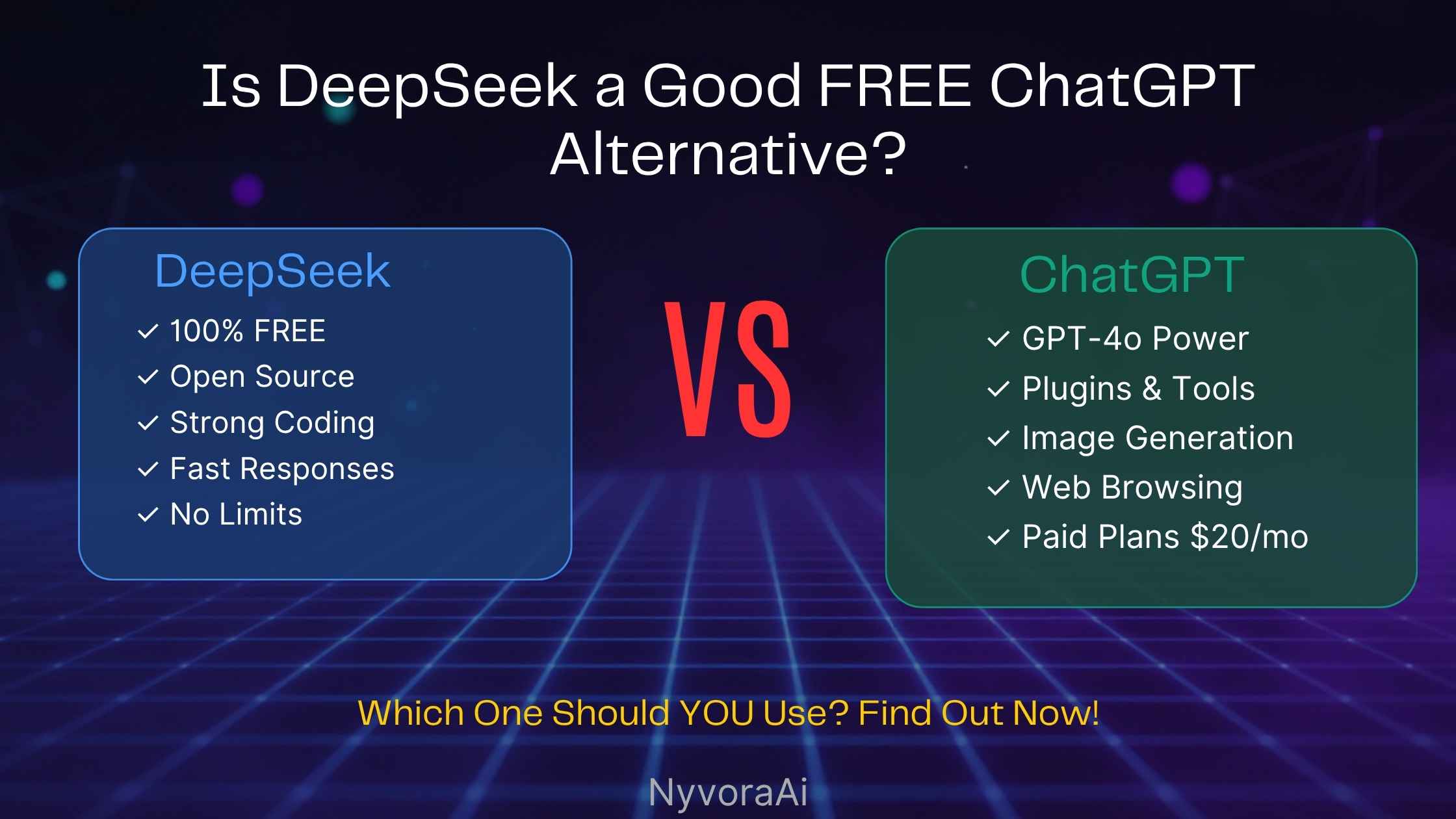
If you’ve spent any time on tech Twitter or Reddit over the last few months, you’ve probably seen the name "DeepSeek" floating around. It started as a whisper among hardcore AI researchers, quickly turned into a viral sensation, and eventually caused a minor panic in the stock market. Suddenly, everyone was asking the same question: Is DeepSeek a good free ChatGPT alternative?
On paper, the pitch is irresistible. You get frontier-level intelligence, massive context windows, and top-tier coding abilities without paying OpenAI a single cent. But as anyone who has used free software knows, there is always a catch. Sometimes the catch is a paywall hiding behind a "generate" button. Sometimes it's a severe lack of privacy. And sometimes, the tool just breaks when too many people try to use it at once.
I’ve spent the last three weeks using DeepSeek as my primary daily driver. I’ve used it to debug messy Python scripts, draft newsletters, brainstorm marketing angles, and solve complex logic puzzles. I’ve pitted it directly against GPT-4o and Claude to see where it wins, where it fails, and whether you should actually cancel your current AI subscriptions. Let's break it all down.
- DeepSeek V3 is an absolute beast for coding, mathematics, and structured data extraction.
- DeepSeek R1 offers a fascinating "chain of thought" reasoning process that rivals OpenAI's o1 model, entirely for free.
- The Catch: Server congestion during peak hours can make the free web interface frustratingly slow or temporarily unavailable.
- The Privacy Warning: Because it is hosted on Chinese servers, enterprise users and those handling sensitive data should avoid the public web interface.
- Bottom Line: It is the best free text/code model on the market, but it lacks the polished multimodal ecosystem of ChatGPT.
01The Origin Story: What Exactly is DeepSeek?
Before we judge the chatbot, we need to understand the engine running under the hood. DeepSeek isn't a scrappy startup operating out of a San Francisco garage. It is an AI research lab backed by High-Flyer, a massive Chinese quantitative hedge fund. This backing gave them something most AI startups lack: virtually unlimited capital and a deep obsession with computational efficiency.
While Western tech giants were burning billions of dollars buying up every Nvidia H100 GPU they could find, DeepSeek took a different route. They focused on architectural innovation. They pioneered techniques like Mixture of Experts (MoE) and Multi-head Latent Attention (MLA). In plain English? They figured out how to make a massive, incredibly smart AI model run on a fraction of the hardware and electricity that Meta or OpenAI requires.
The $5.5 Million Shockwave
When DeepSeek released the technical report for their V3 model, the AI industry was stunned. They estimated the total training cost for the massive model was around $5.5 million. To put that in perspective, training GPT-4 or Llama 3 is estimated to have cost well over $100 million. This efficiency is exactly why they can afford to give it away for free.
Furthermore, unlike OpenAI or Anthropic, DeepSeek releases its models with "open weights." This means the actual mathematical brain of the AI is available for anyone to download, inspect, and run locally. This transparency has made them a darling of the open-source community, but it also sets the stage for a very complicated geopolitical debate, which we will get to later.
02The Free Tier Reality: What Do You Actually Get?
If you go to ChatGPT's free tier today, you are heavily restricted. You get a limited number of messages on GPT-4o before you are downgraded to the older, dumber GPT-3.5 model. You can't use the advanced data analysis tools, and you can't generate images without hitting a paywall.
DeepSeek’s web interface takes a radically different approach. Currently, they offer their absolute top-tier models (DeepSeek V3 and DeepSeek R1) completely free to anyone who creates an account with a phone number. There are no hidden "pro" models locked behind a $20 subscription. What you see is what you get.
However, "free" comes with a physical limitation: server capacity. Because the models are so powerful and the service is free, DeepSeek frequently suffers from massive traffic spikes. During peak hours in the US and Europe, you might encounter the dreaded "Server Busy" error, or watch the text generate at an agonizingly slow crawl. If you are in the middle of a complex coding flow state and the server times out, it can be incredibly frustrating. This is the primary trade-off you make when you refuse to pay.
03Head-to-Head Testing: DeepSeek vs. The Giants
To see if it's a viable alternative, I ran DeepSeek through a gauntlet of real-world tasks and compared the output directly to GPT-4o and Claude Sonnet.
1. Everyday Writing and Brainstorming
I asked all three models to write a persuasive email to a vendor negotiating a contract renewal. ChatGPT produced a very standard, slightly overly enthusiastic corporate email. Claude, as usual, nailed the nuanced, empathetic tone. If you are looking for deep emotional resonance in your prose, you should definitely check out my breakdown of is Claude Sonnet 5 good for everyday writing, because it remains the king of human-like tone.
DeepSeek’s email was... fine. It was logically sound, grammatically perfect, and hit all the negotiation points. But it felt a bit rigid. It reads like a highly competent non-native speaker translating a business textbook. It lacks the idiomatic flair and conversational warmth of its Western counterparts. For quick drafts, it’s great. For final client-facing copy, you will need to edit it heavily.
2. Coding and Technical Reasoning
This is where DeepSeek absolutely flexes its muscles. I fed it a messy, undocumented React component with a hidden state-management bug that had been driving me crazy. GPT-4o suggested a few generic refactors that didn't fix the core issue. DeepSeek V3 immediately spotted the asynchronous race condition, explained exactly why it was happening, and provided a corrected code block using modern React hooks.
For developers, DeepSeek is arguably better than the free tier of ChatGPT. It understands complex system architecture, writes clean Python, and is exceptionally good at SQL and data manipulation. If you are trying to automate your workflow, pairing DeepSeek's coding logic with the best AI tool for Excel and data workflows can turn you into a one-person analytics department.
3. Multimodal Capabilities (Vision and Media)
Here, ChatGPT wins easily. ChatGPT allows you to upload images, analyze charts, and generate DALL-E images natively in the chat. DeepSeek's web interface is primarily text and code focused. While the underlying models have vision capabilities, the user experience for uploading and iterating on images is clunky compared to OpenAI's polished UI.
If your work involves heavy multimedia generation, DeepSeek won't replace your current stack. You will still need dedicated tools. For instance, if you need to generate B-roll for a presentation, you'll still be asking is Runway AI good for video creation. And if you need a talking head avatar for a training module, you'll still be looking into is Synthesia AI good for making videos. DeepSeek is a brain, not a media studio.
04The Magic of R1: Watching the AI Think
The feature that truly broke the internet was the release of DeepSeek-R1. This is a "reasoning" model, similar to OpenAI's o1. Instead of just spitting out an answer immediately, R1 pauses and generates a "Chain of Thought."
When you ask it a complex math problem or a riddle, a secondary text box opens up. You literally watch the AI brainstorm, test hypotheses, realize it made a mistake, backtrack, and correct its own logic in real-time before giving you the final answer. It is fascinating to watch. More importantly, it drastically reduces hallucinations on logic-heavy tasks. If you ask it to plan a 5-day travel itinerary with strict budget and distance constraints, R1 will map out the logistics step-by-step, ensuring the itinerary actually makes geographical sense.
Having this level of deliberate reasoning available for free is unprecedented. It forces the big tech companies to justify their premium pricing models, and it gives students and researchers a incredibly powerful tool for tackling STEM problems without paying a dime.
05The Privacy Elephant in the Room
We have to talk about the elephant in the room: Geopolitics and Data Privacy.
DeepSeek is a Chinese company, and its public web servers are located in China. When you type a prompt into their website, that data is processed on Chinese infrastructure and is subject to Chinese data laws. For a casual user asking for a brownie recipe or a Python script, this doesn't matter. But for enterprise users, government contractors, or anyone handling proprietary business logic, this is a massive red flag.
"DeepSeek is secretly stealing all my data to train their next model and spy on Western companies."
DeepSeek's privacy policy states they do not use API data for training, but the web interface terms are broader. The real issue isn't necessarily malicious corporate espionage; it's legal jurisdiction. Because the servers are in China, the Chinese government technically has the legal right to request access to server data under national security laws, which violates Western corporate compliance standards like GDPR and SOC2.
Because of this, many IT departments have outright banned the DeepSeek web app on company networks. If you are using it to brainstorm a patentable idea, draft a legal contract, or analyze sensitive HR data, you are taking on significant personal and professional risk. This is exactly why professionals often turn to dedicated, localized tools, like finding the best AI tool for resume building 2026 that guarantees your personal career history isn't being ingested into a foreign training cluster.
06Where DeepSeek Falls Short
It’s not all sunshine and free compute. DeepSeek has some glaring weaknesses that keep it from being a total ChatGPT killer.
- The "Robotic" Prose: As mentioned, its creative and conversational writing can feel sterile. It relies heavily on bullet points and bold text, making everything read like a high school textbook. You will almost always need to run its outputs through a polisher. Finding what is the best AI grammar checker in 2026 is essential if you plan to publish anything DeepSeek writes.
- Lack of Native Plugins: ChatGPT has a mature ecosystem of plugins, web browsing, and code execution environments built seamlessly into the chat. DeepSeek's web UI is much more bare-bones. It can search the web, but the integration feels bolted on rather than native.
- Censorship and Guardrails: DeepSeek has strict, hardcoded guardrails regarding Chinese politics, history, and certain geopolitical topics. If your prompt touches on these sensitive areas, the model will simply refuse to answer or pivot to a heavily sanitized, state-approved talking point. It lacks the nuanced, open-ended debate capabilities of Western models on these specific subjects.
- Memory and Personalization: ChatGPT's "Memory" feature, which remembers your preferences, coding style, and personal details across sessions, is highly refined. DeepSeek's memory implementation is currently rudimentary and often forgets context in long, multi-day threads.
07The Ultimate Hack: Running It Locally
Here is the secret that power users know: You don't actually have to use the DeepSeek website. Because the models are open-weight, you can bypass the server queues, the censorship, and the privacy concerns entirely.
Download a Local Runner
Tools like Ollama, LM Studio, or Jan allow you to run LLMs directly on your laptop or desktop. They provide a clean, ChatGPT-like interface but everything happens offline on your own hard drive.
Pull the Distilled Models
DeepSeek has released "distilled" versions of their R1 reasoning model. These are smaller, optimized versions (like 7B, 14B, or 32B parameters) that can run on consumer hardware, including Apple Silicon Macs and PCs with decent Nvidia graphics cards.
Enjoy Total Privacy
Once the model is downloaded, you can disconnect your Wi-Fi and keep chatting. Your proprietary code, your personal journals, and your business strategies never leave your physical machine. It is the ultimate secure AI setup.
This local capability is DeepSeek's true superpower. It has democratized access to frontier-level reasoning, allowing students in developing nations, indie developers, and privacy-focused researchers to access state-of-the-art AI without relying on Silicon Valley subscriptions or foreign servers.
08The Final Verdict: Should You Switch?
So, is DeepSeek a good free ChatGPT alternative? The answer depends entirely on what you value most in an AI assistant.
Yes, switch to DeepSeek if: You are a developer, a data analyst, or a student who needs heavy logical reasoning, math, and coding assistance. If you are tired of hitting the GPT-4o message cap on the free tier and want access to a "smart" model without paying $20 a month, DeepSeek V3 and R1 are absolute game-changers. Furthermore, if you have a powerful computer and want to run a private, uncensored AI locally, DeepSeek is the undisputed king of the open-weight hill.
No, stick with ChatGPT or Claude if: You are a writer, a marketer, or a creative who needs nuanced, emotionally intelligent prose. If your workflow relies heavily on uploading images, generating native graphics, or using advanced data analysis plugins, ChatGPT's polished ecosystem is still worth the monthly fee. Furthermore, if you work in a corporate environment with strict data compliance rules, the DeepSeek web interface is a non-starter due to its server locations.
DeepSeek hasn't killed ChatGPT, but it has fundamentally broken the pricing monopoly of the AI industry. It proved that you don't need to spend a billion dollars to build a genius-level brain. The future of AI isn't just about who has the biggest servers; it's about who has the smartest architecture. And right now, the underdog from the East is holding all the cards.