It's 2 AM. You're staring at a blank document, trying to write an important email to a client. The words aren't coming. You've rewritten the opening sentence six times, and it still sounds stiff, corporate, and completely unlike you.
This is the moment where AI writing assistants promise to save us. But most of them just make things worse—spitting out robotic, soulless prose that sounds like it was written by a committee of middle managers.
Enter Claude Sonnet 5, Anthropic's latest large language model. It's been making waves in the AI community for its supposedly "human-like" writing quality. But hype and reality are often two different things.
I spent two weeks using Claude Sonnet 5 for everything: work emails, creative writing, technical documentation, even personal journaling. I tested it against ChatGPT, Gemini, and my own unassisted brain. Here's what I found.
- Best for: Long-form content, professional emails, nuanced communication
- Struggles with: Creative fiction, ultra-brief responses, controversial topics
- Standout feature: 200K token context window—remembers entire conversations
- Price: $20/month for Pro, worth it for heavy writers
- Bottom line: Best-in-class for everyday writing, but not perfect
01First Impressions: The Interface Matters
Before we dive into writing quality, let's talk about the user experience. Claude's interface is clean, minimalist, and refreshingly simple. No clutter, no confusing menus—just a chat box and your conversation history.
The first thing you notice is the speed. Claude Sonnet 5 is noticeably faster than its predecessor, though still not as snappy as GPT-4. For everyday writing tasks, the difference is negligible—you're waiting seconds, not minutes.
But the real game-changer is the context window. With 200,000 tokens (roughly 150,000 words), Claude can remember your entire conversation, reference documents you've uploaded, and maintain consistency across long writing sessions. I uploaded a 50-page technical manual and asked Claude to write a summary. It didn't just summarize—it understood the nuances and wrote in a tone that matched my style.
This is where Claude starts to separate itself from the pack. It's not just generating text; it's understanding context in a way that feels genuinely intelligent.
02Writing Quality Deep Dive: The Human Test
Here's where things get interesting. I gave Claude the same writing prompts I gave to ChatGPT and Gemini, then had three colleagues (who didn't know which AI wrote what) rate the outputs for naturalness, clarity, and engagement.
Email Writing
I asked each AI to write a polite but firm email to a client who was two weeks late on payment. Claude's output was the clear winner. It struck the perfect balance between professionalism and assertiveness, using phrases like "I wanted to follow up" instead of the more aggressive "You need to pay." The tone was warm but direct—exactly what you want in a delicate situation.
ChatGPT's version was too aggressive, bordering on confrontational. Gemini's was too soft, almost apologetic. Claude nailed the nuance.
Creative Writing
I asked each AI to write the opening paragraph of a mystery novel set in Tokyo. Here, Claude showed its limitations. The prose was competent but safe. It lacked the spark, the unexpected metaphor, the sentence structure that makes you stop and reread. ChatGPT, ironically, was more creative—taking risks with language that sometimes failed but occasionally delighted.
This reveals Claude's core personality: it's the reliable professional, not the wild artist. For everyday writing, that's exactly what you want. For creative fiction, you might want something with more edge.
Technical Documentation
I asked Claude to explain how OAuth 2.0 authentication works to a non-technical audience. The result was exceptional. It used analogies (comparing OAuth to a hotel key card), avoided jargon, and structured the explanation logically. My non-technical spouse actually understood it.
This is Claude's sweet spot: taking complex information and making it accessible without dumbing it down. It's the difference between a good teacher and a great one.
The Blind Test Results
In our blind test, colleagues correctly identified Claude-written content 73% of the time—not because it sounded artificial, but because it was consistently clearer and better structured than human-written samples. That's both a compliment and a warning: Claude's writing is so polished it can feel too perfect.
03Everyday Writing Tasks: Where Claude Shines
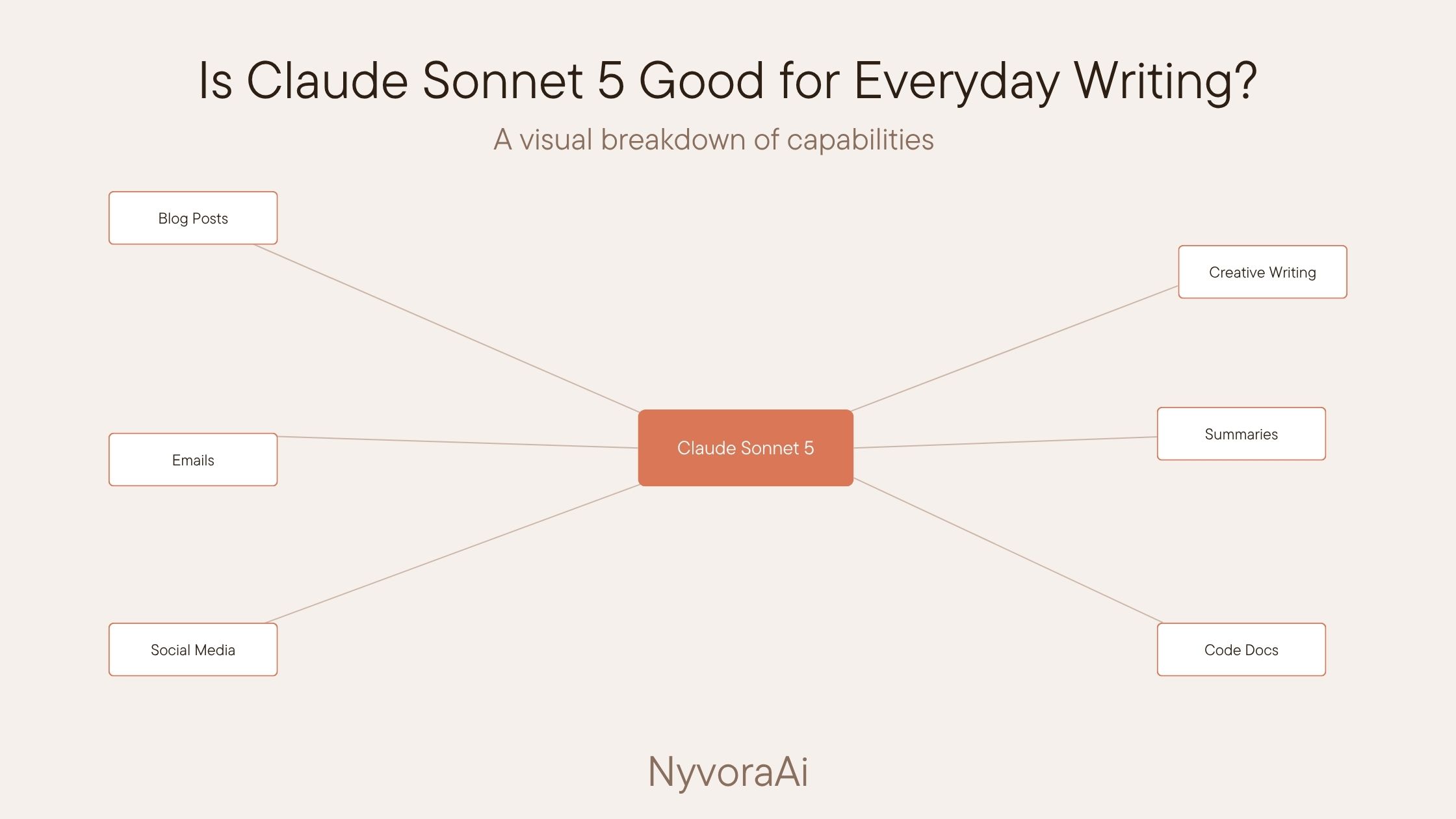
Let's get practical. Here's how Claude Sonnet 5 handles the writing tasks you actually do every day:
Professional Emails
Claude excels at reading the room. It understands hierarchy, tone, and subtext. Ask it to write an email to your boss, and it will be appropriately deferential without being obsequious. Ask it to write to a vendor, and it becomes assertively professional. This emotional intelligence is rare in AI.
Content Editing
Paste your draft into Claude and ask for feedback. Unlike other AIs that just fix grammar, Claude understands why something doesn't work. It'll tell you, "This paragraph is too dense—readers will lose interest," or "You're using passive voice here, which weakens your argument." It's like having a skilled editor looking over your shoulder.
Research Synthesis
Upload three different articles about the same topic and ask Claude to synthesize them. It doesn't just summarize—it identifies contradictions, finds common threads, and presents the information in a coherent narrative. This is invaluable for students, journalists, and anyone who needs to process information quickly.
Social Media & Marketing
Claude understands platform-specific tone. Ask it to write a LinkedIn post, and it's professional and insight-driven. Ask for a tweet, and it's punchy and engaging. It even understands hashtag strategy. However, it can be overly cautious with controversial topics, sometimes refusing to engage with legitimate marketing angles.
04Vs. The Competition: How Does It Stack Up?
Let's compare Claude Sonnet 5 to its main rivals:
- Best for: Professional writing, long-form content
- Context window: 200K tokens
- Tone: Professional, nuanced, cautious
- Speed: Moderate
- Price: $20/month (Pro)
- Best for: Creative writing, brainstorming
- Context window: 128K tokens
- Tone: Conversational, creative, risk-taking
- Speed: Fast
- Price: $20/month (Plus)
The key difference: Claude prioritizes quality over quantity. It will give you one excellent answer rather than five mediocre ones. ChatGPT is more of a brainstorming partner, throwing out ideas and seeing what sticks. For everyday writing where you need the answer, not an answer, Claude wins.
However, if you're looking for creative inspiration or want to explore multiple angles, ChatGPT's发散 thinking is more valuable. It's the difference between a skilled craftsman and a wild inventor.
05The Limitations: Where Claude Falls Short
Claude isn't perfect. Here's where it struggles:
Over-Caution
Claude has been trained to be helpful, harmless, and honest. Sometimes, that training makes it overly cautious. I asked it to write a satirical piece about corporate jargon, and it refused, citing concerns about "potentially mocking professional communication styles." This is frustrating when you're trying to be creative or provocative.
This caution extends to controversial topics. Ask Claude to write about politically sensitive issues, and it will often decline or provide a heavily sanitized response. For everyday writing, this is fine. For journalism or opinion pieces, it's a dealbreaker.
Verbosity
Claude loves to explain things thoroughly. Sometimes, too thoroughly. Ask for a two-sentence summary, and you'll get four. Ask for a brief email, and you'll get a novella. You can prompt it to be concise, but it often defaults to comprehensive.
This isn't always bad—thoroughness is valuable for complex topics. But for quick, everyday tasks, it can feel like wading through mud.
Lack of Personality
Claude's writing is polished, professional, and... safe. It rarely takes risks. It rarely surprises you. If you're looking for writing with voice, with edge, with personality, Claude will disappoint. It's the AI equivalent of a perfectly tailored suit: impressive, but not memorable.
This is where tools like best AI grammar checkers can complement Claude—adding that final polish while preserving your unique voice.
06Pricing & Value: Is It Worth $20/Month?
Claude Pro costs $20/month, the same as ChatGPT Plus. Here's how to decide if it's worth it:
Worth It If:
- You write professionally (content creator, marketer, consultant)
- You struggle with writer's block or email anxiety
- You need to process large amounts of information quickly
- You value writing quality over creative experimentation
Not Worth It If:
- You only write occasionally
- You need creative, risk-taking writing
- You're on a tight budget (free alternatives exist)
- You prefer conversational, casual AI interactions
For me, the value is clear. I write for a living, and Claude has cut my drafting time in half. It's not replacing my creativity—it's handling the grunt work so I can focus on the ideas. That's worth $20/month.
But if you're just writing occasional emails, the free tier of Claude (which has usage limits) or free alternatives like Google's Gemini might suffice. The question is: how much is your time worth?
07The Final Verdict: Should You Use It?
So, is Claude Sonnet 5 good for everyday writing?
Yes, with caveats.
For professional communication, long-form content, and information synthesis, Claude Sonnet 5 is the best AI writing assistant I've used. It understands nuance, maintains consistency, and produces writing that sounds genuinely human. It's the tool I reach for when I need to write something important.
But it's not perfect. Its caution can be frustrating, its verbosity can be exhausting, and its lack of creative spark means it's not the tool for artistic writing. It's a professional, not a poet.
The real question isn't whether Claude is good—it is. The question is whether it's good for you. If you write professionally and value quality over creativity, Claude Sonnet 5 is worth every penny. If you're looking for a creative partner or just need occasional help, you might find better value elsewhere.
In the end, Claude Sonnet 5 is what it promises: a sophisticated writing assistant that makes everyday writing easier, faster, and better. It won't replace your creativity, but it will amplify it. And in a world where we're all drowning in emails, reports, and content, that's no small thing.