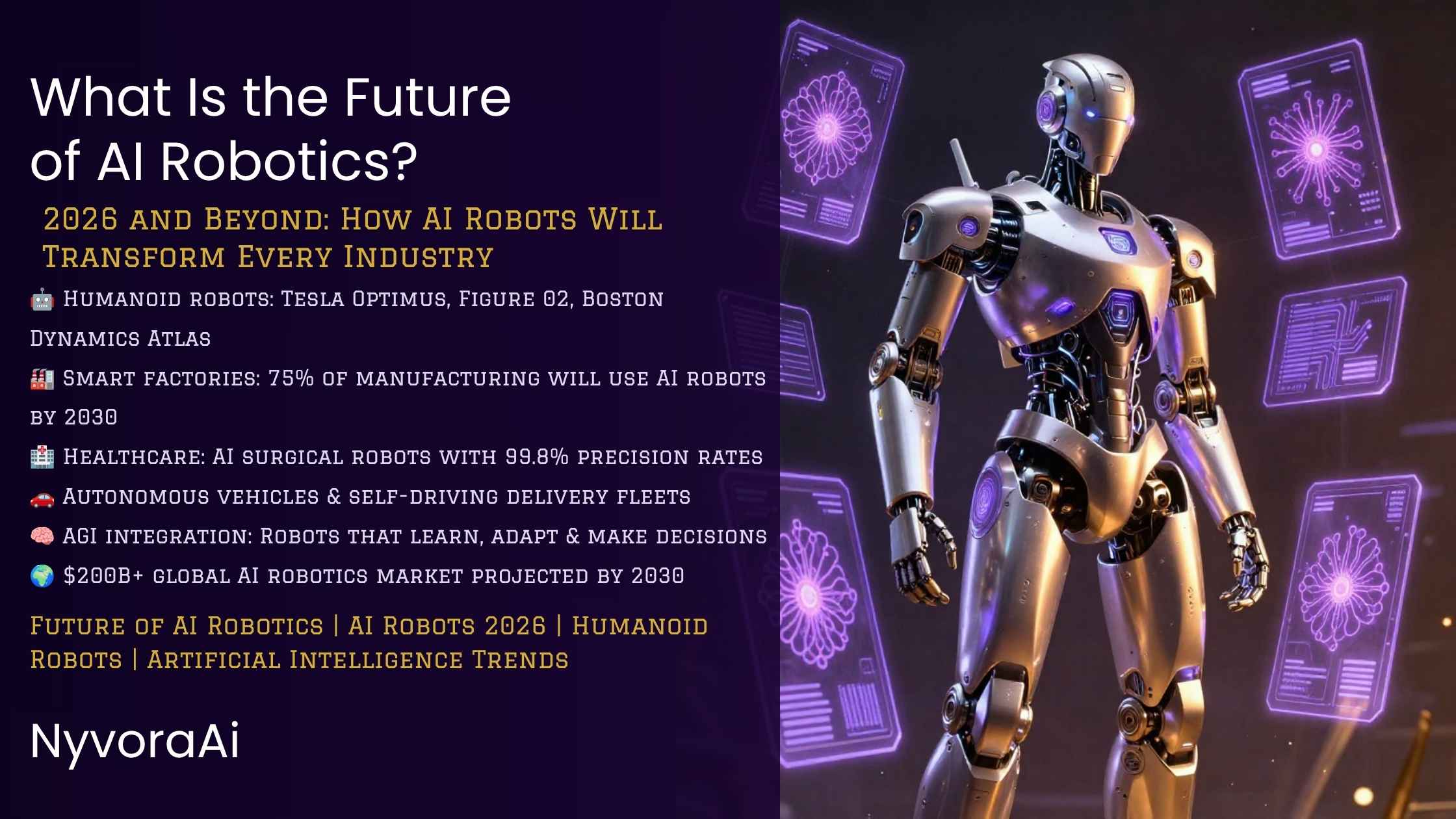
For the last decade, most of the AI story has played out on screens — in our phones, our search bars, our recommendation feeds. It's been a software revolution. But look closely at where the money is actually going right now, and one thing becomes hard to ignore: the next phase of AI is going to have a body.
When people ask, "What is the future of AI robotics?" they're usually picturing faster factory arms or a slightly smarter vacuum. That's part of it, but the bigger story is the emergence of general-purpose, physically embodied intelligence — machines that can perceive a messy, unpredictable physical world, reason about it, and act on it.
By 2030, the line between "using a tool" and "working alongside a machine" is going to blur. In this guide, we'll walk through the realistic predictions for the next five years — from surgical assistance to household humanoids — and the technical hurdles standing in the way. For extra context, the World Economic Forum's robotics coverage and ISO's robotics standards work are both worth a look if you want to go deeper on the policy side.
- Embodied AI: The future is the merger of advanced LLMs (brains) with agile hardware (bodies), creating robots that understand context and physical physics.
- Healthcare: AI robots will move from assisting in surgeries to performing routine procedures autonomously and providing elder care.
- Domestic Life: General-purpose humanoid robots will begin entering homes between 2028 and 2032, handling chores like laundry and cooking.
- Enterprise: Physical automation will merge with digital workflows, creating end-to-end autonomous supply chains.
- The Big Hurdle: Battery density, tactile sensing, and the "Morphy Problem" (manipulating soft objects) remain the biggest bottlenecks.
01 The Great Convergence: When AI Gets a Body
To understand where this is headed, it helps to understand the old limitation. AI and robotics used to be two separate fields. AI was good at processing data, spotting patterns, and generating text. Robotics was good at precise, repetitive movement — and not much else. Ask an industrial arm to adapt to a slightly different part, and it would just fail.
That's changing fast. Multimodal large language models and what researchers call Vision-Language-Action (VLA) models mean a robot can now be given a verbal instruction, "see" its surroundings through cameras, and turn that understanding into motor commands. Google DeepMind's RT-2 research was one of the clearest early demonstrations of this idea in action. If you're still getting your bearings on the basic distinction between the software and the hardware, our guide on what is the difference between AI and a robot is a good place to start.
In practice, this means a robot won't need to be explicitly programmed to pick up a red apple. You'll say "I'm hungry," and it will navigate to the kitchen, identify the apple, grasp it without bruising it, and hand it over. That's the promise of embodied AI — and it's why companies like Figure AI and Boston Dynamics have poured so much R&D into it.
02 The Healthcare Revolution: From Tools to Partners
Healthcare is probably the industry where the future of AI robotics will be felt most directly. Today we already use systems like Intuitive Surgical's da Vinci platform, which is essentially a highly advanced teleoperated tool controlled entirely by a human surgeon's hands.
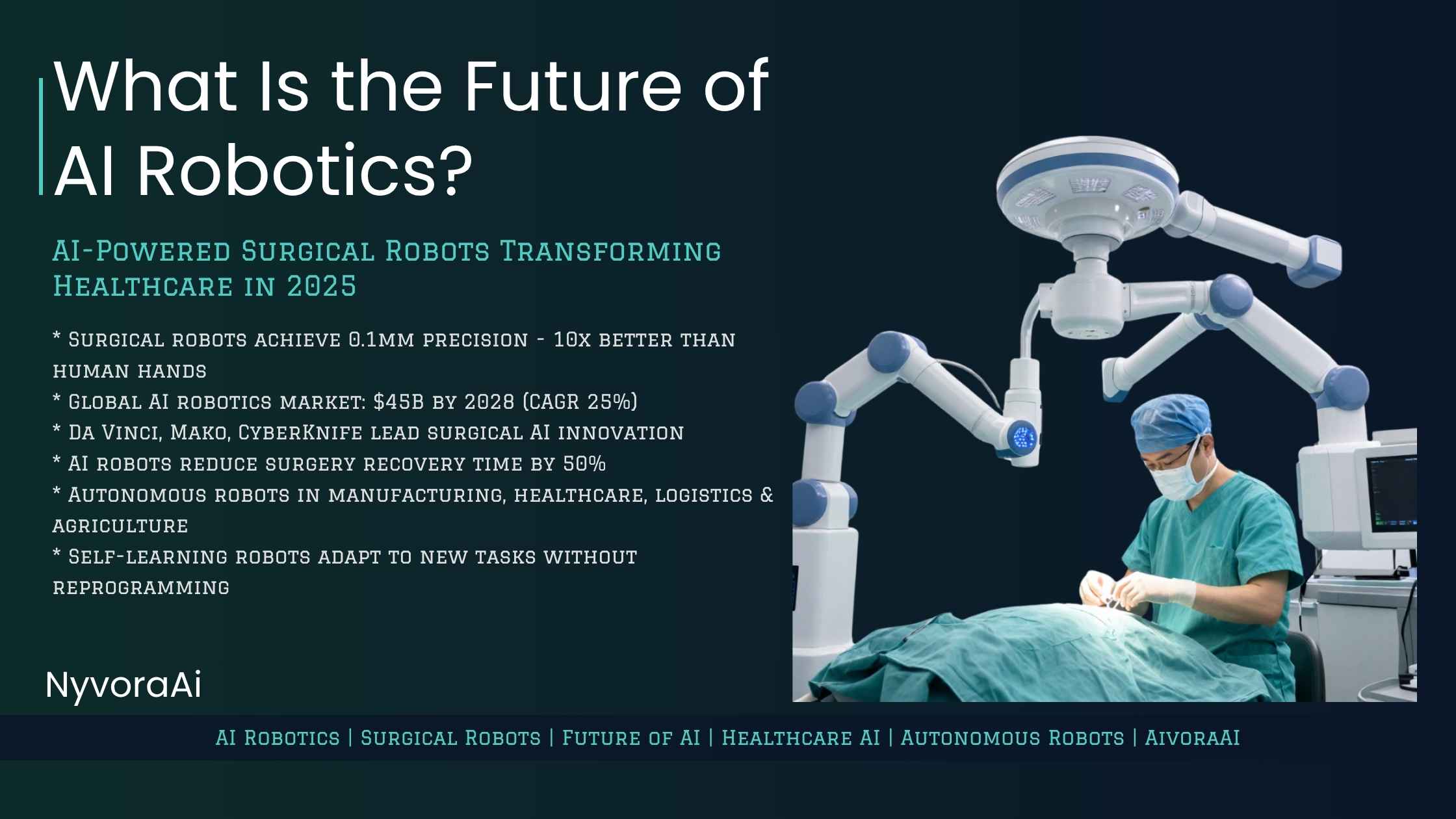
The next step is semi-autonomous, and eventually autonomous, surgical robots. Picture a system that can close a wound with sub-millimeter precision, faster and steadier than any human hand, while an AI monitors vitals and adjusts anesthesia in real time. Researchers at Johns Hopkins have already demonstrated early autonomous soft-tissue surgery with their STAR surgical robot, so this isn't purely speculative. To see how the transition is already starting, check out how are AI robots used in hospitals today.
The Elder Care Boom
Global populations are aging fast, and there simply aren't enough human caregivers to keep up — the World Health Organization projects the number of people aged 60+ will nearly double by 2050. By 2030, expect a real surge in specialized care robots: not just vital-sign monitors, but machines that can physically help someone out of bed, fetch medication, and provide conversational company to ease loneliness. The ethical questions here are significant, but the demographic pressure is real and not going away.
03 The Smart Home: Enter the Humanoid Helper
This is the future most people are actually waiting for: a general-purpose household robot. Right now, if you want clean floors, you buy a Roomba. If you want the lawn mowed, you buy a separate robotic mower. You end up with a house full of single-purpose discs.
The bet several companies are making is that a single humanoid form factor can replace all of them. Our homes are built for human bodies — stairs, door handles, cabinets at human height — so a bipedal robot with human-like hands is arguably the most efficient shape for navigating them. Tesla's Optimus program, Figure AI, and Boston Dynamics are all racing toward some version of this machine.
The real question is affordability. Early prototypes cost hundreds of thousands of dollars, and the stated goal from several manufacturers is to eventually bring that down to roughly the cost of a car. If you want a sense of where pricing actually stands today, we broke it down in how much does an AI robot cost in 2026.
By 2030, the hope is that you'll be able to come home, tell your robot to "tidy the living room and start prepping vegetables for dinner," and it will actually understand and carry out that multi-step request.
04 Enterprise & Logistics: The Autonomous Supply Chain
Humanoid robots get the headlines, but the near-term money in robotics is being made in warehouses and logistics centers. Amazon alone now operates hundreds of thousands of robots across its fulfillment network, and that number keeps climbing.
Businesses already use software to automate digital tasks like data entry and invoicing — if you want the primer on that side of things, read our breakdown of what is Robot Process Automation (RPA). What's changing now is combining that digital RPA with physical robotics.
Picture a supply chain where an AI agent spots a materials shortage from shipping data, places the order, and then directs a fleet of autonomous forklifts and robotic arms to unload, sort, and pack the incoming shipment — all without a person touching a clipboard. This "physical RPA" could meaningfully cut the cost of goods and reshape parts of global trade.
05 The Timeline: What to Expect (2026–2030)
Predicting the pace of technology is always a little risky, but based on current R&D pipelines and where the capital is flowing, here's a reasonable timeline for the next five years:
Humanoid robots stay mostly in controlled factory settings. We see real progress in AI-driven delivery bots, autonomous agricultural harvesters, and more capable robotic surgery assistants. The "Morphy Problem" — robots struggling with soft objects — starts getting chipped away at with better tactile sensors.
Companies like Tesla and Figure begin leasing general-purpose humanoid robots to enterprise customers — warehouses, auto plants. They're clumsy but functional, able to lift boxes and handle repetitive assembly work next to human coworkers.
The first wealthy early adopters buy humanoid robots for their homes. These robots can fold laundry, load dishwashers, and act as mobile home security. They're expensive, need frequent software updates, and still occasionally get stuck on a rug.
Prices for basic humanoid assistants drop below $30,000. AI robotics becomes something closer to a standard utility, the way smartphones are today. Autonomous vehicles and delivery robots are fully woven into city infrastructure, cutting traffic accidents noticeably.
06 The Tech Bottlenecks: What's Holding Us Back?
None of this is a straight line. There are real physical and computational hurdles that engineers are racing to solve before any of the sci-fi version becomes reality.
1. The Battery Density Problem
A human brain runs on roughly 20 watts. A humanoid robot running advanced neural networks, powering 28+ actuators, and processing 3D spatial data in real time needs kilowatts. Current lithium-ion batteries are too heavy and don't hold enough charge for the job. The solid-state battery research the US Department of Energy is backing could be the breakthrough that lets a robot work a full 8-hour shift without a lengthy recharge.
2. The "Morphy Problem"
Robots are good at picking up rigid objects like metal blocks. They're still bad at a crumpled t-shirt, a squishy tomato, or a tangled necklace. The physical world is soft, deformable, and unpredictable, and giving robots real tactile intelligence — the ability to feel and adjust grip pressure on the fly — is one of the last big frontiers in physical AI.
3. Edge Computing vs. Cloud Latency
A robot can't afford to wait 200 milliseconds for a cloud server to tell it how to catch a falling glass. The AI "brain" has to live on the robot itself (edge AI), which means the chips need to be powerful enough to run large models locally without overheating or draining the battery in minutes.
07 The Ethical and Societal Impact
As these robots get more capable, the question shifts from "can we build it" to "should we build it."
- The Labor Shift: The same way the internet destroyed some jobs and created others, AI robotics will automate physical labor. Truck driving, warehouse picking, and basic construction are the most exposed. Society will need to think seriously about retraining programs and possibly new economic models like universal basic income. The McKinsey Global Institute has published detailed research on this labor transition if you want the numbers.
- Safety & Liability: If a humanoid robot breaks a valuable heirloom in your home, or worse, injures someone, who's on the hook? The manufacturer? The software team? The owner? Legal systems aren't remotely ready for this, and regulators are only beginning to catch up.
- Human-Robot Bonding: We're social creatures. If a robot cares for an elderly parent or plays with a child, people will form attachments to it. The psychological impact of treating machines as companions is still a fairly unexplored frontier.
08 Frequently Asked Questions
What is the future of AI robotics?
Will AI robots replace human jobs?
When will we have humanoid robots in our homes?
What are the biggest challenges for the future of robotics?
Are AI robots safe to be around?
How will AI robots change education?

Written by the NyvoraAI Team
We track the bleeding edge of AI and robotics to help you prepare for the future. This guide was updated in June 2026. Want to know more about the physical realities of robots today? Check out if AI robots can do household chores yet, or reach out to our team with your predictions for 2030.