Picture this: You open your IDE. You type a comment: // Build a REST API for user authentication with JWT and rate limiting. You hit a shortcut key. Ten seconds later, 300 lines of perfectly structured, fully tested, and documented code materialize on your screen. It even wrote the Dockerfile.
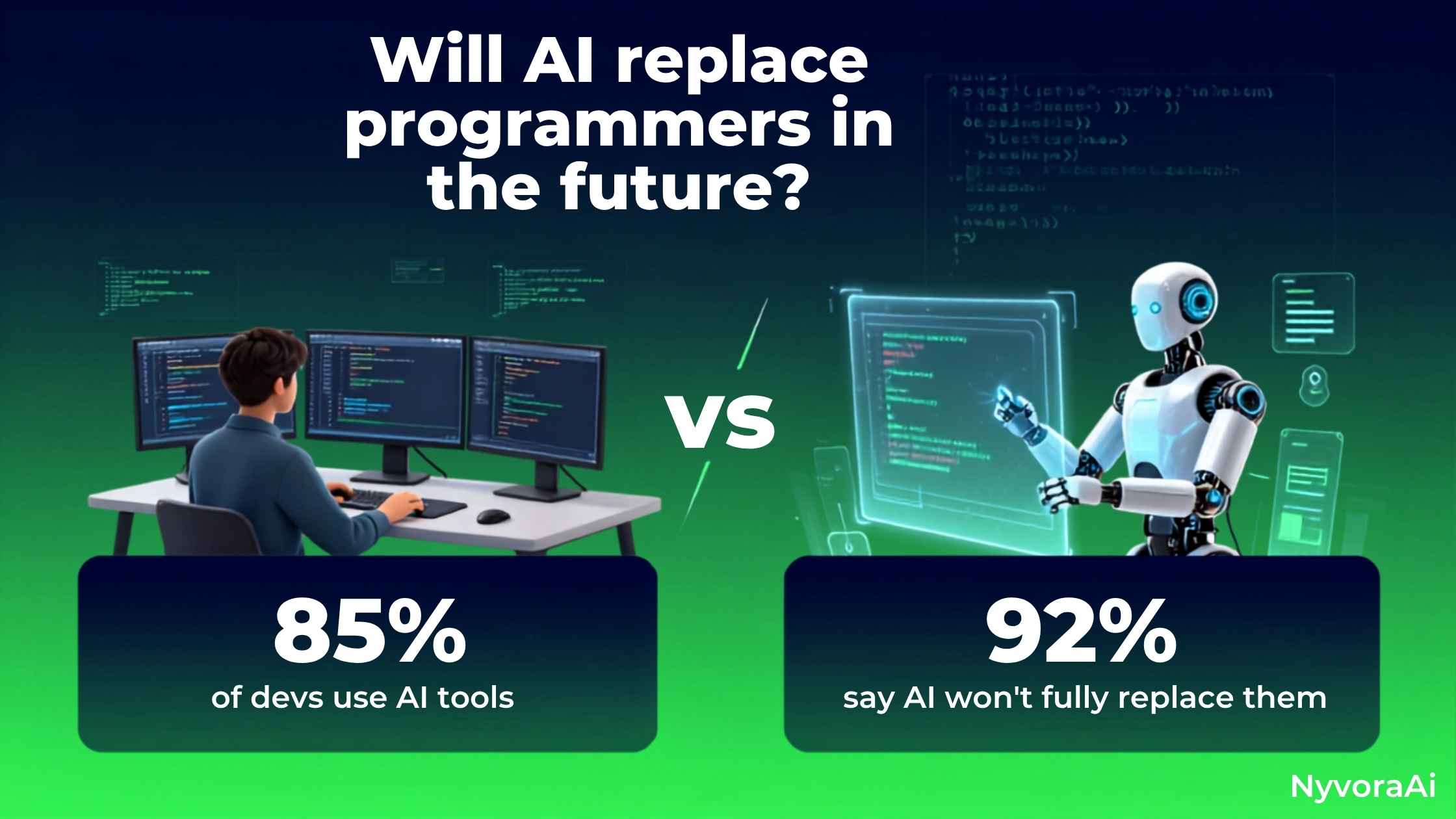
Five years ago, that was science fiction. Today, it’s a Tuesday. Tools like GitHub Copilot, Cursor, and autonomous agents like Devin aren't just suggesting autocomplete anymore; they are actively architecting software. The productivity gains are astronomical. But lurking beneath the hype is a cold, existential dread echoing through Slack channels and Reddit threads worldwide: Will AI replace programmers in the future?
If the machine can write the code, why do we need the human? As a developer who has watched my daily workflow transform from typing syntax to reviewing machine output, I’m here to tell you that the answer is not a simple "yes" or "no." The reality is far more nuanced, far more brutal, and far more exciting. We aren't facing the end of programming. We are facing the end of programming as we know it.
- AI is a multiplier, not a replacement: It handles the "how" (syntax, boilerplate), but humans must define the "what" and "why" (business logic, architecture).
- The Junior Dev crisis is real: Entry-level coding tasks are being automated, raising the barrier to entry for new developers.
- The Jevons Paradox: Cheaper code doesn't mean fewer developers; it means exponentially more software being built.
- The new skill stack: System design, AI auditing, and product empathy are replacing raw syntax memorization.
- The Verdict: AI won't replace programmers. Programmers who use AI will replace programmers who don't.
01The Illusion of the "Empty Prompt"
There is a pervasive myth among non-technical executives that software engineering is just "typing code." If that were true, AI would have put us all out of work in 2024. But anyone who has shipped production software knows the truth: coding is only about 20% of a developer's job.
The other 80% is reading legacy code written by a guy named Dave who quit three years ago. It’s arguing with a product manager about whether a feature actually solves the user's problem. It’s debugging a race condition that only happens on leap years. It’s sitting in a meeting trying to translate vague business requirements into strict technical constraints.
AI is incredibly good at the 20%. Give it a clear, isolated problem, and it will solve it faster than you. But give it a messy, ambiguous, human problem? It hallucinates. It confidently writes a function that does the exact opposite of what you asked. The "Empty Prompt" dream—where a CEO types "build me an Uber clone" and retires to a beach—is a fantasy. Software is a castle of cards built on millions of tiny, interconnected assumptions. AI cannot hold that mental model.
02The Death of the Junior Developer
Here is the darkest part of the AI coding revolution. While senior developers are using AI to become 10x more productive, the traditional "Junior Developer" role is evaporating.
Historically, juniors paid their dues by writing boilerplate, fixing minor UI bugs, and writing unit tests. These were low-risk tasks that taught them the codebase. Today, AI does those tasks instantly. Companies are realizing they don't need to hire three juniors to do the work that one mid-level developer with an AI assistant can do in an hour.
If you are currently trying to break into the industry, this is terrifying. The barrier to entry has shifted from "can you write a sorting algorithm?" to "can you architect a scalable system and audit AI-generated code?" This systemic shift in the labor market is exactly why we must ask is AI in hiring fair to job seekers when algorithms and automated LeetCode tests filter out human potential before a hiring manager ever sees a resume.
"AI will write all the code, so we don't need to teach computer science in schools anymore."
Computer science is more critical than ever. You cannot audit, debug, or secure AI-generated code if you don't deeply understand data structures, memory management, and algorithmic complexity. AI is a junior dev; you still need to be the senior engineer.
03The Jevons Paradox of Code
In the 19th century, economist William Jevons noticed that as steam engines became more efficient and used less coal, the total consumption of coal actually increased. Why? Because the technology became so useful that we found a million new ways to use it.
This is the Jevons Paradox, and it is the saving grace of the software engineering profession. As AI makes coding cheaper and faster, the cost of building software will plummet. What happens when software is cheap? We build a lot more of it.
Every small business, every local charity, every niche hobby will suddenly be able to afford custom software. The demand for software will explode, far outpacing the efficiency gains of AI. We won't need fewer programmers; we will need programmers to manage the explosion of micro-SaaS, internal tools, and automated workflows. The pie isn't shrinking; it's getting infinitely larger.
This shift in how we discover and build solutions is changing the internet itself. We used to spend hours digging through forums to find answers. Now, we just ask an LLM. This shift is so profound that it forces us to ask: will AI make search engines obsolete entirely, replacing the traditional "search and copy-paste" workflow with direct, synthesized code generation?
04Where AI Hits a Brick Wall
To understand the future, we must respect the limitations of the machine. AI operates on probability, not comprehension. It doesn't know why a database schema is designed a certain way; it only knows that in its training data, those tokens usually appear together.
1. The Context Window Trap
Enterprise codebases are massive. They are millions of lines of code, spanning decades, filled with undocumented quirks and "temporary" hacks that became permanent. AI models have context limits. They cannot hold the entire architecture of a legacy banking system in their "head" at once. They will suggest a refactor that breaks a critical, undocumented dependency in a module they can't see.
2. The Empathy Deficit
Software is ultimately built for humans. Understanding user frustration, navigating office politics to get API access from another team, and designing an intuitive UI requires deep emotional intelligence. An AI doesn't understand user pain. This is the same reason we debate will AI ever replace human therapists—empathy, lived experience, and the ability to read between the lines are irreplaceable human traits.
3. The "Last Mile" Problem
AI can get you 80% of the way there in seconds. But that last 20%—integrating with a bizarre proprietary API, handling edge-case security compliance, optimizing for a specific hardware constraint—takes 80% of the time. AI is terrible at the last mile. It gives up, hallucinates, or writes insecure workarounds.
05From Code Monkey to AI Orchestrator
The title "Software Engineer" is evolving into something closer to "AI Orchestrator" or "Systems Architect." The developers who will thrive in 2026 and beyond are not the ones who memorized the React documentation. They are the ones who treat AI as a team of infinite, slightly hallucinating interns.
Prompt Engineering as Architecture
Writing a good prompt for an AI agent requires the same logical rigor as writing a good function. You must define the inputs, the constraints, the expected outputs, and the edge cases. The syntax is English; the logic is computer science.
Ruthless Code Auditing
AI writes code with the confidence of a mediocre senior dev. It will introduce subtle security flaws, memory leaks, and performance bottlenecks. The human role is now primarily "Reviewer." You must read code faster and more critically than ever before.
Gluing the Ecosystem
AI is great at isolated tasks. Humans are great at integration. Connecting the AI-generated microservice to the legacy mainframe, the third-party payment gateway, and the cloud infrastructure requires a holistic view of the system that AI lacks.
This transition can be isolating. When your primary coworker is a chatbot, the collaborative friction of pair programming disappears. Relying entirely on a machine for collaboration can exacerbate the feeling of isolation, making us wonder: are AI chatbots making people more lonely in the modern, remote-first workplace? Maintaining human connection in engineering teams is no longer just a "nice to have"—it's a vital safeguard against groupthink and AI echo chambers.
06The Security & Legal Nightmare
As AI floods GitHub and enterprise repositories with synthetic code, we are opening Pandora's Box of security vulnerabilities. AI models are trained on the open internet, which means they have also ingested millions of lines of insecure, deprecated, and malicious code. They don't know the difference between a best practice and a StackOverflow answer from 2013 that contains a critical SQL injection flaw.
With models like StarCoder and Llama available locally, we must confront the reality: is open source AI dangerous when it comes to embedding silent security vulnerabilities into enterprise codebases? If an AI agent autonomously writes and deploys a smart contract with a logic flaw, who is liable? The developer? The AI company? The user?
When you push code generated by Copilot, do you owe it to your team and your users to declare it? This mirrors the broader cultural debate: should you tell people when you use AI to write? Transparency in codebases is becoming a matter of legal compliance and professional ethics.
Furthermore, as AI-generated spam and malicious scripts flood platforms, we have to ask: should social media use AI to filter content, and by extension, should code repositories use AI to filter malicious synthetic contributions? The legal landscape is a mess, proving that is AI moving too fast for regulators is a question with a resounding "yes."
07How to Future-Proof Your Career
If you want to survive the next decade of software engineering, you need to pivot your skill set immediately. Stop competing with the machine on speed and syntax. You will lose.
- Memorizing framework syntax
- Writing boilerplate CRUD apps
- Basic CSS/HTML layout generation
- Writing simple unit tests
- Translating clear specs to code
- System Architecture & Design
- AI Auditing & Security Review
- Cloud Infrastructure & DevOps
- Product Management & Empathy
- Navigating ambiguous requirements
Learn how to read code faster than you can write it. Understand the deep, foundational concepts of how computers work—memory, networking, concurrency. AI can write a Python script, but it struggles to optimize a distributed database cluster for high-frequency trading. Go deep, not wide.
The "Centaur" Model
In chess, a "Centaur" is a human playing alongside an AI. For years, Centaur teams consistently beat both solo human grandmasters and solo supercomputers. The future of coding is Centaur programming. The human provides the intuition, the strategy, and the context; the AI provides the brute-force calculation and syntax generation.
08The Final Verdict: The Machine Needs a Pilot
Will AI replace programmers in the future? No. But it will replace the idea of what a programmer is.
The era of the "code monkey"—the developer who simply translates tickets into functions without questioning the underlying logic—is over. That work is gone, and it's not coming back. But the era of the "Software Architect," the "Problem Solver," and the "AI Orchestrator" is just beginning.
AI is the most powerful lever humanity has ever created for building digital infrastructure. But a lever is useless without a hand to pull it. The machine can generate a million lines of code a day, but it doesn't know if that code should exist in the first place. It doesn't care if it solves a human problem. It doesn't feel the weight of a security breach.
We are not being replaced. We are being promoted. The syntax is dead. Long live the architecture.