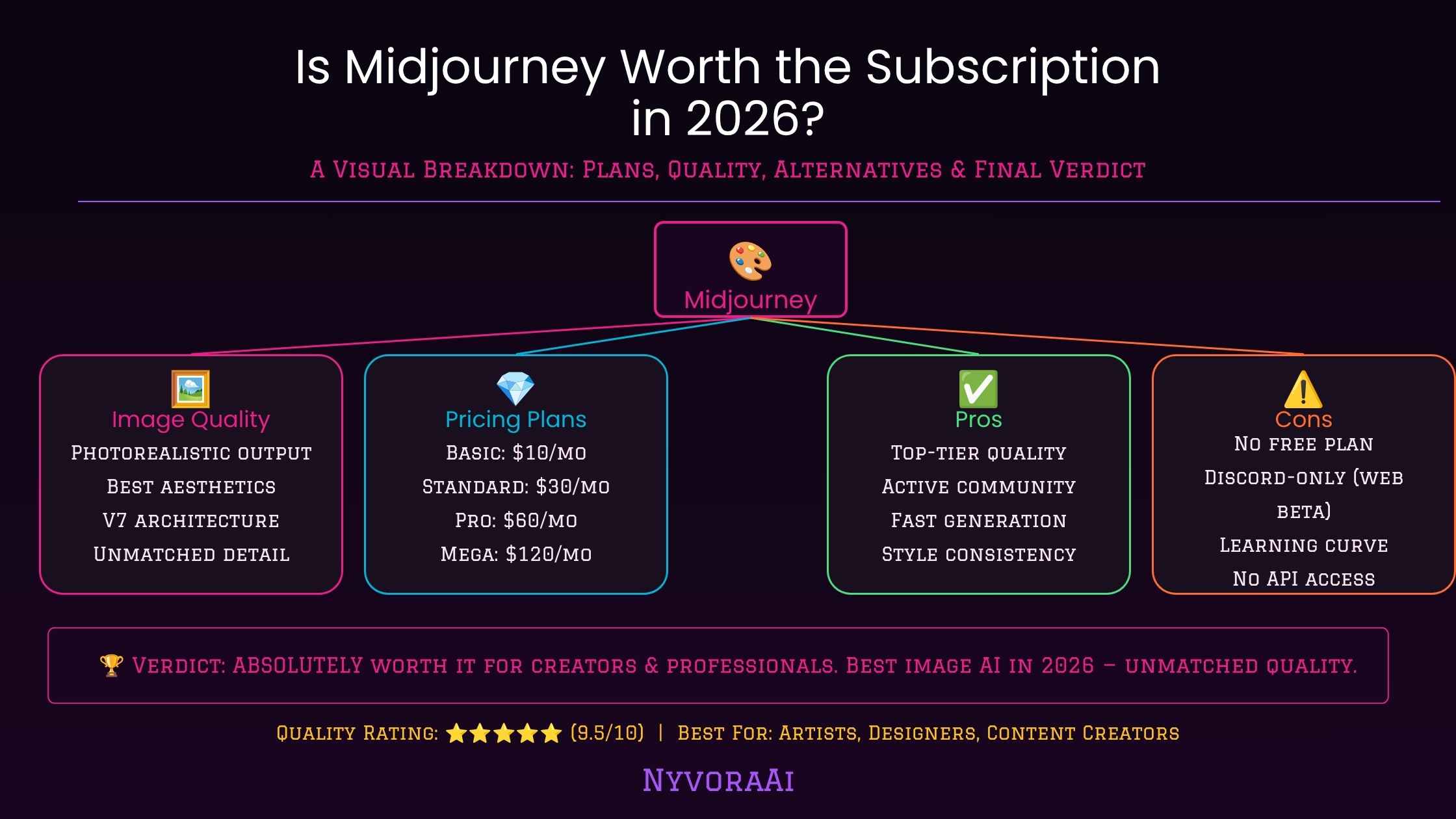
Quick answer, since you probably want it before the details: Midjourney is worth the subscription in 2026 if you regularly need high-quality, artistic images and don't mind a short learning curve. It's not worth it if you generate images occasionally, need a free option, or just need competent, functional visuals without caring much about artistic flair. The rest of this comes down to which one of those you actually are.
This isn't the only AI subscription question worth asking this year either. If you're also weighing writing tools, we've broken down whether Jasper AI is worth buying, and if research tools are part of your stack, our look at whether Perplexity AI is good for research covers that side of the decision.
Midjourney's value depends entirely on how often you'd actually use it and what you're using it for.
- For regular creative or artistic work: The subscription pays for itself quickly through image quality and speed alone.
- For occasional or casual use: Free alternatives like Microsoft Designer or Adobe Firefly's free credits likely cover your needs.
- For commercial client work: Check licensing terms carefully; Adobe Firefly may be the safer default for paid deliverables.
- For budget-conscious power users: Open-source options like FLUX or Stable Diffusion offer a genuinely free, unlimited alternative if you have the hardware or don't mind hosted platforms.
01What's Changed With Midjourney by 2026
Midjourney has quietly kept its lead on artistic image quality for a couple of years now, largely on the strength of its v7 model. The improvements since earlier versions are less about raw photorealism and more about coherence: fewer mangled hands, better understanding of complex, multi-subject scenes, and noticeably more consistent style control across a batch of generations. If you tried Midjourney back in 2023 or 2024 and walked away unimpressed, it's worth knowing that the gap between "decent" and "genuinely impressive" has closed a lot since then.
What hasn't changed is the business model. There's still no free tier, the interface is still built around Discord (with a web app as an alternative that's improved but still feels secondary), and you're still paying a flat monthly or annual fee regardless of how much or how little you actually generate that month. That structure is exactly why the "is it worth it" question is worth asking properly instead of assuming the answer based on hype alone.
02Midjourney's Pricing Plans, Broken Down
Midjourney runs a tiered subscription model, and the right tier depends entirely on how much you generate and whether you need extra features like faster "fast hours," relaxed unlimited generation, or stealth mode for private images.
The cheapest way in, at roughly $10 a month. It gives you a limited number of fast generations per month plus access to general community features. It's enough to try Midjourney properly and cover light, occasional use, but heavier users will burn through the fast-generation allowance quickly.
Priced around $30 a month, this tier adds unlimited relaxed-speed generations on top of a larger fast-generation allowance. For most regular users, this is the sweet spot: enough volume that you're not watching a credit counter, without paying for capacity you won't use.
At around $60 a month, Pro adds stealth mode, which keeps your generations private rather than visible in the public community feed, along with a bigger fast-generation allowance. Worth it for professional or client work where privacy matters, less so for hobbyists.
The top tier, aimed at teams and agencies generating at high volume, with the largest fast-generation allowance of all plans. Only worth considering if you're running Midjourney as a core part of daily production work across multiple people.
Annual billing knocks a meaningful percentage off each of these tiers, so if you're confident you'll stick with it past a couple of months, paying yearly is the better deal.
03What You Actually Get for the Money
Setting price aside for a moment, here's what the subscription buys you that's genuinely hard to replicate elsewhere. Image quality and style range top the list. Midjourney's aesthetic sensibility, the thing that makes its outputs look considered rather than just technically correct, is still its clearest differentiator. Feed it the same prompt as a competitor and the Midjourney version usually looks more like something a human art director would sign off on.
You also get a genuinely deep set of parameters for controlling output: aspect ratio, stylization strength, weirdness, and the ability to blend reference images, upscale selectively, and vary specific regions of an image without regenerating the whole thing. None of that shows up in a simple side-by-side comparison screenshot, but it's the difference between generating one image and hoping, versus iterating toward exactly what you need.
Finally, there's the community and prompt-learning ecosystem. Because Midjourney has been the artistic benchmark for a while, there's a large, active body of shared prompts, style references, and community knowledge that makes the learning curve shorter than it looks from the outside, provided you're willing to spend an evening or two actually exploring it.
The Real Cost Isn't Just the Subscription
The monthly fee is only part of the equation. Midjourney also costs you a learning curve: time spent figuring out parameters, style references, and prompt structure before you're getting consistently great results. If you only need the occasional image and don't want to invest that time, the subscription cost is the smaller part of what you're actually paying.
04Where the Subscription Falls Short
The most common complaint is still the interface. Generating through Discord means typing commands into a chat window, hunting through a busy server for your own results, and generally accepting a workflow that feels more like a developer tool than a polished creative app. The web app is a real alternative now and closes most of that gap, but it can feel like a secondary experience rather than the primary one.
There's also no free tier at all, which is a real barrier if you just want to test whether Midjourney fits your workflow before committing money. You're paying before you know for certain it's the right tool, which is a bigger ask than a "sign up free, upgrade later" model.
Commercial licensing is another thing to check carefully. Paid plans do grant commercial usage rights, but the specifics can matter depending on your company's size and how the images are used, so it's worth reading the current terms rather than assuming your plan covers every use case automatically.
05Midjourney vs Free and Cheaper Alternatives
Still the benchmark for stylised, editorial-quality output, at the cost of a subscription and a learning curve.
Free through Microsoft Designer or included in a ChatGPT Plus subscription you may already have. Lower artistic ceiling, but zero extra cost and no prompting syntax to learn.
Monthly free credits, commercially safe training data, and native Creative Cloud integration make it the lower-risk choice for client-facing or brand work.
Fully free and open-source if you can run them locally or use a free-tier hosted platform. Quality has closed the gap with commercial tools considerably, though setup takes more effort.
If images are only one part of the AI toolkit you're evaluating, our full breakdown of the best AI image generators in 2026 ranks all of these side by side with pricing and use-case guidance, and pairs well with this article if you're still deciding where to spend your budget.
06Who Should Actually Pay for Midjourney
Designers & artists
Regular need for high-quality, stylised visuals makes the subscription pay for itself fast.
Content marketers
Producing a steady stream of branded visuals where quality and style consistency matter.
Indie creators
Book covers, album art, and game assets where artistic distinctiveness is the whole point.
Students
Occasional project visuals rarely justify the cost; a free tool is usually the smarter start. See our guide on which AI tool is best for students for the full picture.
Casual users
If you generate images a few times a year, a free tier elsewhere covers you without any subscription at all.
Agencies & teams
High-volume production work justifies the Pro or Mega tiers, especially where stealth mode and speed matter.
07Mistakes People Make Deciding on Midjourney
08Is Midjourney Worth It for You?
Answer three quick questions and get a direct recommendation based on how you'd actually use it, not just what's trending. Still unsure after that? Reach out to the NyvoraAI team and we'll help you think it through.
09Frequently Asked Questions
Is Midjourney worth the subscription in 2026?
How much does Midjourney cost in 2026?
Is there a free version of Midjourney?
Is Midjourney better than DALL-E 3 or Adobe Firefly?
Can I cancel my Midjourney subscription anytime?
10Conclusion
So, is Midjourney worth the subscription in 2026? If you're someone who needs genuinely striking, artistic images on a regular basis, and you're willing to spend a little time learning how the tool thinks, the answer is a confident yes. The quality gap between Midjourney and its closest competitors has narrowed, but it hasn't closed, and for creative work where visual impact matters, that gap is exactly what you're paying for.
If your needs are more occasional, more functional than artistic, or budget is the deciding factor, there's no shame in starting free. Tools like Microsoft Designer, Adobe Firefly's free credits, or a self-hosted FLUX setup will cover a lot of ground without costing you anything, and you can always upgrade to Midjourney later once you know exactly what you'd be using it for. The worst outcome is paying for a subscription you open twice a month, so be honest with yourself about which category you actually fall into before you commit.
AI tool pricing and features shift quickly, so if you want to stay current on what Midjourney and its competitors are doing next, the NyvoraAI news section tracks updates as they land. And if writing tools are next on your list to evaluate, our comparison of Claude AI versus ChatGPT for writing is a good next read.

Written by Varun Lalwani
Varun covers AI tools, trends, and practical guides at NyvoraAI. This article was reviewed for accuracy in July 2026. Spotted something that's changed or have a tool we should add? Let us know, we update our guides when things shift.