"Which AI is better for writing" is one of the most searched questions in the AI space right now, and it's also one of the hardest to answer honestly in a single sentence. Both Claude and ChatGPT have improved dramatically since they first launched, both are used daily by professional writers, and both have loyal users who will tell you the other one "just doesn't get it" for their specific kind of work. The honest answer is that the right tool depends heavily on what you're actually writing.
This guide breaks the comparison down by the writing tasks people actually care about — tone, creativity, structure, and accuracy — instead of trying to crown one universal winner. If you want to see how these tools have evolved recently, our AI News section tracks new model releases and feature updates from both companies as they happen.
Neither tool wins every category — the right pick depends on your specific writing task.
- Claude is frequently praised for maintaining a consistent tone across long documents
- ChatGPT is frequently praised for fast brainstorming and a wider ecosystem of plugins and integrations
- Both can hallucinate facts — always verify anything factual before publishing, regardless of which tool you use
- Many professional writers use both, drafting in one and editing or fact-checking in the other
- Your specific task matters more than general reputation — test both on your actual work before committing to one
01Quick Answer
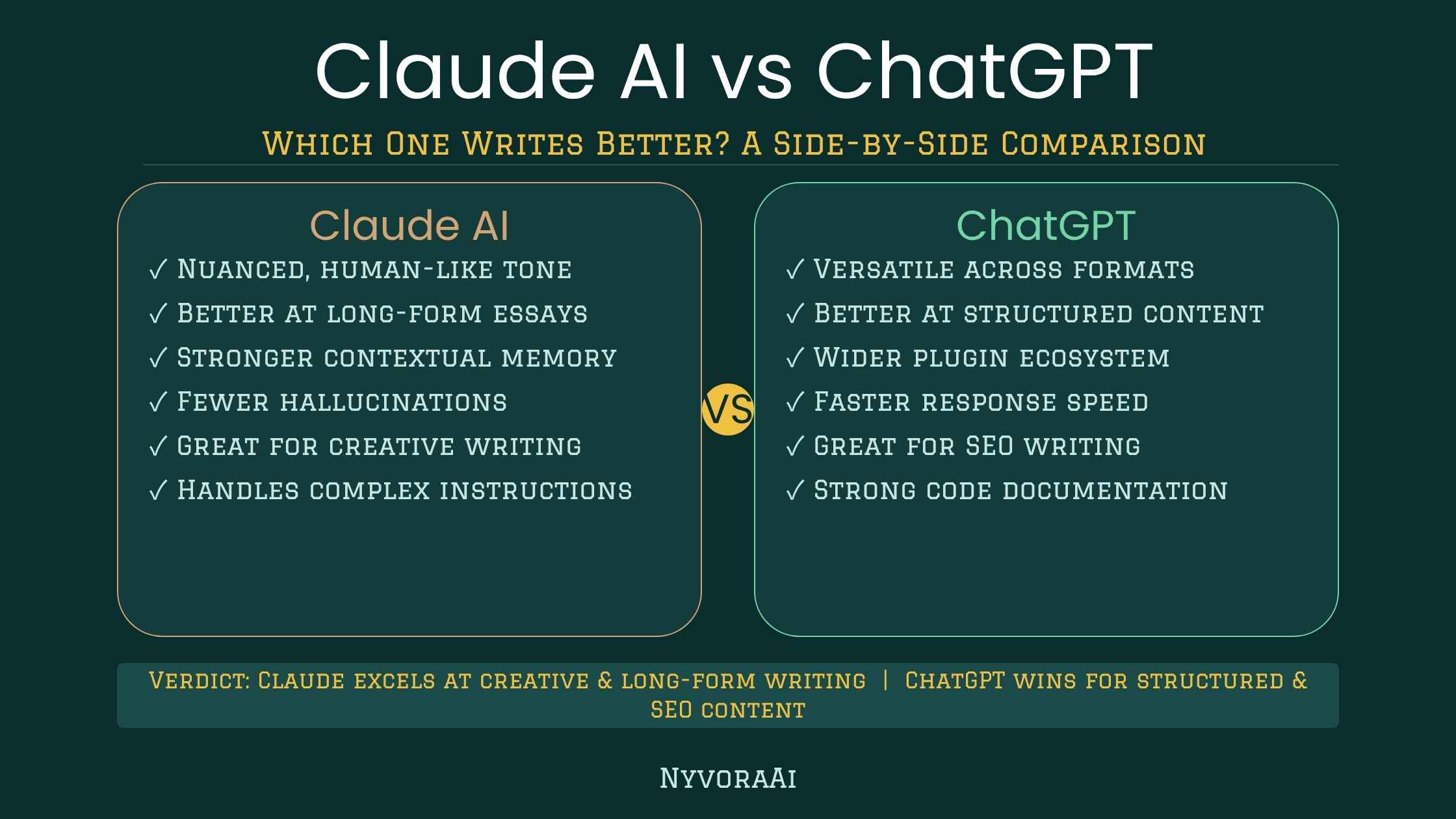
There's no single "better" answer — it depends on the writing task. Claude tends to perform strongly on longer, structured, tone-consistent writing like essays, reports, and editing passes, and many users describe its output as reading a little more naturally on longer pieces. ChatGPT tends to shine for fast brainstorming, quick variations, and tasks that benefit from its broader plugin and integration ecosystem. If your writing leans toward long-form, editorial, or brand-voice-sensitive content, Claude is worth testing first. If you want rapid-fire ideas or need tight integration with other apps, ChatGPT is worth testing first. Trying both on your actual writing task is more useful than any single ranking.
02Why This Comparison Isn't as Simple as It Looks
Both Claude and ChatGPT are large language models trained on huge amounts of text, and both are genuinely capable writing tools in 2026. The differences that matter for writers usually aren't about raw capability — they show up in smaller, more practical things: how naturally each tool holds a consistent tone across a long document, how each one responds to detailed style instructions, and how each handles the editing and revision loop that real writing actually involves.
It's also worth remembering that both companies update their models regularly, so a comparison that felt true six months ago can shift. Rather than treating any ranking as permanent, the more useful approach is understanding what each tool has consistently been good at, and testing both against your own writing before deciding.
03Tone and Writing Style
If your work is mostly short, punchy, conversational copy, both tools handle it well, and preference often comes down to personal taste. If you're writing something long where tone drift becomes a real risk — a whitepaper, a brand style guide, a book chapter — it's worth specifically testing how each tool holds up over several thousand words before choosing.
04Creativity and Brainstorming
For pure brainstorming — headline options, story premises, marketing angles — both models generate genuinely useful lists quickly. ChatGPT's larger plugin and integration ecosystem means it's often the faster choice when brainstorming needs to plug directly into another tool, like a project management app or a design platform. Claude is frequently described as producing fewer but more thoughtfully developed options, which some writers prefer when they want fewer choices to sift through and more substance in each one.
Neither approach is objectively better for creativity — it depends on whether you want volume to choose from or depth per option. A practical approach many writers use is generating a first batch of ideas in whichever tool they're more comfortable with, then switching to the other for a second opinion before committing to a direction.
05Editing and Long-Form Structure
This is the category where the comparison matters most for professional and serious hobbyist writers. Editing a 3,000-word draft requires a model to hold the entire structure in mind — what's already been said, what tone has been established, where the argument is heading — and this is consistently cited as one of Claude's stronger areas, particularly for essays, reports, and long articles that need structural editing rather than just line-level polish.
ChatGPT handles editing well too, especially for shorter pieces or section-by-section revision where you're working on one part at a time rather than asking the model to hold the whole document's structure at once. If your editing workflow is naturally chunked into sections, either tool works; if you regularly need whole-document structural feedback in one pass, it's worth specifically testing Claude on that exact task.
06Accuracy and Fact-Checking
Both Claude and ChatGPT can hallucinate — state something confidently that turns out to be wrong — and neither should be treated as a fact-checked source on its own. This matters most in writing that includes statistics, dates, quotes, or technical claims. Independent evaluations of hallucination rates shift with every model update on both sides, so treating either tool's current reputation as permanent is a mistake.
Always Verify Factual Claims, Regardless of the Tool
Whichever AI you use for writing, treat any statistic, date, quote, or specific claim as something to verify independently before publishing. Neither Claude nor ChatGPT is a substitute for a real source check on anything that matters.
07Side-by-Side: Claude vs ChatGPT for Writing
| Writing Task | Claude | ChatGPT | Notes |
|---|---|---|---|
| Long-form essays / reports | Strong | Solid | Claude often holds tone better over length |
| Quick brainstorming | Solid | Strong | ChatGPT often generates more variations, faster |
| Editing whole documents | Strong | Solid | Structural feedback across full length is a Claude strength |
| Short marketing copy | Solid | Strong | Both are genuinely good here; often comes down to taste |
| App & plugin integrations | Growing | Strong | ChatGPT has a wider third-party ecosystem currently |
Treat this table as a starting point for your own testing, not a final verdict — both companies ship updates regularly enough that specific strengths can shift. The more reliable approach is running your actual writing task through both and comparing the results yourself.
08How to Decide for Your Own Use Case
Identify your primary writing task
Long-form editorial work, quick marketing copy, brainstorming, or a mix — your answer changes which tool to test first.
Run the same real prompt through both
Use an actual piece you need to write, not a generic test prompt, and compare the two drafts side by side.
Check which one needs less editing
The tool that gets you closer to a finished piece with less rewriting is doing the better job for that specific task.
Consider your existing tools
If you're already deep into an ecosystem that integrates tightly with one of them, that convenience may outweigh a small quality edge.
Don't rule out using both
Many professional writers draft in one and use the other for a second opinion, an editing pass, or a tone check.
09Mistakes People Make Comparing AI Writing Tools
- Trusting a single viral post as the final word. Both models update often enough that a comparison from months ago may no longer reflect current performance.
- Testing with a generic prompt instead of real work. "Write me a poem" tells you very little about how a tool will handle your actual client report or blog post.
- Ignoring your own editing workflow. The best tool is the one that fits how you actually work, not the one that wins an abstract benchmark.
- Skipping fact-checking because a tool "seems" more accurate. Reputation for accuracy is not the same as guaranteed accuracy — verify claims either way.
- Assuming you have to pick just one. Plenty of professional writers keep both tools open and use whichever fits the specific task in front of them.
A Simple Test Worth Running
Take a piece of writing you've already finished and are happy with. Ask both Claude and ChatGPT to edit it for tone and clarity without changing the meaning. Compare which edit you'd actually want to keep — it tells you more about fit than any general comparison ever could.
If you'd like to go deeper on how either tool fits into a broader content workflow — from first draft through to a published piece — feel free to explore more comparisons and guides on our homepage, or reach out through our contact page if you have a specific use case you'd like us to test and cover.
10Frequently Asked Questions
Is Claude AI better than ChatGPT for writing?
Which AI is better for creative writing, Claude or ChatGPT?
Is Claude AI free to use for writing tasks?
Does Claude AI hallucinate less than ChatGPT?
Can I use both Claude and ChatGPT together for writing?
11Conclusion
Is Claude AI better than ChatGPT for writing? The honest answer is that it depends on what you're writing, not on which tool has the louder fanbase this month. Claude tends to earn its reputation on long, structured, tone-sensitive writing where consistency across length matters. ChatGPT tends to earn its reputation on fast brainstorming and a wider set of integrations that plug into the rest of your workflow. Both are genuinely capable, and both keep improving with every update.
Rather than picking a side based on a single comparison post, run your own actual writing task through both, see which one gets you closer to a finished piece with less editing, and don't feel obligated to choose only one. A growing number of writers simply keep both tools open and reach for whichever fits the job in front of them — which, in practice, is the most reliable answer this question has.
Want to explore more honest, practical AI comparisons like this one? Head back to our NyvoraAI homepage or check the About page to learn more about how we test and cover these tools.

Written by Varun Lalwani
Varun writes practical, beginner-friendly guides on AI tools and business workflows for NyvoraAI. Updated July 2026 based on hands-on testing of both Claude and ChatGPT across a range of real writing tasks. Questions about your setup? Contact us — we're happy to help.