It happened in a matter of months. One day, generating a stunning, photorealistic image of a "cyberpunk cityscape at sunset" required years of study in digital painting, a deep understanding of lighting, and dozens of hours hunched over a drawing tablet. The next day, it required a Wi-Fi connection and a six-word text prompt.
The explosion of generative AI tools like Midjourney, DALL-E 3, and Stable Diffusion didn't just introduce a new tool to the creative workflow; it dropped a nuclear bomb on the foundational economics and philosophy of art. Overnight, the internet was flooded with breathtaking, impossible imagery. And almost as quickly, a fierce, deeply emotional backlash erupted from the very humans whose life's work the machines were trained on.
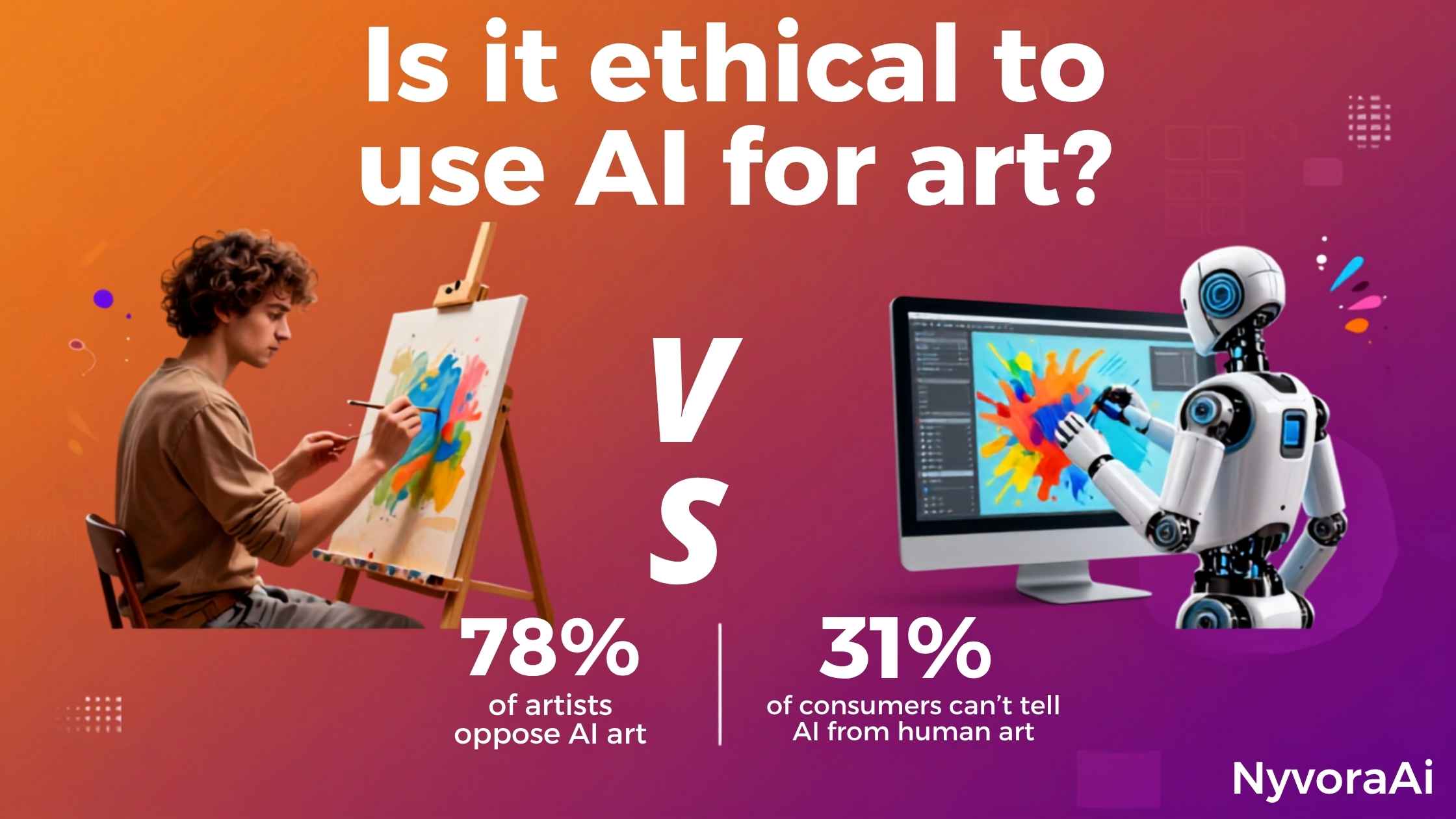
Artists are protesting, suing, and boycotting. Tech enthusiasts are heralding a new renaissance of human imagination. Caught in the crossfire is a question that has no easy answer: Is it ethical to use AI for art?
To answer this, we have to look past the angry tweets and the utopian press releases. We need to examine the mechanics of how these models learn, the economic reality of the creative class, and the philosophical definition of what "art" actually means. Grab a coffee. We are diving into the most heated debate in the tech world.
- The Training Data Dilemma: AI models are trained on billions of scraped images, often without the original artists' consent or compensation.
- The Economic Threat: Commercial artists (illustrators, concept artists) face existential job displacement as companies opt for cheap, instant AI alternatives.
- The "Soul" Argument: Art is traditionally defined by human intent and lived experience—two things a neural network fundamentally lacks.
- The Democratization Defense: AI lowers the barrier to entry, allowing people without motor skills or technical training to visualize their imagination.
- The Verdict: AI art is a mirror. It is ethically neutral as a tool, but highly problematic as a replacement for human labor and expression.
01The Spark and the Server: How AI "Learns" to Paint
To understand the ethics, you first have to understand the technology. When a human art student learns to paint, they go to a museum. They look at a Rembrandt, study the brushstrokes, analyze the chiaroscuro, and try to replicate the technique. They are learning the rules of light and shadow.
Generative AI does something mathematically similar, but on a scale that is impossible for a human brain. Models like Stable Diffusion are trained on massive datasets—often billions of images scraped from the internet. The AI doesn't "copy and paste" pieces of those images. Instead, it learns the statistical relationships between pixels and text prompts. It learns that the concept "sunset" correlates with specific gradients of orange and purple, and that "cyberpunk" correlates with neon lighting and rain-slicked streets.
When you type a prompt, the AI starts with a canvas of pure visual static (noise) and slowly denoises it, guided by its training, until an image emerges that matches your text. It is a mathematical approximation of human creativity. But here is where the ethical line gets blurry: What exactly was in that training data?
02The Great Data Heist: Consent and Compensation
This is the primary ethical failing of the current AI art boom. The companies that built these multi-billion-dollar models did not ask for permission to use human art to train them. They simply scraped it.
If a publisher wanted to print a book of human art, they would have to license the images, pay the artists, and attribute the work. AI companies bypassed this entirely by arguing that their process is "fair use"—that the AI is merely "learning" from the art, just as a human student does. But there is a fundamental difference. A human student buys a textbook, studies it, and creates a new, transformative work. An AI company ingests millions of copyrighted works, builds a commercial product that can directly replicate the styles of those artists, and sells subscriptions to it.
Artists are understandably furious. They spent decades developing a unique style, only to have it commodified by a tech company that can now generate "Art by [Living Artist]" in seconds. It feels like a violation. It feels like theft. And for many, the lack of an opt-in mechanism or a revenue-sharing model is a profound ethical breach.
The legal system is struggling to keep up, forcing us to confront: is AI moving too fast for regulators? The courts are currently flooded with class-action lawsuits regarding copyright infringement, but the outcomes remain uncertain, leaving artists in a state of limbo.
03The Economic Guillotine: Who Loses Their Job?
Ethics aren't just about philosophy; they are about livelihoods. The most immediate impact of AI art isn't in fine art galleries; it's in the commercial sector.
Consider the concept artist for a video game, the illustrator for a children's book, or the storyboard artist for an ad agency. These are highly skilled professionals who translate abstract ideas into visual reality. For decades, they have been the backbone of the visual entertainment industry. Today, a marketing manager can generate 50 variations of a book cover in an afternoon for the cost of a $20 monthly AI subscription.
When we look at the broader economic displacement caused by automation, we often ask: is AI in hiring fair to job seekers? The art world is facing the exact same existential threat. Companies are not evil; they are bound by fiduciary duty to maximize profit. If AI can do the job 100x faster and 100x cheaper, the commercial artist is out of work. The ethical question here is whether society has a moral obligation to protect the creative class from being entirely automated out of existence, or if this is just the brutal, natural evolution of the free market.
04The Philosophy of the "Soul": Can a Machine Create Art?
Beyond the money and the copyright, there is a deeper, more existential debate: Is AI output actually art?
Historically, art is a form of communication. It is a human being saying, "I experienced this emotion, I saw the world this way, and I am trying to make you feel it too." When you look at Frida Kahlo’s self-portraits, you aren't just looking at paint on canvas; you are looking at her physical pain, her heartbreak, and her political fury. The art is valuable because of the intent and the lived experience behind it.
An AI has no lived experience. It has never felt the sting of a breakup, the awe of a mountain range, or the fear of mortality. It is a statistical engine predicting pixels. When it generates a weeping woman, it doesn't know what tears are. It just knows that "weeping" correlates with certain curved lines and blue tones.
If AI can perfectly mimic a comforting voice or a beautiful painting, we are left wondering about deeper connections, like will AI ever replace human therapists. Art, like therapy, requires a shared human soul. A machine can simulate the aesthetic of sorrow, but it cannot mean it. For many critics, art without intent is just decoration. It is aesthetically pleasing, but spiritually hollow.
05The Democratization Argument: The Pencil for the Mind
But we cannot ignore the other side of the coin. For every master painter whose style is being mimicked, there is a person with a vivid imagination but zero motor skills.
Consider someone with severe arthritis who can no longer hold a brush. Consider a neurodivergent individual who struggles to articulate their thoughts in words but can visualize entire worlds in their head. Consider a writer who needs a quick visual reference for a scene in their novel but can't afford a commission.
For these people, AI art is not theft; it is liberation. It is a pencil for the mind. It democratizes visual storytelling, allowing anyone with an idea to participate in the creative process. Just as content creators debate should you tell people when you use AI to write, visual artists are now demanding disclosure for AI-generated imagery, but the underlying utility of the tool for non-artists is undeniable.
The ethical defense of AI art rests on this: Is it right to gatekeep visual expression behind a paywall of technical skill that not everyone possesses? Proponents argue that AI is just the next evolution of the camera. When photography was invented, painters panicked, claiming it was the death of art. Instead, it birthed cinema, photojournalism, and freed painters to invent abstract art. AI, they argue, will do the same.
The "Théâtre D'opéra Spatial" Shock
In 2022, an AI-generated image titled "Théâtre D'opéra Spatial" won first place in a digital arts competition at the Colorado State Fair. The artist had used Midjourney to generate the image, simply tweaking it in Photoshop. The traditional artists were outraged, arguing it was like "bringing a gun to a knife fight." The incident became ground zero for the AI art culture war.
06The Legal Wild West and the Open Source Loophole
The ethics of AI art are currently being fought in courtrooms, but the law is moving at a glacial pace. The US Copyright Office has ruled that purely AI-generated works cannot be copyrighted because they lack "human authorship." This means if you generate a stunning image with Midjourney, you don't legally own it. Anyone can take it, print it on a t-shirt, and sell it.
This creates a bizarre ethical paradox: The AI companies can use human art to train their models without permission, but humans cannot claim ownership over the art the AI generates.
Furthermore, the proliferation of open-source models like Stable Diffusion raises the question: is open source AI dangerous when it comes to copyright infringement and deepfakes? Once a model is released to the public, it can be run locally on a gaming PC. There is no central server to shut down, no API to throttle, and no way to enforce an "opt-out" list. The genie is not just out of the bottle; the bottle has been shattered into a million pieces.
07Coexistence or Extinction? The Future of the Canvas
So, where does this leave us? Are we heading toward a future where human artists are a niche luxury, and AI handles all commercial visual needs?
We are likely heading toward a bifurcated art world.
The Commercial Slop Layer
For 80% of commercial needs—stock photos, generic blog headers, basic concepting, fast-food advertising—AI will take over completely. It is simply too cheap and fast to ignore. This layer will be flooded with synthetic, homogenized, "perfect" imagery.
The Premium Human Layer
Because AI art is infinite and free, human-made art will become a premium, scarce commodity. The "flaws" of human art—the visible brushstrokes, the idiosyncratic choices, the physical texture—will become its greatest selling points. People will pay for the story, the struggle, and the humanity behind the piece.
The Centaur Artists
The most successful artists won't fight the AI; they will integrate it. They will use AI to generate base textures, brainstorm compositions, or handle tedious rendering tasks, while applying their human taste, direction, and final brushwork to create something entirely new.
As algorithms decide what art we see, we must ask: should social media use AI to filter content? If platforms are flooded with AI-generated imagery, will they use AI to detect and suppress it, or will they promote it because it drives engagement? The curation of our visual culture is being handed over to the same algorithms that generated it.
As AI generates more visual content, the way we discover art is shifting, making us wonder if will AI make search engines obsolete entirely. Instead of searching for "inspiring landscape photography," we might just ask an AI to "generate a landscape that makes me feel nostalgic for a place I've never been." The very act of seeking inspiration is being automated.
The psychological impact of interacting with synthetic media is profound, leading researchers to study are AI chatbots making people more lonely when they replace human interaction with AI-generated companionship and art. If we surround ourselves with beautiful images that no human cared to create, do we lose a vital thread of our shared cultural fabric?
08The Final Verdict: The Tool and the Master
Is it ethical to use AI for art?
If you are using it to replace a human artist's livelihood, to bypass the creative process, or to pass off machine output as your own human effort: No. It is ethically bankrupt. It relies on the uncompensated labor of thousands of humans, and it strips the intent and soul out of the creative act.
If you are using it to explore your own imagination, to overcome physical limitations, to brainstorm, or to create something entirely new that could not exist without the tool: Yes. It is just a brush. It is just a camera. It is a mirror reflecting the prompter's mind.
The technology is not going away. The lawsuits will eventually settle, the laws will eventually be written, and the initial shock will fade. What will remain is a fundamental choice for every creator: Will you use the machine to hide your lack of skill, or will you use it to amplify your human vision?
The AI can generate a million images in a minute. But it cannot care about a single one of them. Only you can do that. And in a world drowning in synthetic perfection, the messy, intentional, soul-baring act of human creation is the most valuable thing we have left. Protect it.