You sit down to watch one quick video about fixing a leaky tap. Two hours later you're seventeen videos deep into a rabbit hole about Soviet submarine history, and you genuinely cannot explain how you got there. If that sounds familiar, you've already met the most powerful recommendation engine on the internet, you just didn't see it working.
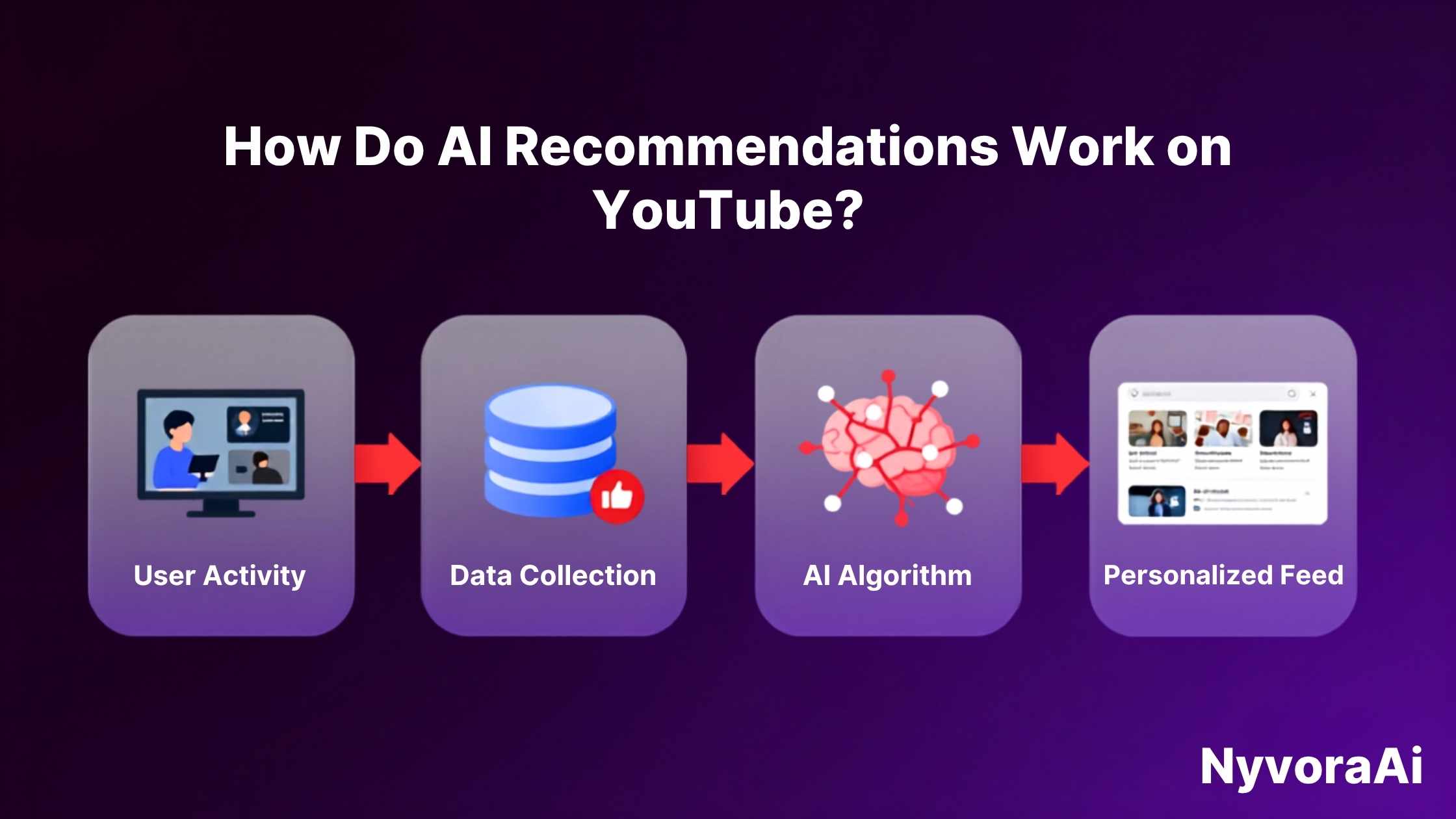
So how do AI recommendations work on YouTube, exactly? It isn't magic, and there's no person somewhere hand-picking videos for you. It's a layered system of machine learning models that watches what you watch, learns from millions of other viewers doing the same thing, and constantly re-guesses what will keep you on the platform for one more video. In this guide, we'll open up that black box and walk through exactly how YouTube decides what lands in your Home feed, your Up Next list, and your Shorts shelf.
Before we go further, it's worth separating two ideas people often mix up: not everything YouTube does counts as "AI" in the deep-learning sense. Some of it is simple rule-based automation, like a filter that blocks videos in a language you've never watched. If you want the full breakdown, our guide on what is the difference between AI and automation covers exactly where that line sits. The recommendation engine itself, though, is genuine machine learning, trained on an almost unimaginable amount of viewing data from billions of watch sessions.
- Behavior over words: watch time, clicks, and session data matter far more to the algorithm than likes or comments alone.
- Two-stage pipeline: candidate generation narrows millions of videos down before a ranking model scores the survivors.
- Embeddings: every video and every viewer is converted into a numerical vector that can be measured and compared.
- Real-time inference: the heavy training happens offline; what you see live is the model instantly applying what it already learned.
- A constant feedback loop: every click you make reshapes tomorrow's recommendations, for better or worse.
01The Simple Answer: It Learns From Your Behavior, Not Your Words
YouTube's recommendation system doesn't read your mind, and it doesn't really care what you say you like. It cares about what you do. Every video you click, every second you watch before skipping, every video you close immediately, every comment you leave, and every search you type gets logged as a tiny signal. None of these signals mean much on their own, but stacked together across the hundreds of hours you've spent on the platform, they form a surprisingly accurate picture of your taste.
This is the same basic trick used in plenty of other AI systems. If you've read our explainer on how does AI recognize faces in photos, you already know the pattern: a system takes something messy and human, in that case a face, and converts it into a clean set of numbers it can compare and measure. YouTube does the same thing with your viewing behavior. Every video and every viewer gets compressed into a long list of numbers called an "embedding," a kind of mathematical fingerprint of taste and content.
Embeddings get placed in a giant mathematical space where similar things sit close together. A video about espresso machines lands near other videos about espresso machines, and a viewer who's watched a dozen of them ends up with an embedding in that same neighbourhood. Finding what to recommend then becomes a matter of looking for videos whose embedding sits closest to yours. If the underlying idea of "training" a system to do this is new to you, our guide on what is machine learning and how is it trained walks through the basics in plain language.
02Step-by-Step: How YouTube Decides What to Show You
Let's break down the exact journey from "you open the app" to "here's your feed":
Candidate Generation: Narrowing Billions to Hundreds
Out of the hundreds of hours of video uploaded to YouTube every minute, no system checks all of it individually for you. This first stage pulls together a shortlist of a few hundred plausible matches, based on your subscriptions, your watch history, and what similar viewers enjoyed.
Signal Collection: Building Your Profile
While candidates are gathered, the system pulls together everything it knows about you: average watch time, how often you finish videos versus abandon them, which topics you search for, what device and time of day you're on, and how you reacted to similar recommendations before.
Ranking Model: Scoring Each Candidate
Each of the few hundred candidates runs through a ranking model, a neural network that predicts how likely you are to click, and for how long you'll watch, if that specific video is shown to you next. This is the heaviest computational step, and it happens in a fraction of a second.
Re-Ranking & Diversity Filters
Raw ranking scores alone would flood your feed with near-identical clickbait. So YouTube layers re-ranking rules on top: limiting how many videos from one channel appear in a row, mixing in some variety, and applying policy filters that downrank misleading titles or thumbnails.
Real-Time Personalization
All of this scoring happens live, the moment you open the app, using a model that was already trained beforehand on historical data. The heavy training happened earlier, offline, on huge servers; what you experience in real time is the model simply applying what it already learned. Our article on AI inference vs training explains that distinction with everyday examples if it still feels fuzzy.
Feedback Loop: Tomorrow Starts Here
Whatever you do next, click, skip, watch fully, or scroll past, becomes a brand-new data point that flows back into the system. Tomorrow's recommendations are partly built from today's clicks. This loop never really stops, which is part of why your feed can feel like it "knows you" a little better every week.
03Interactive Demo: Score a Video Like the Algorithm Does
Curious which signals carry the most weight? Click the buttons below to see how different types of viewer behavior would shift a video's recommendation score on a simplified version of YouTube's ranking model.
See how individual signals push a video's match score up or down
04The Brain Behind It: Neural Networks and Transformers
Underneath the ranking step sits a deep learning architecture often described as a "two-tower" model. One tower learns a numerical representation of you, the viewer, based on your history. The other tower learns a numerical representation of the video, based on its title, description, thumbnail, audio, and how other viewers responded to it. The system is trained to pull these two towers closer together in mathematical space whenever a real viewer genuinely enjoyed a real video.
In more recent versions of YouTube's recommendation systems, researchers have also adopted transformer-based architectures, the same family of model that powers modern chatbots and translation tools, to treat your viewing history as a sequence rather than a random pile. A transformer pays attention to order and context, similar to how it tracks word order in a sentence, instead of treating your last fifty watched videos as an unordered list. If you want the deeper technical picture, our guide on what is a transformer model in AI breaks down how that attention mechanism actually works.
There's a neat parallel here with how large language models operate. Our explainer on how does AI decide what to say next describes a model predicting the next word in a sentence based on everything that came before it. YouTube's sequence models do something structurally similar, predicting the next video you're likely to watch based on the sequence of videos you've already watched, just trained on viewing patterns instead of language. None of this would work without enormous amounts of training data; our piece on why does AI need so much data to train explains why, since YouTube's models learn from signals generated by billions of daily watch sessions.
| Component | What It Does | Real-World Analogy |
|---|---|---|
| Embedding Layer | Converts viewers and videos into comparable numerical vectors | Like translating taste into a coordinate on a map |
| Two-Tower Model | Matches viewer embeddings to video embeddings | Like a matchmaker comparing two profiles for compatibility |
| Attention / Transformer Layer | Weighs which past videos matter most to the next prediction | Like remembering your last few conversations, not just one word |
| Re-Ranking Layer | Applies diversity, freshness, and policy rules on top of raw scores | Like an editor making sure the final list isn't repetitive |
05Where AI Recommendations Show Up Across YouTube
This isn't one feature, it's the engine running underneath almost everything you see on the platform:
Home Feed
Your personal front page, rebuilt every time you open the app from a fresh ranking pass over your latest signals and subscriptions.
Up Next & Autoplay
Predicts what keeps a single viewing session going, weighted heavily toward whatever you're watching right now.
Shorts Feed
A faster-moving version of the same engine, collecting many more signals per minute since each video is only seconds long.
Search Suggestions
Blends what you typed with what people like you searched and watched afterward, not just keyword matching.
Notifications
Decides which new uploads from your subscriptions are worth alerting you about, based on your typical engagement with that channel.
Trending & Explore
Mixes broad popularity signals with personalization, so two viewers rarely see an identical Trending page.
06How Accurate Is It? (And When Does It Get It Wrong?)
YouTube's recommendation system is genuinely good at predicting what you'll click and how long you'll stay, that's the metric it was optimized for, and it shows. But "good at predicting clicks" isn't the same as "always good for you," and the model has clear blind spots.
What It Actually Optimizes For
The core objective is watch time and satisfaction, not necessarily quality or accuracy of information. A well-made but slow video can lose out to a faster-paced, more clickable one even if the slow video is more useful to you.
When the Algorithm Struggles:
The Cold Start Problem
Brand-new viewers and brand-new videos have no watch history to learn from, so early recommendations are rough guesses based on general popularity rather than your specific taste.
Filter Bubbles
Because the system keeps showing you variations of what you already watch, it can quietly narrow your feed into an echo chamber unless you actively seek out different topics.
Clickbait Bias
Exaggerated thumbnails and titles can temporarily boost click-through rate even when the video itself disappoints, skewing short-term signals before watch-time data corrects course.
Stale Interests
If your tastes shift faster than your watch history does, the model can keep recommending an old hobby long after you've moved on to a new one.
Shared Devices & Accounts
One account used by an entire household produces mixed, often confusing signals, since the model is trying to satisfy several different viewers at once.
07The Privacy and Ethics Debate
A system this good at predicting human behavior raises questions that go beyond "is my feed accurate":
- Data collection: the model relies on detailed, long-term tracking of what you watch, search, and skip.
- Engagement-first design: optimizing for watch time can reward content engineered to be hard to stop watching, not necessarily content that's good for you.
- Filter bubbles & misinformation: personalization can narrow exposure to differing viewpoints and, in some cases, amplify low-quality or misleading content that performs well on engagement.
- Children's content: recommendation systems around younger audiences face extra scrutiny and regulation due to advertising and content-safety concerns.
- Regulation: laws like the EU's Digital Services Act now require large platforms to disclose how recommendation systems work and offer non-personalized alternatives.
You're not entirely without control here. Features like "Not interested," "Don't recommend this channel," and clearing or pausing your watch history all feed new, deliberate signals back into the system, nudging the algorithm in a direction you actually want.
08Frequently Asked Questions
How do AI recommendations work on YouTube?
What signals does YouTube's algorithm use to recommend videos?
Why does YouTube recommend videos I didn't search for?
Can I reset or improve my YouTube recommendations?
Is YouTube's recommendation algorithm the same as a chatbot's AI?
Why do YouTube Shorts get recommended differently than long videos?
Can I turn off AI recommendations on YouTube?

Written by the NyvoraAI Team
We're passionate about making complex AI technology accessible to everyone. This guide breaks down YouTube's recommendation engine into digestible concepts. Questions? We're here to help!