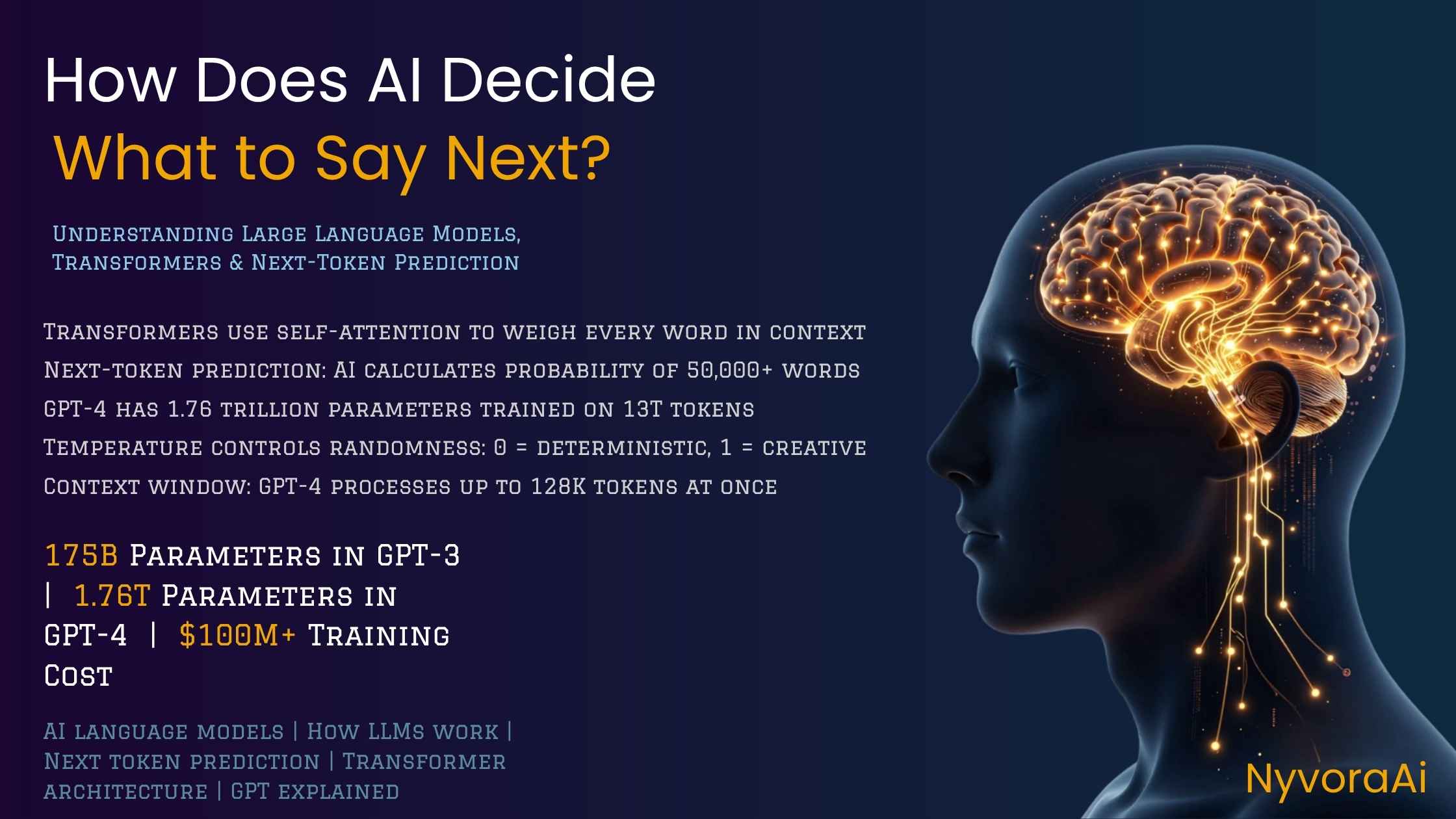
You type a question into ChatGPT or Claude, and almost instantly, a coherent, thoughtful answer begins to stream across your screen. It feels like you're talking to a person who is thinking about their response. But here’s the truth: the AI isn’t "thinking" in any human sense. It isn’t recalling a memory or forming an opinion. Instead, it is performing a incredibly complex game of predictive text.
At its core, how AI decides what to say next comes down to one simple question: "Given all the words that have come before this moment, which word is statistically most likely to come next?" It asks this question dozens of times per second, building a sentence one tiny piece at a time. In this guide, we’re going to look under the hood of this process. We’ll explore tokens, probability distributions, and the "attention" mechanisms that allow modern AI to sound so surprisingly human.
AI doesn't retrieve pre-written answers. It generates them on the fly using three main components:
- Tokenization: Breaking your text into small numerical chunks the computer can process.
- Probability Calculation: Analyzing billions of parameters to guess the next likely token.
- Sampling: Choosing a word from the top candidates, often with a bit of randomness to keep things interesting.
01The Basic Concept: Advanced Autocomplete
The easiest way to understand how AI works is to think about the predictive text on your smartphone. When you type "I'll see you," your phone might suggest "tomorrow" or "later." It does this because it has seen that phrase combination millions of times in your past messages.
Large Language Models (LLMs) are essentially this same technology, but scaled up to a mind-boggling degree. Instead of learning from your personal texts, they have "read" a significant portion of the public internet—books, articles, code repositories, and forums. They have learned the statistical relationships between virtually every word in the English language (and many others). When you ask a question, the AI isn't searching a database for an answer; it is constructing a response from scratch, predicting the most logical continuation of your sentence based on everything it has ever seen.
02Step 1: Turning Words into Numbers (Tokens)
Computers don't understand words like "apple" or "run." They only understand numbers. Before an AI can decide what to say next, it has to convert your input into a format it can do math with. This process is called tokenization.
A token isn't always a whole word. It can be a syllable, a prefix, or even a single character. For example, the word "unbelievable" might be broken into three tokens: "un," "believe," and "able." Each of these tokens is assigned a unique ID number. The AI then performs complex matrix multiplication on these numbers to understand their relationships. If you want to dive deeper into this foundational step, our guide on what tokenization is in AI explains exactly how text becomes math.
03Step 2: The Probability Distribution
Once the AI has processed your prompt, it looks at its vast internal network of parameters (the "knowledge" it gained during training) and generates a list of every possible word that could come next, along with a percentage score for how likely each one is. This is called a probability distribution.
In the example above, if the previous words were "Look at those dark," the AI calculates that "clouds" is the most statistically probable next word. However, it doesn't always pick the number one option. If it did, AI would be incredibly repetitive and boring. Instead, it uses a process called sampling to pick from the top few likely options, which adds a layer of variety and creativity to the output.
04Step 3: Understanding Context (Attention)
Early AI models were terrible at context. If you started a sentence with "The bank was steep," they might assume you were talking about money. Modern AI uses a breakthrough architecture called the Transformer. Transformers use a mechanism called "self-attention," which allows the model to look at every other word in the sentence simultaneously to determine meaning.
This is how AI knows that "bank" means a river edge in one sentence and a financial institution in another. It pays "attention" to the surrounding words like "steep" or "money" to adjust its probabilities. This ability to maintain long-range context is what makes modern AI feel so coherent. You can learn more about this revolutionary technology in our article on what a Transformer model is in AI.
05The Role of Temperature: Creativity vs. Accuracy
Have you ever noticed that sometimes AI is very factual and dry, while other times it’s witty and creative? This is often controlled by a setting called Temperature. Think of temperature as a dial that controls how risky the AI’s word choices are.
- Low Temperature (0.2): The AI plays it safe. It almost always picks the highest-probability word. This is great for coding or factual summaries where accuracy is key.
- High Temperature (0.8+): The AI takes more risks. It might pick a less likely word if it fits the vibe. This leads to more creative, surprising, and human-like writing, but it also increases the chance of nonsense.
06Why AI Sometimes Makes Things Up
One of the biggest frustrations with AI is "hallucination"—when it confidently states something that is completely false. This happens because of how it decides what to say next. The AI is optimized for plausibility, not truth.
If a false fact follows a statistically common sentence structure, the AI might generate it because it "sounds right" based on its training data. It doesn't have a built-in fact-checker; it only has a probability calculator. This is why it is crucial to verify important information. This limitation is also why AI is different from traditional automation. While automation follows strict rules, AI follows patterns. You can read more about this distinction in our guide on the difference between AI and automation.
Did You Know?
AI models don't just predict the next word; they predict the next token. In some languages like Chinese or Japanese, one token can represent a whole concept, while in English, it might just be a suffix like "-ing". This is why AI sometimes struggles more with certain languages than others.
07The Fuel: Why Data Matters
An AI is only as good as the data it was trained on. If an AI has never seen a specific type of technical manual, it won't know how to predict the next word in that specialized context. This is why companies spend millions curating massive, diverse datasets. The more high-quality examples an AI sees, the better its probability calculations become for niche topics. We explore this in detail in our post on why AI needs so much data to train.
08A Real-World Example: AI Translation
Nowhere is this "next word" logic more impressive than in translation. Old translation tools swapped words one-by-one, resulting in clunky, awkward sentences. Modern AI translates by understanding the entire context of the source sentence and then generating the most probable equivalent in the target language.
It doesn't just translate "Hello"; it looks at the tone, the formality, and the cultural context to decide if the next word should be a formal greeting or a casual one. This contextual fluency is what makes modern AI translation so powerful. You can see this process in action in our guide on how AI translation works.
09Frequently Asked Questions
How does AI decide what to say next?
Does AI actually understand what it is saying?
Why does AI sometimes make up facts?
What is a token in AI?
How fast does AI generate text?

Written by the NyvoraAI Team
We love breaking down the complex mechanics of AI into simple, digestible explanations. This guide was reviewed for technical accuracy in June 2026. Have a question about how LLMs work? Drop us a line—we’re always happy to chat!