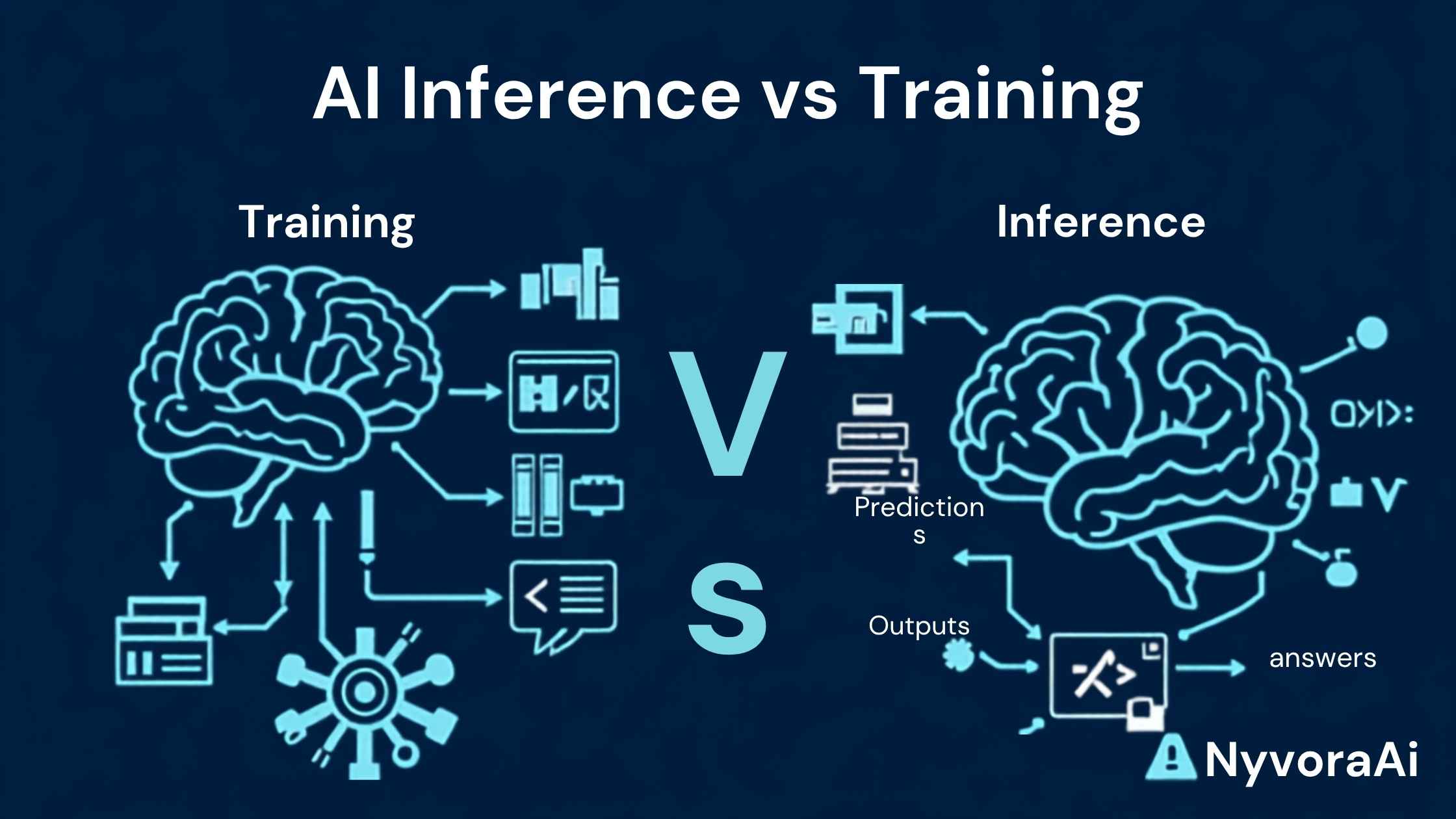
If you’ve ever read about artificial intelligence, you’ve likely encountered two words that sound technical and intimidating: training and inference. They are often used interchangeably by people who don't quite understand the distinction, but in the world of AI development, they represent two completely different stages of a model's life.
Understanding the difference between AI inference vs training is crucial if you want to grasp how AI actually works, why it costs so much to build, and why your chatbot sometimes feels slow. One is about learning; the other is about doing. In this guide, we’ll strip away the jargon and explain exactly what happens in each phase, using simple analogies and real-world examples.
Think of it like school versus a job:
- Training is like going to university. It’s a long, expensive period of studying vast amounts of information to gain knowledge and skills.
- Inference is like going to work. It’s using the knowledge you gained in university to solve specific problems and answer questions in real-time.
01The Simple Analogy: The Chef
To understand what is AI inference vs training, let’s imagine a professional chef.
Training is the years the chef spends in culinary school and working under mentors. They taste thousands of dishes, learn how flavors combine, memorize recipes, and practice their knife skills. During this phase, they are consuming massive amounts of "data" (ingredients and techniques) and adjusting their internal understanding of cooking. This phase is slow, expensive, and requires a lot of resources.
Inference is what happens when you walk into their restaurant and order a meal. The chef doesn’t go back to culinary school to figure out how to make your pasta. They simply use the skills they already learned to prepare your dish quickly and efficiently. This phase is fast, repetitive, and focused on delivering a result to a customer.
In AI, the "chef" is the model. The "culinary school" is the training phase, and "serving your meal" is inference.
02Phase 1: AI Training (The Learning Phase)
Training is the foundational stage where an AI model is created from scratch. It involves feeding the model massive datasets—often terabytes of text, images, or code—and allowing it to find patterns within that data.
What Happens During Training?
- Data Ingestion: The model processes billions of examples. For a language model, this means reading most of the public internet.
- Parameter Adjustment: The model starts with random internal settings (parameters). As it processes data, it makes predictions. If it’s wrong, it adjusts its parameters slightly to reduce the error. This happens billions of times.
- Loss Calculation: A mathematical function calculates how far off the model’s predictions are from the correct answers. The goal of training is to minimize this "loss."
This process is incredibly computationally intensive. It can take weeks or even months to train a state-of-the-art model, requiring thousands of specialized GPUs running 24/7. If you’re curious about why this process requires such massive resources, check out our deep dive on why AI needs so much data to train.
Did You Know?
Once a model is trained, its internal parameters are "frozen." This means that when you chat with an AI, it isn’t learning from your conversation in real-time. It’s simply applying what it already learned during training.
03Phase 2: AI Inference (The Doing Phase)
Inference is what happens after the model is trained and deployed. When you type a question into ChatGPT or ask Siri for the weather, you are triggering an inference request. The model takes your input, runs it through its frozen network of parameters, and generates an output.
What Happens During Inference?
- Input Processing: Your question is converted into tokens (numbers) that the model can understand.
- Forward Pass: The data moves through the neural network layers. Unlike training, the model doesn’t adjust its weights here. It just calculates the result.
- Output Generation: The model produces a response, which is then converted back into human-readable text or action.
Inference is all about speed and efficiency. Users expect instant answers, so engineers optimize models to perform these calculations as quickly as possible. This is why how AI decides what to say next is a critical area of research for improving inference performance.
04Key Differences: Training vs. Inference
- Goal: Learn patterns from data
- Frequency: One-time or periodic
- Compute: Extremely High
- Data: Massive datasets (Terabytes)
- Latency: Not critical (can take weeks)
- Hardware: Thousands of GPUs/TPUs
- Goal: Apply learned patterns
- Frequency: Continuous (every user query)
- Compute: Moderate to Low
- Data: Single user input
- Latency: Critical (must be instant)
- Hardware: Optimized CPUs/GPUs
05The Cost Factor: Why Inference is Getting Expensive
Historically, training was the most expensive part of AI. But as models become more popular, the cost of inference is skyrocketing. Why? Because while you only train a model once (or occasionally), you perform inference every single time a user interacts with it.
If a million people ask an AI assistant a question every day, that’s a million inference requests. Each one requires computational power. This is why many AI companies are scrambling to make their models smaller and more efficient. They are using techniques like quantization (reducing the precision of numbers) and distillation (teaching a smaller model to mimic a larger one) to keep inference costs manageable.
This economic pressure is also driving the difference between AI and simple automation. While automation scripts are cheap to run, AI inference carries a recurring computational tax. You can read more about this distinction in our guide on the difference between AI and automation.
06Hardware Needs: Different Tools for Different Jobs
Because training and inference have different goals, they often use different hardware strategies.
Training Hardware
Requires massive parallel processing power. Companies use clusters of NVIDIA H100 or B200 GPUs connected by high-speed networks. The focus is on throughput—processing as much data as possible.
Inference Hardware
Requires low latency and energy efficiency. While GPUs are still used, specialized chips like TPUs (Tensor Processing Units) or NPUs (Neural Processing Units) are becoming common. The focus is on speed—getting an answer to the user as fast as possible.
07Real-World Example: AI Translation
Let’s look at how this applies to a tool you might use daily: AI translation.
During Training: The model is fed millions of pairs of sentences in different languages (e.g., English and French). It learns the statistical relationships between words and grammar structures. It doesn’t know "what" a word means, but it knows which French words usually appear when certain English words are present.
During Inference: You paste a paragraph of English text into a translator. The model doesn’t re-learn languages. It simply takes your text, runs it through its trained network, and predicts the most likely French equivalent for each token. This happens in milliseconds. If you want to understand the mechanics behind this, our article on how AI translation works breaks it down further.
08The Role of Transformers
Most modern AI models, both for training and inference, are built on the Transformer architecture. Transformers are particularly good at handling sequential data like text because they can "pay attention" to different parts of the input simultaneously. This makes them highly effective for both learning complex patterns during training and generating coherent responses during inference. To learn more about the engine powering these models, read our guide on what a Transformer model is in AI.
09The Future: On-Device Inference
One of the biggest trends in 2026 is moving inference from the cloud to your own device. Instead of sending your question to a massive server farm, your phone or laptop will run the AI model locally. This improves privacy and reduces latency. However, it requires highly optimized models that can run on limited hardware. This is why understanding the efficiency of inference is becoming just as important as understanding how models are trained.
If you want to dive deeper into the learning process itself, we recommend our comprehensive guide on what machine learning is and how it is trained.
10Frequently Asked Questions
What is the difference between AI training and inference?
Which is more expensive: AI training or inference?
Does an AI model continue to learn during inference?
Why does AI inference need powerful hardware?
Can I run AI inference on my own computer?

Written by the NyvoraAI Team
We demystify the technical side of AI for everyone. This guide was reviewed for accuracy in June 2026. Have a question about how AI models are built? Reach out to us—we love talking tech!