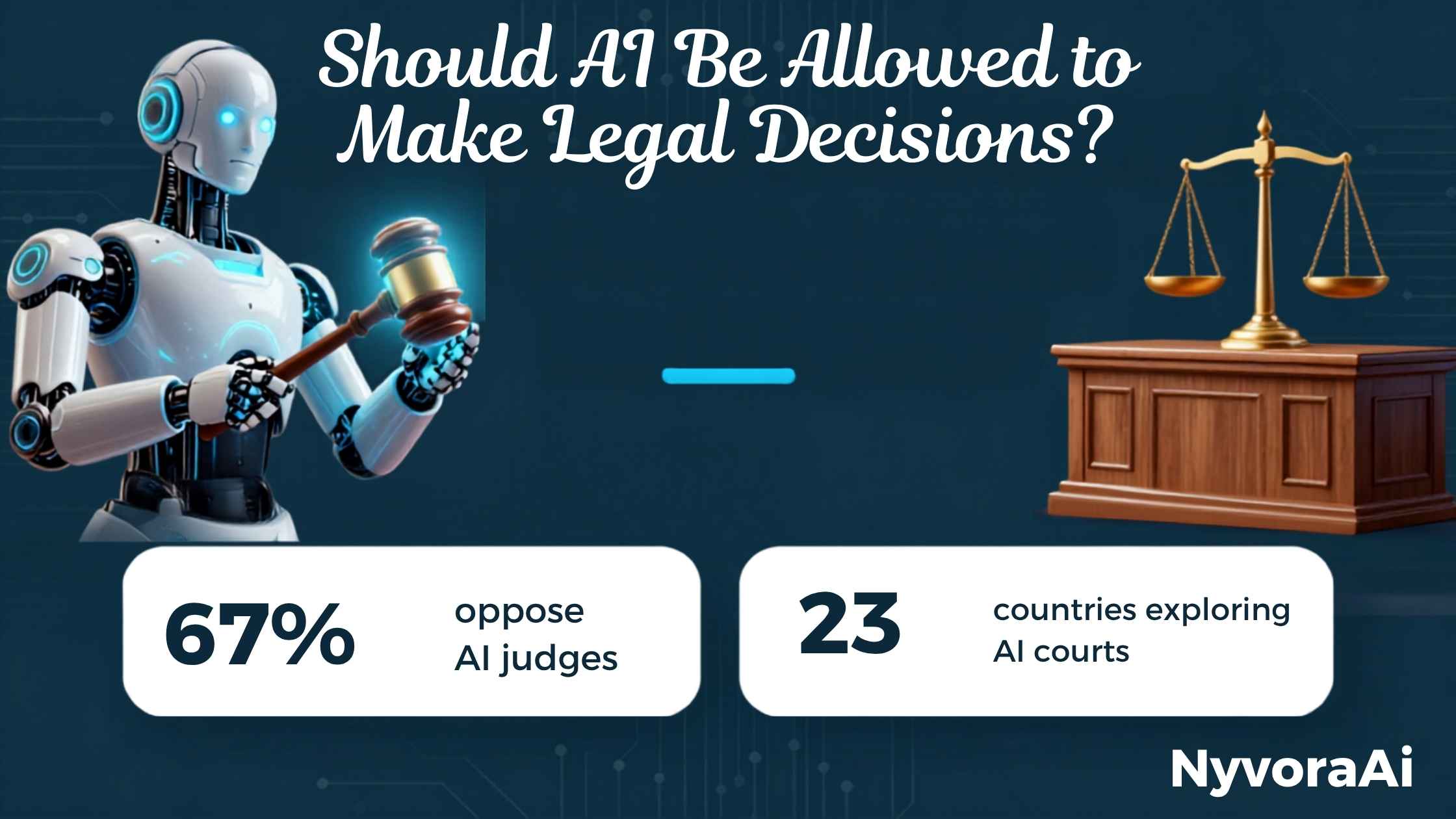
We are living in an era where artificial intelligence is writing our code, diagnosing our diseases, and driving our cars. So, it was only a matter of time before someone asked the ultimate, terrifying question: Should AI be allowed to make legal decisions?
On paper, the idea is seductive. Human judges are tired, biased, and prone to making terrible rulings right before lunchtime because their blood sugar is low. An AI, theoretically, would be a tireless, perfectly objective dispenser of justice. But as with almost everything in the AI revolution, the reality is a lot messier, a lot darker, and a lot more complicated than the tech bros want to admit.
- Efficiency is not justice. AI can clear court backlogs, but speed means nothing if the outcome is fundamentally unfair.
- AI automates historical bias. If trained on flawed human data, the algorithm will scale up systemic racism and classism.
- The Black Box violates due process. You cannot appeal a ruling if the AI cannot explain its own reasoning.
- Accountability is impossible. If an AI sends an innocent person to prison, there is no human to hold responsible.
01The Allure of the Algorithmic Judge
Let’s play devil’s advocate for a minute. Why do we even want to put a microchip on the bench? Because the human justice system is, frankly, a disaster.
Courts are drowning in backlogs. It can take years to get a basic civil case heard. Legal fees are so astronomically high that the justice system is essentially paywalled, accessible only to the rich or those desperate enough to go into debt. Human judges are overwhelmed. They suffer from decision fatigue. Studies have literally shown that judges are more likely to grant parole right after they’ve eaten a meal, and nearly deny it right before. That is not justice; that is biology.
So, the pitch for AI is simple: Efficiency. An AI can read ten thousand case precedents in a second. It doesn’t get tired. It doesn’t get hungry. If we just feed the facts of a case into a highly advanced legal model, it should be able to spit out a fair, consistent ruling every single time. It sounds like a utopia. But this utopia is built on a very dangerous misunderstanding of what the law actually is.
02The Ghost in the Precedent (The Bias Problem)
Here is the fatal flaw in the "AI is objective" argument: AI is not objective. AI is a mirror. And if the reflection it’s looking at is ugly, the output will be ugly too.
Machine learning models are trained on historical data. In the context of law, that means they are trained on decades, sometimes centuries, of human legal decisions. And human legal history is stained with systemic bias, racism, classism, and sexism. If you train an AI on historical sentencing data, it will quickly learn that certain demographics receive harsher sentences. It won’t understand why that happened. It won’t recognize that the historical data is flawed. It will just see a pattern and mathematically reinforce it.
We’ve already seen this happen with early algorithmic bail and sentencing tools. They were sold as "colorblind" math, but they ended up flagging minority defendants as "high risk" at drastically higher rates, simply because of zip codes and historical arrest data. When we ask if we should trust these systems, we have to remember that an AI doesn’t correct historical injustices; it automates them.
03The Empathy Deficit and the Human Context
Law is not just a flowchart of rules. It is the messy, complicated attempt to apply abstract rules to deeply human situations.
Imagine a case involving a teenager who shoplifted food. The strict, logical application of the law says: theft is a crime, punish the thief. But a human judge looks at the context. Are they feeding a younger sibling? Are they a victim of a broken foster system? Is this a one-time mistake or a symptom of a deeper societal failure?
A human judge can exercise mercy. They can look a defendant in the eye and understand the weight of the moment. An AI cannot. It doesn’t know what hunger feels like. It doesn’t understand fear, desperation, or remorse. When we debate whether we should you trust AI for medical advice, we are fundamentally asking if a machine can be trusted with human vulnerability. The stakes in a courtroom are even higher. Delegating that level of vulnerability to a machine that cannot feel empathy is a moral failure.
04The Black Box and the Right to Know Why
In any functioning democracy, if the government takes away your rights, you have the right to know exactly why. This is the bedrock of due process. If you lose a case, you need to understand the judge's reasoning so you can appeal it.
But modern AI, particularly deep learning neural networks, operates as a "black box." Even the engineers who build these models often cannot explain exactly how the AI arrived at a specific conclusion. The AI processes millions of parameters in hidden layers and spits out an answer.
If an AI judge sentences you to ten years in prison, and your lawyer asks, "Why?", the answer cannot just be, "Because the math said so." If the reasoning is opaque, the right to a fair appeal is completely destroyed. This opacity forces us to confront some heavy philosophical questions. If an entity is making life-altering decisions but cannot explain its own moral reasoning, does it possess any real understanding of justice? It brings us right back to the core debate of will AI ever be truly conscious. A system without consciousness, without an internal moral compass, has no business weighing the scales of justice.
05The Accountability Vacuum
Let’s talk about what happens when the machine gets it wrong. And make no mistake, it will get it wrong.
If a human judge takes a bribe, or makes a reckless, ignorant ruling, we have mechanisms. They can be impeached, disbarred, or voted out. There is a chain of human accountability. If an AI makes a catastrophic error and sends an innocent person to prison, who goes to jail? The developer who wrote the code? The politician who bought the software? The data scientist who curated the training set?
We are already seeing this dynamic play out on a smaller scale. When we argue about whether using AI is cheating in school or work, the core issue is always accountability. Who is responsible for the final output? In a corporate setting, a bad AI-generated report loses money. In a courtroom, a bad AI-generated ruling destroys a life. We cannot outsource our moral accountability to a server farm. The justice system requires a human neck to wring when things go wrong.
06The Death of Legal Nuance
The law is not a science; it is an art. It requires interpretation. Words like "reasonable," "cruel," and "fair" are not mathematical constants. They change based on culture, time, and context.
AI is fundamentally rigid. It deals in probabilities and patterns. It struggles immensely with the gray areas, the edge cases, the bizarre, one-in-a-million scenarios that human lawyers and judges deal with every day. While we might be okay with AI drafting a routine contract or generating a marketing email—much like the ongoing debate over whether AI will replace content writers in 2026—a legal ruling requires a level of interpretive flexibility that a language model simply doesn't possess. AI will always default to the statistical average. But justice often requires us to look at the extreme, unique individual.
Furthermore, legal interpretation requires a type of creative empathy to understand unique human circumstances. This raises the exact same concerns we see when asking is AI making us less creative. If we rely on algorithms to interpret the law, our legal system will become rigid, homogenized, and entirely divorced from the evolving, messy reality of the human condition.
07The Civic Impact and the Death of Transparency
Finally, we have to think about what an AI justice system does to the public’s understanding of the law.
The law is meant to be a social contract. It’s a set of rules that we, as a society, agree to live by. When a human judge writes a ruling, they are participating in a civic dialogue. They are explaining to the public how our shared values apply to a specific situation. If the law becomes an opaque algorithm managed by a private tech company, the public loses its connection to the justice system. You can’t have a civic debate with a proprietary algorithm. You can’t vote out a neural network.
This profound disconnect impacts how we understand our own rights, which is closely tied to the debate about whether AI is good or bad for education. If the next generation grows up believing that "justice" is just a black-box algorithm that spits out verdicts, they won’t learn how to engage with the civic process. They will view the law not as a reflection of societal values, but as an unavoidable force of nature, like the weather. And you can’t protest the weather.
08The Final Verdict: AI as the Clerk, Not the Judge
So, where does this leave us? Should we ban AI from the courtroom entirely?
No. That would be throwing the baby out with the bathwater. AI is an incredibly powerful tool for the legal profession. Imagine an AI that can instantly scan millions of pages of discovery documents to find the one smoking-gun email. Imagine an AI that helps public defenders draft motions in seconds, leveling the playing field against wealthy corporate legal teams. Imagine an AI that analyzes past rulings to help judges ensure their sentences are consistent and free from unconscious bias.
AI should be the ultimate law clerk. It should do the heavy lifting of research, summarization, and organization. But the final decision—the actual weighing of human lives, freedom, and justice—must remain in human hands.
We need judges who can look a defendant in the eye. We need lawyers who can argue the nuances of human suffering. We need a justice system that is built by humans, for humans. Because at the end of the day, justice isn’t just about getting the right answer. It’s about the human process of figuring it out together.
"AI judges will be completely unbiased because they don't have human prejudices or bad days."
AI doesn't have prejudices, but it has training data. If the historical data it learns from contains systemic bias, the AI will mathematically encode and amplify that bias, often making it harder to detect and challenge than human prejudice.