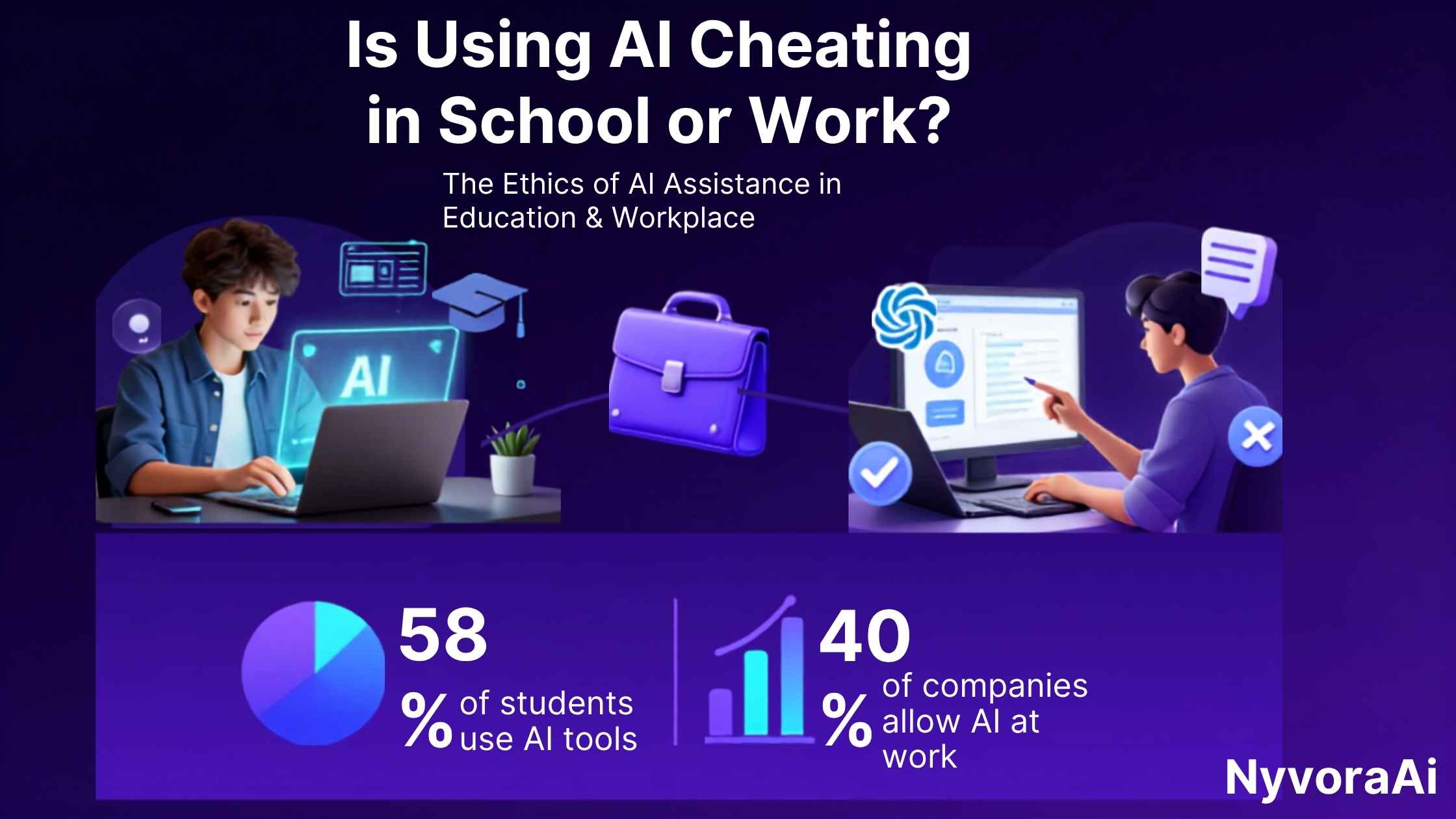
If you’re asking "Is using AI cheating in school or work?", you are not alone. In 2026, this is the defining ethical dilemma of the digital age. We are caught in a massive transitional phase. The technology has evolved faster than the rulebooks, leaving students, professionals, teachers, and managers in a gray area that feels incredibly uncomfortable.
On one hand, AI is the most powerful productivity tool ever created. On the other hand, it can replicate the exact output we are supposed to be producing ourselves. So where is the line? When does a helpful tool become a crutch, and when does a crutch become outright fraud?
- Context is everything. Using AI to brainstorm is usually fine; using it to generate your final essay without disclosure is almost always cheating.
- School is about the process. If you outsource the thinking, you rob yourself of the cognitive development the assignment was designed to build.
- Work is about the result (but with caveats). Companies care about output, but passing off AI work as your own unassisted effort can still get you fired.
- Transparency is your shield. If you disclose your AI use and your instructor or boss approves it, you aren't cheating. You're collaborating.
01The 11 PM Guilt Trip
Let’s talk about that feeling you get right after you hit "submit" on an AI-assigned paper. It’s not the relief of finishing a hard task. It’s a hollow, sinking feeling in your gut. It’s imposter syndrome mixed with the fear of getting caught.
That guilt is your moral compass telling you that you bypassed the struggle. And the struggle is the whole point. Whether you are a high schooler writing a history paper or a marketing manager drafting a quarterly report, the friction of creating something from nothing is where the value lies. When you remove the friction, you don't just save time; you strip away the human element of the work.
But let’s not pretend we’re saints. Humanity has always looked for shortcuts. We used spark notes instead of reading the book. We used calculators instead of doing long division. We used GPS instead of reading maps. Every generation thinks their shortcut is the one that will ruin society. The difference with AI is the scale and the sophistication of the shortcut. It doesn't just give you the answer; it gives you the appearance of having done the work.
02The Classroom: Learning vs. Outsourcing
In an academic setting, the question of cheating comes down to one fundamental reality: School is not about the paper. School is about what happens to your brain while you write the paper.
When a professor assigns a 10-page essay on macroeconomic theory, they don't actually care about the PDF you upload to the portal. They care about the neural pathways you are forced to build as you synthesize complex ideas, structure an argument, and wrestle with counter-points. If you feed the prompt into an LLM and submit the output, you have successfully produced a document, but you have completely bypassed the learning process. You have outsourced your cognitive development to a server farm.
This is why the debate over is AI good or bad for education is so fiercely contested. If used as a tutor to explain difficult concepts, AI is a miracle. If used as a ghostwriter to bypass the assignment, it is an academic poison. The cheating occurs not when you touch the keyboard, but when you surrender the critical thinking to the machine.
03The Workplace: Output vs. Process
The corporate world operates on a completely different axis. Your boss doesn't care about your neural pathways; they care about the Q3 marketing strategy. In the workplace, the definition of cheating is much murkier.
If you use AI to write the first draft of a codebase, summarize a 100-page legal document, or generate 50 variations of an email subject line, and then you edit, refine, and take responsibility for the final output... are you cheating? Most progressive companies would say no. You are being efficient. You are leveraging the best tools available to deliver value.
However, the line is crossed when deception enters the picture. If your company hires you as a "Senior Content Strategist" and you are secretly feeding every prompt into an AI, doing zero strategic thinking, and just copy-pasting the results, you are committing fraud. You are collecting a salary for human expertise you are not providing. This is the exact anxiety driving the fear of will AI replace content writers in 2026. If your entire job can be reduced to prompt engineering without human oversight, your role is already obsolete; you're just waiting for the spreadsheet to catch up.
04The Cognitive Atrophy Problem
Beyond the rules of academic integrity and corporate contracts, there is a deeper, more terrifying question: What is this doing to our brains?
Muscles atrophy when you stop using them. What happens to our creative and analytical muscles when we stop forcing them to lift heavy cognitive loads? If you never have to stare at a blank page and fight for the right word, do you lose the ability to write? If you never have to debug a complex logic error yourself, do you lose the intuition required to be a great engineer?
This is the core of the argument when people ask is AI making us less creative. AI gives us the average of all human knowledge. It is the ultimate regression to the mean. If we rely on it for every creative spark, our collective output will become a homogenized, beige sludge of statistically probable ideas. True creativity requires the messy, inefficient, deeply human experience of making weird connections that an algorithm wouldn't predict. Using AI for everything isn't just cheating the system; it's cheating yourself out of your own unique genius.
05The Absurdity of AI Detectors
In the panic to stop AI cheating, schools and companies have rolled out "AI Detectors." Let me save you the suspense: They are fundamentally flawed, scientifically dubious, and incredibly dangerous.
These tools work by calculating the "perplexity" and "burstiness" of a text. AI writes in very predictable, low-perplexity patterns. Humans write with high burstiness (mixing short, punchy sentences with long, complex ones). But here is the problem: A highly educated human writing a formal, technical document will naturally write in a low-perplexity, predictable style. An AI that has been prompted to "write like a human" or has been heavily edited will easily bypass the detector.
We are currently seeing innocent students fail classes and employees face disciplinary action because a flawed algorithm flagged their human-written work as AI-generated. It is a digital witch hunt. This is why relying on detectors is a massive mistake. The only way to know if someone cheated is to assess their actual understanding of the material, not to run their text through a glorified guesser.
06The Ethical AI Framework: Co-Pilot vs. Autopilot
So, how do you navigate this minefield? How do you use these incredible tools without losing your soul, your grades, or your job? You need a framework.
I call it the Co-Pilot vs. Autopilot test.
Autopilot is cheating. If you give the AI the prompt, let it write the whole thing, and hit submit, you are on autopilot. You are a passenger. This is unacceptable in almost all academic and high-level professional scenarios.
Co-Pilot is ethical. If you are the one flying the plane, and you use the AI to check the instruments, suggest a route, or handle the boring radio chatter, you are a co-pilot. You are still doing the hard work of navigating.
Furthermore, you must verify everything. AI hallucinates. It makes up facts, citations, and code libraries. If you are a professional using AI to draft a client report or a medical summary, you must verify the output with the same rigor you would apply when asking should you trust AI for medical advice. Blind trust in AI output in a professional setting is not just lazy; it's negligent.
07The Future of Assessment
Because of the AI cheating crisis, the way we measure competence is going to have to change. We can no longer rely on take-home essays or unsupervised coding tests. They are dead.
Schools will return to in-person, oral defenses of written work. "You wrote this thesis on quantum mechanics? Great, come to the front of the room and explain chapter three to me." Companies will shift from assessing the portfolio of work to assessing the problem-solving process in real-time.
This brings up a fascinating philosophical point. We are building systems that can mimic human output so perfectly that we are forced to redefine what makes us human. It forces us to ask deep questions about agency and responsibility, much like the debate over will AI ever be truly conscious. If an AI generates a brilliant strategy, but it has no consciousness, no moral agency, and no skin in the game, the human who submitted it must bear 100% of the moral and professional responsibility for that output. You can't blame the tool when it breaks.
08The Final Verdict: The Transparency Rule
Is using AI cheating in school or work? The answer is not a simple yes or no. It depends entirely on the rules of the environment you are in, and more importantly, your level of transparency.
If you hide your use of AI, you are cheating. You are claiming ownership of work you did not do. But if you say, "I used AI to help me outline this paper, but the research and writing are mine," or "I used an AI assistant to help me debug this script, here is the final code," you are operating in the light. You are being a professional. You are being an honest student.
The future belongs to those who can wield these tools without being wielded by them. Don't let the convenience of the machine rob you of the satisfaction of your own hard work. Use the AI to lift the heavy boxes, but make sure you're still the one building the house.
"If I rewrite the AI output in my own words, it's no longer cheating."
If the core ideas, structure, and arguments were generated by the AI, and you are just acting as a human thesaurus to bypass a detector, it is still academic or professional dishonesty. The origin of the intellectual work matters, not just the syntax of the final text.