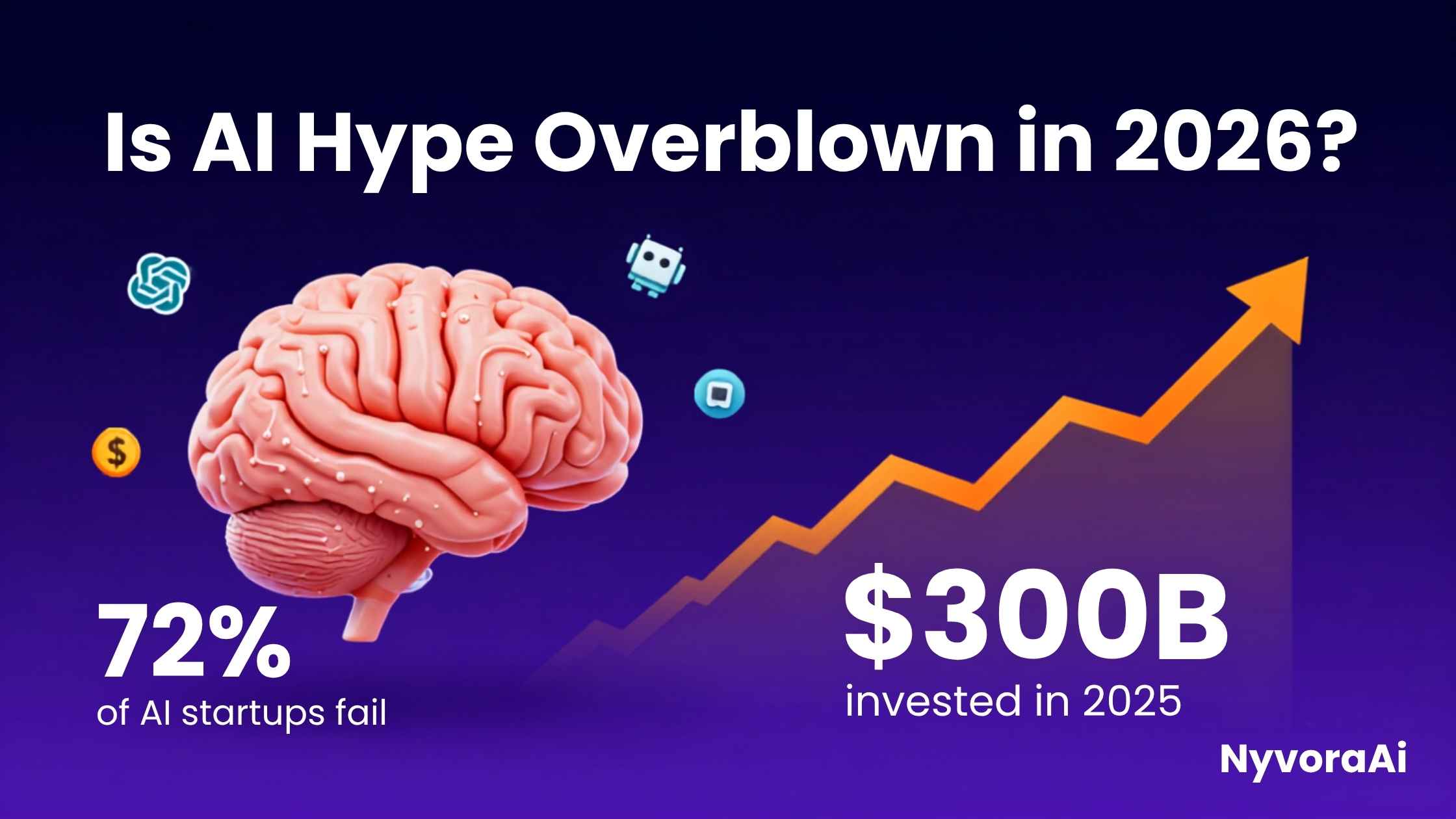
I remember 2023. It was the year of pure, unadulterated magic. Every time a new model dropped, it felt like we were watching the future unfold in real-time. We were all collectively losing our minds over a chatbot that could write a mediocre poem about a toaster. Fast forward to 2026, and the vibe has shifted. The magic has worn off, replaced by a deep, collective exhaustion. People are asking if the whole AI boom was just a massive financial bubble waiting to pop.
So, is AI hype overblown in 2026? If you're looking for a simple yes or no, you're out of luck. The reality is a messy, complicated gray area. The tech evangelists are still promising utopia, while the doomers are predicting the collapse of civilization. Both are wrong. Let's strip away the marketing speak, the VC pitch decks, and the Twitter threads, and look at what AI is actually doing right now.
- The demos are lies. The viral videos of AI coding full games in minutes are cherry-picked and heavily edited. Real-world application is much slower.
- It's a tool, not a god. AI is incredible at summarizing, translating, and debugging, but it still hallucinates and requires heavy human oversight.
- The productivity trap. Instead of saving time, AI often just increases the volume of work we're expected to produce.
- The bubble is popping, but the tech is here. Valuations are correcting, but the underlying utility in specific niches is permanently changing how we work.
01The "AI Can Do Everything" Myth
Let’s start with the biggest lie of all: the idea that AI is this omnipotent oracle that can solve any problem you throw at it. If you spend any time on tech Twitter, you’d think AI can cure cancer, write a bestselling novel, and fix your marriage, all before lunch.
The reality? AI is basically a super-charged autocomplete engine. It is exceptionally good at pattern recognition and statistical probability. But it has zero understanding of the physical world, zero common sense, and zero ability to truly reason through novel, complex problems without hand-holding.
When we see AI generating endless streams of content, people naturally ask is AI making us less creative. The answer is that AI is making us lazier. It’s flooding the internet with a beige sludge of average, statistically probable ideas. It can mimic the style of creativity, but it can't replicate the spark of human lived experience. The hype tells you AI is your new creative partner; the reality is that it's a very fast intern who sometimes makes things up.
02Where the Hype is Actually Real
Now, don't swing too far into cynicism. AI isn't a scam. It is doing some genuinely incredible things, just not the things the marketing departments want you to focus on.
The real wins are in the boring, unsexy stuff. AI is folding proteins at speeds that would have taken human biologists decades. It's optimizing supply chain logistics, saving millions of tons of carbon emissions. It's helping developers debug obscure code errors that would have taken three days to track down manually.
If you work in data-heavy fields, AI is a miracle worker. It can ingest a 500-page legal contract and summarize the key liability clauses in seconds. It can translate technical documentation into plain language. The hype is overblown when it comes to "replacing humans," but it is entirely justified when it comes to "automating the boring parts of human jobs."
03Welcome to the Valley of Disillusionment
If you've ever heard of the Gartner Hype Cycle, you know how this goes. We had the "Peak of Inflated Expectations" in 2023 and 2024. Now, in 2026, we are firmly in the "Trough of Disillusionment."
This is the phase where companies that slapped "AI" on their legacy software to boost their stock price are getting exposed. Users are realizing that the AI chatbot on their bank's website is useless. They're realizing that AI-generated images still struggle with hands and text. They're realizing that training these massive models costs a fortune in electricity and water.
The trough is painful for investors, but it's great for the rest of us. It’s filtering out the snake oil. The companies that survive this phase will be the ones building actual, practical utility, not just flashy demos. We are moving from the era of "look what AI can do" to "how do we actually make AI work without breaking the bank or the law?"
04The Great Productivity Paradox
Here is the biggest bait-and-switch of the AI era. We were promised that AI would give us our time back. We were told we'd be working four-hour days, leaving the rest of the time to pursue our passions while the machines did the heavy lifting.
Instead, what happened? We just got more work. Because AI can draft an email in three seconds, your boss now expects you to send fifty emails a day. Because AI can generate a first draft of a report in a minute, the deadline for the report was moved up by two days.
This leads to the massive, heated debate over is using AI cheating in school or work. If the tool is supposed to make us more productive, why does it feel like we're just running faster on a treadmill? The paradox is that AI didn't eliminate the work; it just changed the bottleneck. The bottleneck is no longer typing speed or basic research; it's editing, verifying, and managing the sheer volume of output the machine can produce.
05The AGI Ghost Story
You can't talk about AI hype without talking about the elephant in the room: Artificial General Intelligence. The tech bros love to dangle AGI in front of us like a carrot. "Just wait until the next model drops," they say. "It's going to be sentient. It's going to solve everything."
This constant teasing sparks endless philosophical debates about will AI ever be truly conscious. But let's be real: current AI architectures are hitting a wall. We are seeing diminishing returns on scaling. Throwing more compute and more data at a Large Language Model doesn't magically give it a soul or common sense. It just makes it better at sounding like it has a soul.
The AGI hype is the most overblown aspect of the entire industry. It's a useful distraction. As long as everyone is terrified of or praying for a god-like AI arriving in 2028, no one is paying attention to the very real, very boring ways AI is currently disrupting labor markets and privacy rights today.
06The Real-World Friction
The ultimate test of any technology is how it handles the messy, unpredictable reality of human life. And this is where AI hype goes to die.
In a sterile, controlled environment, AI looks like a genius. In the real world, it's a liability. When the stakes are high, like in healthcare where patients are desperately asking should you trust AI for medical advice, the hallucinations aren't just annoying; they're dangerous. An AI might confidently prescribe a dosage that is fatally wrong because it misread a decimal point in its training data.
In schools, the debate is fierce about is AI good or bad for education. The hype said AI would be the ultimate personalized tutor. The reality is that it's mostly being used by students to bypass learning, and by teachers to grade papers they don't have time to read. It's an arms race of detection and evasion, not a learning revolution.
And in the justice system, we are rightfully terrified of the idea that should AI make legal decisions. The hype suggests an unbiased, perfectly logical judge. The reality is an algorithm trained on decades of biased human data, automating systemic injustice at the speed of light. When you strip away the marketing, the friction of integrating AI into high-stakes human systems is almost insurmountable.
07The Final Verdict: Signal vs. Noise
So, is AI hype overblown in 2026? Yes. The idea that AI is going to magically utopia our lives into a post-scarcity paradise is pure fiction. The idea that it's going to instantly render all human labor obsolete is equally absurd.
But here is the catch: the technology isn't overblown. It is a profound, foundational shift in how we process information. It's just taking the boring, frustrating, incremental path of actual technological adoption, rather than the magical leap the hype promised.
We are moving past the noise. The companies that are just wrapping a basic API in a chat interface are going to die. The ones that are deeply integrating AI into complex, proprietary workflows are going to thrive. As users, we need to stop looking at AI as a magic wand or a terminator. It's a power tool. It can build a house, or it can cut your hand off, depending on how carefully you're paying attention.
The hype is dead. Long live the useful, flawed, deeply interesting reality of AI.
"AI is getting exponentially smarter every month and will surpass human intelligence by 2027."
The rate of improvement is slowing down. We are hitting the limits of current training data and compute scaling. AI is getting better at specific tasks, but the leap to general, human-like reasoning is not happening on the timeline the hype suggests.