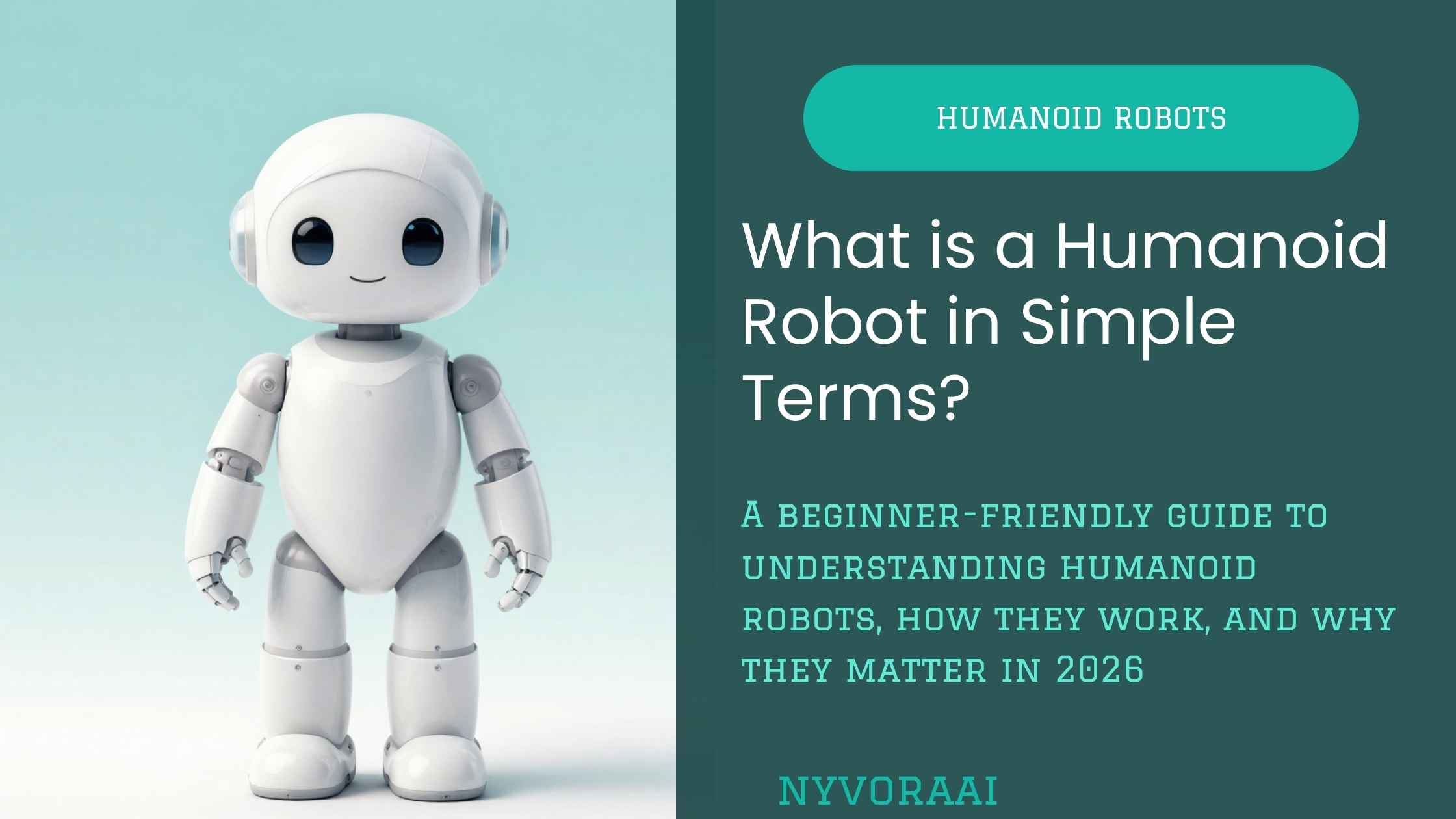
If you've ever watched a sci-fi movie and wondered, "Could that actually happen?" you're in good company. Humanoid robots have captured our imagination for decades, from the Tin Man in The Wizard of Oz to the advanced androids in Westworld. But what is a humanoid robot in simple terms?
Quite literally, it's a machine engineered to mimic the human form and, to some extent, human behavior. The word itself is a dead giveaway: "human" + "-oid" (meaning "resembling"). Think of it as a machine built in our image, designed to navigate our world, use our tools, and interact with us naturally.
But there's so much more to these fascinating machines than just their appearance. In this guide, we'll explore everything from their basic anatomy to the cutting-edge AI that powers their decision-making. We'll also look at why companies are investing billions to make them a reality. If you're curious about the latest breakthroughs, check out our latest news on AI robots in 2026 to stay ahead of the curve.
- Simple Definition: A humanoid robot is a machine designed to look and move like a human, with a head, torso, two arms, and two legs.
- Key Feature: Unlike wheeled or fixed robots, humanoids are bipedal (two-legged) and can navigate human-built environments without requiring structural modifications.
- The Brain: Modern humanoids use advanced AI and sensor fusion to perceive their environment, make split-second decisions, and learn from experience.
- Real-World Use: They're already working in warehouses, hospitals, retail stores, and even homes, assisting with tasks from customer service to elderly care.
01 What is a Humanoid Robot? The Simple Explanation
Let’s cut through the technical jargon and get to the heart of the matter. A humanoid robot is essentially a machine that has been engineered to mirror the human body plan.
The Core Characteristics
What makes a robot "humanoid" rather than just any old machine? There are three key characteristics:
- Bipedal Locomotion: It walks on two legs, just like us. This is crucial because it allows the robot to navigate stairs, doorways, and spaces designed for people without requiring the environment to be redesigned.
- Anthropomorphic Design: It has a recognizable human structure—a head (often packed with sensors that act as eyes and ears), a torso (housing the "brain" and power source), and limbs (arms and hands for manipulation).
- Human-Like Interaction: Advanced humanoids can communicate through speech, facial expressions, and gestures, making interaction with humans feel natural and intuitive.
Think of it this way: If a traditional industrial robot is like a specialized tool (say, a drill press), a humanoid robot is like a general-purpose assistant that can pick up and use many different tools. It's designed to fit into our world, not force us to redesign our world for it.
02 The Anatomy of a Humanoid Robot: Breaking It Down
Just like the human body has different systems working in harmony, a humanoid robot is composed of several key components. Let's break down the anatomy in simple, relatable terms.
How These Parts Work Together
Imagine you ask a humanoid robot to "bring me that book." Here's what happens behind the scenes in milliseconds:
- Sensing: The robot's microphones hear your voice, and its cameras locate both you and the book.
- Processing: The AI brain processes your request, understands the command, and plans the safest, most efficient path.
- Actuation: The motors in the legs activate to walk toward the book, while the arm motors prepare to grasp it.
- Feedback: Touch sensors in the hand confirm the book is securely held, and the robot returns to you.
This seamless coordination is powered by sophisticated algorithms and real-time sensor feedback. It's the same principle that allows warehouse robots to work safely alongside humans, as explored in our article on whether AI robots can replace warehouse workers.
03 How Do Humanoid Robots Actually Work?
Now that we understand the anatomy, let's dive deeper into the mechanics and intelligence that bring these machines to life.
1. Balance and Walking (The Hardest Part)
You probably don't give it a second thought, but walking is a marvel of biological engineering. When you take a step, your brain makes thousands of micro-adjustments to keep you from toppling over. Humanoid robots face this exact same "balance problem."
Robots use several clever techniques to stay upright:
- Gyroscopes and Accelerometers: These sensors detect tilt and acceleration, constantly monitoring the robot's orientation.
- Zero Moment Point (ZMP): A mathematical concept that helps the robot calculate exactly where to place its feet to maintain stability.
- Reactive Control: If the robot starts to fall, it can take a quick step or swing its arms to regain balance, much like humans instinctively do.
2. Perception and Understanding
A robot needs to understand its environment to navigate it safely. This is where computer vision and AI shine:
- Computer Vision: Cameras capture images, and AI algorithms instantly identify objects, people, obstacles, and clear pathways.
- Depth Sensing: LiDAR or stereo cameras measure distances, creating a real-time 3D map of the surroundings.
- Natural Language Processing: Advanced AI allows the robot to understand spoken commands, context, and even the tone of your voice.
3. Decision Making and Learning
This is where the magic happens. Modern humanoids don't just follow rigid, pre-programmed instructions; they learn and adapt:
- Machine Learning: The robot learns from experience, continuously improving its performance over time.
- Reinforcement Learning: Through trial and error in virtual simulations, the robot discovers the most efficient ways to complete physical tasks.
- Neural Networks: These AI systems mimic the human brain, allowing for complex pattern recognition and dynamic decision-making.
The connection between AI and robotics is fundamental to how these machines operate. To understand this relationship better, read our detailed exploration of how AI and robotics are connected.
04 Types of Humanoid Robots: Not All Are Created Equal
While all humanoid robots share the basic human-like form, they vary significantly in capability, purpose, and sophistication.
1. Research Humanoids
These are the lab experiments, designed to push the absolute boundaries of what's possible. Examples include Boston Dynamics' Atlas and Honda's legacy ASIMO. They're incredibly advanced but often too expensive or delicate for everyday commercial use.
2. Service Humanoids
Designed for real-world applications, these robots assist humans in various settings:
- Customer Service: Greeting customers, answering questions, and providing information in retail or hospitality settings.
- Healthcare: Assisting nurses, providing companionship to the elderly, or helping with rehabilitation therapy.
- Education: Teaching children, especially those with autism, through interactive, patient engagement.
3. Industrial Humanoids
These are the workhorses, designed for manufacturing, logistics, and dangerous environments. Companies like Tesla (with Optimus) and Figure AI are leading this charge. They can work alongside humans or in areas too hazardous for people, such as nuclear facilities or disaster zones.
4. Social/Companion Humanoids
Smaller, less complex robots designed for companionship and entertainment. Think of robots like SoftBank's Pepper, which can recognize basic emotions and engage in simple conversation.
05 Real-World Applications: Where Are Humanoids Being Used?
Humanoid robots are no longer confined to research labs. They're actively being deployed in various industries, transforming how we work and live.
1. Warehouses and Logistics
These robots can pick items from shelves, pack boxes, and move goods around—tasks that traditionally required human workers. The advantage? They can work 24/7 without fatigue, and they can use the exact same tools and infrastructure designed for humans.
2. Healthcare and Elderly Care
With aging populations worldwide, there's a growing shortage of caregivers. Humanoid robots are being developed to assist with:
- Medication reminders and vitals monitoring
- Fall detection and emergency response
- Companionship to combat loneliness
- Physical therapy assistance
3. Retail and Hospitality
Hotels and stores are deploying humanoids to greet guests, provide directions, answer frequently asked questions, and handle check-in/check-out processes, freeing up human staff for more complex customer needs.
4. Dangerous Environments
Humanoids can venture where humans simply cannot, such as disaster response (earthquakes, nuclear accidents), space exploration (like NASA's Valkyrie robot), and deep-sea exploration.
06 Challenges and Limitations: Why Aren't They Everywhere Yet?
As thrilling as the progress has been, humanoid robots still face some massive hurdles before they become as common as smartphones.
1. The Balance Problem (Still)
While robots have gotten much better at walking, they still struggle with uneven terrain, slippery surfaces, and unexpected obstacles. One wrong step, and a multi-million dollar robot can fall and damage itself.
2. Battery Life
Most humanoids can only operate for 2–4 hours on a single charge. For a robot to be truly useful in a work setting, it needs to last a full 8-hour shift. Current battery technology is a major bottleneck.
3. Cost
High-end humanoids can cost anywhere from $50,000 to over $2 million. While prices are coming down thanks to mass production, they're still prohibitively expensive for most small and medium businesses.
4. Dexterity and Fine Motor Skills
Human hands are incredibly sophisticated, with 27 bones and the ability to perform delicate tasks. Replicating this dexterity in robots is extremely challenging. Picking up a fragile egg versus a heavy wrench requires completely different grip strategies.
5. Social Acceptance
There's the "uncanny valley" effect—when a robot looks almost human but not quite, it can be unsettling or even creepy to people. Overcoming this psychological barrier is crucial for widespread adoption.
6. Ethical and Legal Questions
As humanoids become more autonomous, we face difficult questions: Who is responsible if a robot causes harm? Should robots have rights? How do we prevent misuse? And what happens to workers whose jobs are replaced by automation?
07 The Future of Humanoid Robots: What's Next?
The field of humanoid robotics is advancing at an astonishing pace. Here's what we can expect in the coming years:
Near Future (2026–2030)
- Improved Battery Technology: Solid-state batteries could double or triple operational time.
- Better AI Integration: Large Language Models (LLMs) will make robots more conversational, context-aware, and capable of following complex, multi-step instructions.
- Cost Reduction: Mass production and improved manufacturing will bring prices down significantly.
Medium Term (2030–2040)
- Home Assistants: Affordable humanoids that can help with cooking, cleaning, and elderly care.
- Seamless Human-Robot Collaboration: Robots that can work safely and efficiently alongside humans in any environment.
- Advanced Learning: Robots that can learn new skills simply by watching humans or reading digital manuals.
Long Term (2040+)
- General Purpose Humanoids: Truly versatile robots that can perform almost any task a human can do.
- Human-Robot Integration: The blurring line between human and machine, with potential cybernetic enhancements and deeper symbiotic relationships.
08 Frequently Asked Questions
What is a humanoid robot in simple terms?
What are the main parts of a humanoid robot?
How are humanoid robots different from other robots?
What are humanoid robots used for?
How much do humanoid robots cost?
Can humanoid robots think and feel?
Are humanoid robots safe to be around?

Written by the NyvoraAI Team
We explore the fascinating world of AI and robotics to help you understand the technology shaping our future. This guide was updated in June 2026. Have questions about humanoid robots? Contact our team or learn more about our mission.