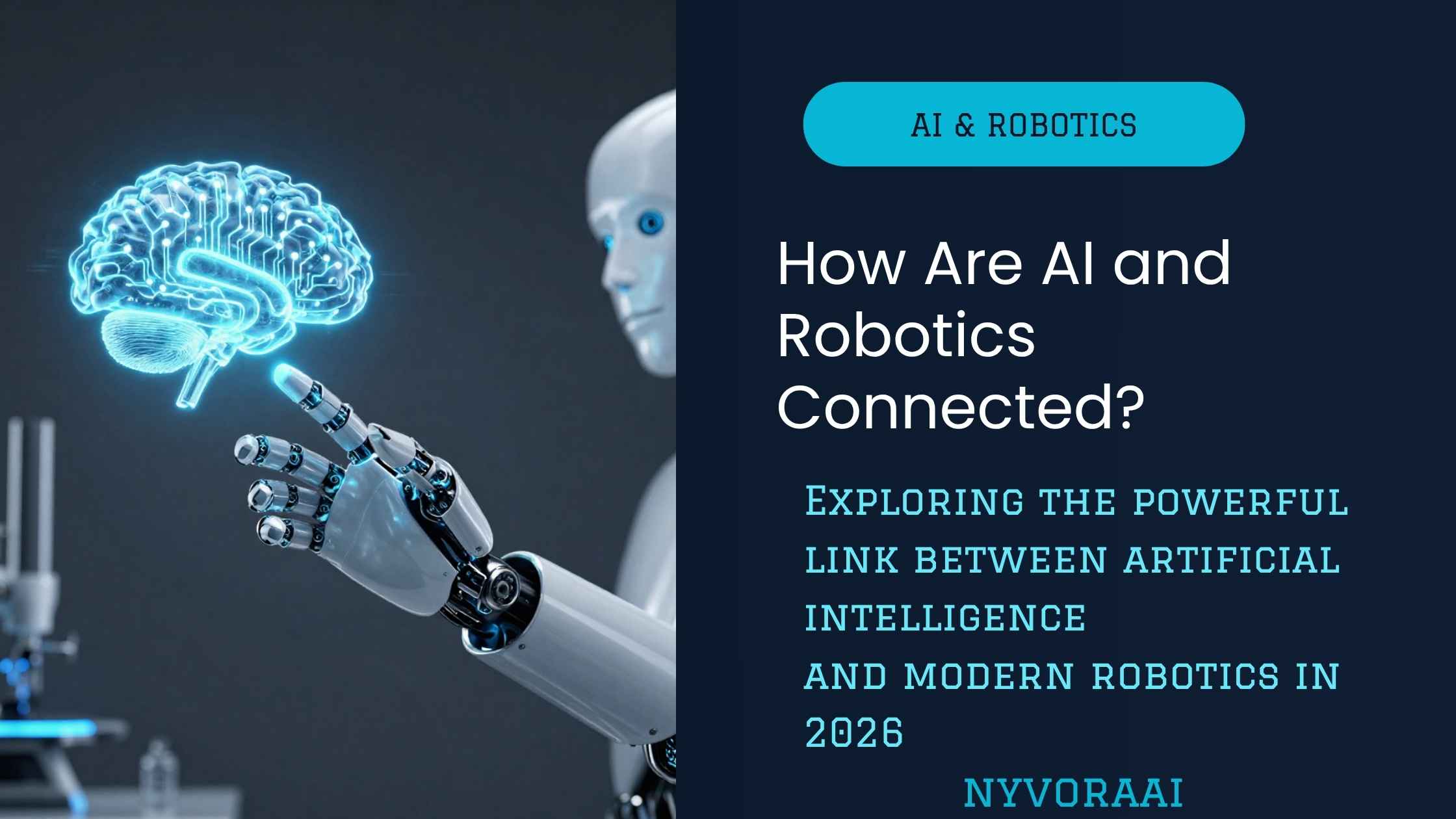
Let’s be honest for a second: when most of us hear "Artificial Intelligence," we picture a sleek chatbot on a screen. When we hear "Robotics," we picture a clunky mechanical arm welding a car door in a factory. For decades, these two fields existed in completely separate universes. Software engineers built brains in the cloud, while mechanical engineers built bodies on the assembly line. But if you look at the cutting edge of technology today, that boundary has completely vanished.
So, how are AI and robotics connected? The simplest way to understand it is this: AI provides the cognition, the decision-making, and the ability to learn. Robotics provides the physical form, the sensors to perceive the world, and the actuators to interact with it. Together, they create "Embodied AI"—machines that do not just process data, but actually exist and act in the physical world. Let us dive deep into how this symbiotic relationship works and why it is the most important technological shift of the 2020s.
- The Brain vs. The Body: AI is the software (the brain) that processes information and makes decisions. Robotics is the hardware (the body) that physically interacts with the environment.
- Embodied AI: The intersection of the two fields is called Embodied AI. It refers to intelligent systems that have a physical presence and can learn from physical interactions.
- Can they exist separately? Yes. AI exists purely in software (like LLMs and predictive algorithms), while traditional robotics exists as pre-programmed, non-learning machines. But the real magic happens when they combine.
- The Core Link: Technologies like Computer Vision, Reinforcement Learning, and Sensor Fusion are the bridges that allow a robot's physical sensors to feed data into an AI's neural networks.
- The Result: Autonomous vehicles, surgical assistants, and humanoid robots that can navigate messy, unpredictable real-world environments.
01 The Brain and The Body: A Perfect Analogy
To truly grasp how these fields connect, it helps to think about human biology. Your brain is an incredible processing engine. It takes in visual data from your eyes, auditory data from your ears, and tactile data from your skin. It processes that information, recognizes patterns, makes decisions, and sends electrical signals down your spine to your muscles, telling your hand to pick up a cup of coffee.
AI and robotics replicate this exact loop. The "sensors" on a robot (cameras, LiDAR, microphones, touch sensors) are the eyes and ears. The AI algorithms (neural networks, machine learning models) are the brain. The "actuators" (motors, hydraulic pistons, grippers) are the muscles.
What Happens When They Are Separated?
If you have robotics without AI, you get a traditional industrial robot. It is incredibly fast and precise, but it is completely "deaf" and "blind." If you move the part it is supposed to weld by just two inches, the robot will blindly weld the empty air. It cannot adapt. It only knows the exact coordinates it was programmed to follow.
If you have AI without robotics, you get a software model. It can write a poem, predict stock market trends, or diagnose a disease from an X-ray. But it cannot physically reach out and turn a valve, deliver a package to a doorstep, or help an elderly person stand up from a chair. It is trapped behind the glass of a screen.
When you connect them, you get a system that can perceive an unpredictable environment, think about the best way to handle it, and physically execute a solution. For a broader look at how these physical systems are making headlines, you should definitely check out the latest news in AI robots 2026 to see these concepts in action.
02 A Brief History of the Convergence
The connection between AI and robotics was not always this seamless. In the 1960s and 70s, robotics was purely mechanical and hydraulic. The focus was on raw strength and repeatable precision. AI, meanwhile, was in its "winter" phases, struggling with basic logic puzzles and chess.
The turning point came in the 2010s with the explosion of Deep Learning and massive increases in computing power. Suddenly, AI could process visual data in real-time. A camera mounted on a robotic arm could finally "see" a pile of jumbled objects, identify a specific wrench, calculate its angle, and guide the arm to pick it up. This was the birth of modern "pick-and-place" AI robotics, and it completely changed the logistics industry overnight.

03 The 3 Core Technologies Bridging the Gap
How does a stream of pixels from a camera turn into a physical movement of a motor? It happens through three critical technological bridges.
These technologies are not just for giant factories. The same underlying AI principles that allow a robot to navigate a warehouse are being scaled down for everyday business use. If you want to apply this connection to your own digital workflows, learning how to automate repetitive tasks with AI is the perfect starting point for boosting your productivity today.
04 Real-World Applications of the AI-Robotics Connection
When AI and robotics connect, the results are nothing short of revolutionary. Here is how this synergy is manifesting in the real world right now.
1. Autonomous Vehicles
A self-driving car is the ultimate example of AI and robotics connected. The robotics side includes the steering, braking, and acceleration systems. The AI side processes terabytes of data per second from cameras and LiDAR, predicting the behavior of pedestrians, other cars, and traffic lights. It is a split-second decision-making engine housed in a two-ton metal body.
2. Smart Manufacturing & Cobots
Collaborative robots (Cobots) work side-by-side with humans. Unlike old caged robots, cobots use AI-driven force sensors and computer vision. If a human steps into their path, or if a hand gets too close, the AI instantly calculates the safest way to stop or reroute the arm to prevent injury. Platforms like NVIDIA Isaac are pioneering these simulations, allowing robots to learn complex manipulation tasks before they ever touch the physical factory floor.
3. Healthcare & Surgical Assistants
Robotic surgical systems are being profoundly enhanced by AI that can overlay 3D maps of a patient's internal anatomy onto the surgeon's view, highlighting blood vessels to avoid. The robot provides the physical precision to make a micro-incision, while the AI provides the cognitive map to ensure it is done safely, as frequently documented in IEEE Spectrum robotics reports.
4. Space and Deep Sea Exploration
When you send a rover to Mars, the communication delay means you cannot use a joystick to drive it. The robot must be entirely autonomous. It uses AI to analyze the terrain, identify dangerous sand traps, plan a safe route, and physically drive itself. The AI is the explorer; the rover is just the boots on the ground.
| Feature | Traditional Robotics | AI-Connected Robotics |
|---|---|---|
| Environment | Strictly controlled, static | Dynamic, unpredictable, messy |
| Programming | Hard-coded coordinates | Machine learning & simulation |
| Perception | Blind (No sensors) | Computer Vision, LiDAR, Touch |
| Adaptability | Fails if variables change | Adapts in real-time |
| Learning | Cannot learn from errors | Improves with more data |
05 The Future: General-Purpose Embodied AI
We are currently transitioning from "Narrow AI Robotics" to "General-Purpose Embodied AI." Today, a robot that learns to fold towels cannot suddenly use that same knowledge to wash dishes. It is highly specialized.
The future, however, involves "Foundation Models for Robotics." Just as Large Language Models (LLMs) learned the underlying structure of human language and can now write code, poems, and emails, future robotic models will learn the underlying physics of the real world. You will be able to show a humanoid robot a completely new task—like making a specific type of coffee—just by demonstrating it once. The AI will understand the physics of the cups, the liquid, and the machine, and generalize that knowledge to perform the task.
To stay updated on all these mind-bending technological shifts, our AI News hub covers everything from software algorithms to hardware robotics, keeping you ahead of the curve.
06 Frequently Asked Questions
How are AI and robotics connected?
Can robotics exist without AI?
Can AI exist without robotics?
What is the future of AI and robotics integration?
What is "Embodied AI"?
Is AI making robots dangerous?

Written by the NyvoraAI Team
We break down the complex intersection of software and hardware to help you understand the future of technology. This guide was updated in June 2026. Have questions? Contact our team or learn more about our mission.