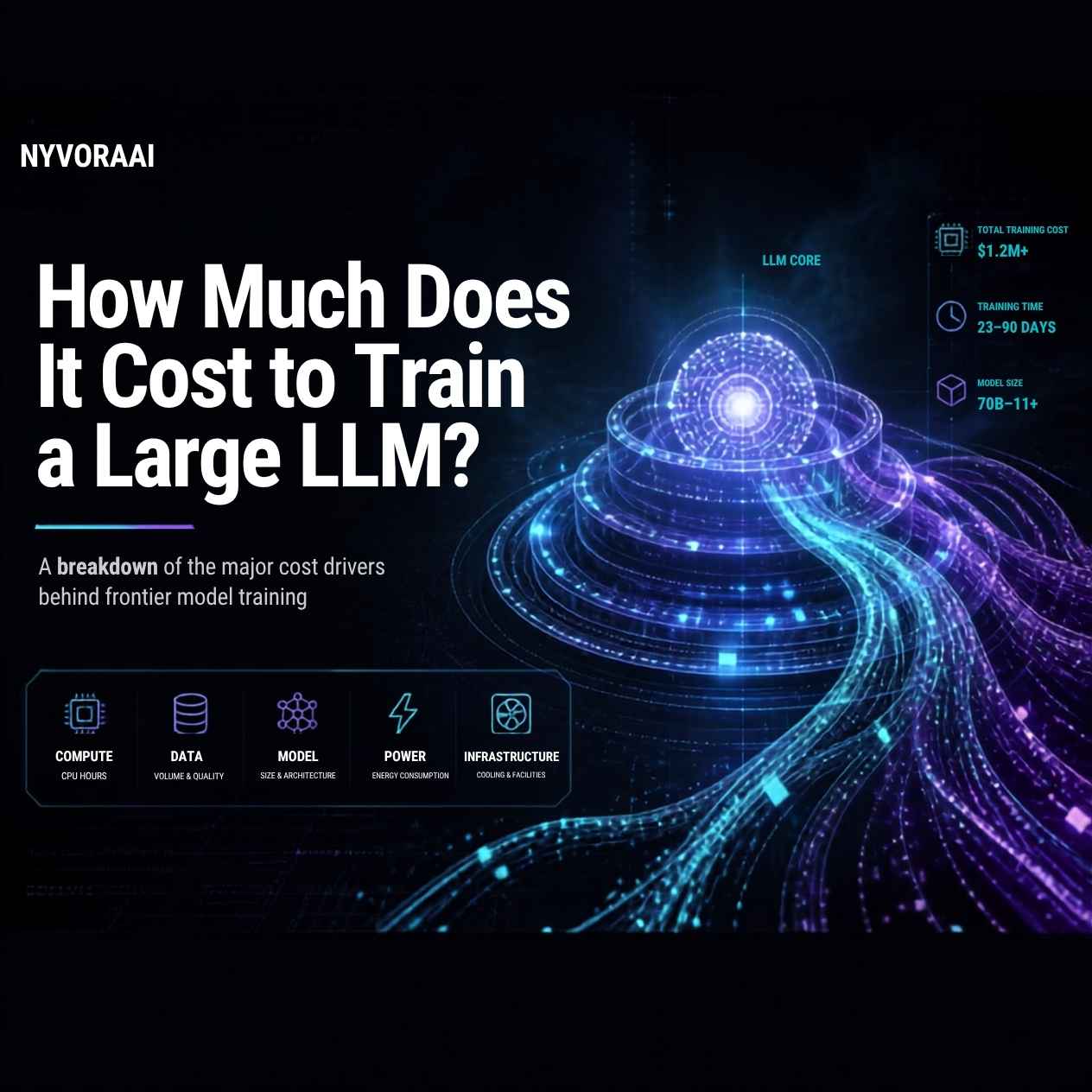
Ask ten people how much it costs to train a large LLM and you'll get ten wildly different answers, and honestly, all of them could be right. That's because "training an LLM" isn't one single price tag — it's a spectrum that runs from a weekend hobby project costing a few hundred dollars in cloud credits, all the way up to frontier systems that burn through hundreds of millions of dollars in compute before they ever answer a single prompt. The confusion usually comes from people quoting frontier-model numbers as if they apply to every LLM, when in reality, model size, training duration, and infrastructure choices swing the final bill by several orders of magnitude.
So let's actually break it down. Not vague ranges pulled from a headline, but the real cost drivers, real numbers from real frontier models, and a framework for estimating what training something of your own might actually cost.
- The Range: Anywhere from roughly $50,000 for a small 1–20 billion parameter model to over $190 million for a frontier system.
- GPT-4: Estimated at $78–100 million in training compute, according to the Stanford AI Index Report.
- Gemini Ultra: Estimated at approximately $191 million in training compute.
- The Biggest Line Item: GPU compute time dominates the budget — a single NVIDIA H100 can cost $25,000–$40,000, and frontier runs use thousands of them for months.
- The Good News: Smaller open-weight models can now be trained within a $100,000 budget using efficient architectures, and fine-tuning an existing model costs a tiny fraction of training from scratch.
01 What Actually Drives the Cost?
When people picture the cost of training an LLM, they usually just picture a giant computer running for a long time. That's directionally correct, but the real line items break down into several distinct categories, and each one is expensive in its own way.
GPU compute is consistently the single largest expense, and it's not hard to see why once you look at the raw numbers. GPT-4's training run is estimated to have consumed around 2.1 × 10²⁵ floating-point operations, while a model like Gemini Ultra may have used more than double that. To push that much computation through in a reasonable timeframe, labs run thousands of high-end accelerators like NVIDIA's H100 in parallel, continuously, for weeks or months. A single H100 GPU costs somewhere between $25,000 and $40,000, meaning a cluster of just 1,000 of them represents $25–40 million in hardware alone — before you've even factored in the electricity, networking, and cooling needed to keep that cluster running.
Data is the second major cost center, though it's less visible than GPU spend. Training a competent LLM requires trillions of tokens of text, and sourcing, cleaning, deduplicating, and licensing that data at scale is its own significant undertaking. If you want to understand this stage in more depth, our explainer on what is a foundation model in AI covers how this raw data becomes the base layer every downstream model builds on.
02 Cost by Model Size: Small, Mid, and Frontier
The single biggest factor in the final bill is simply how big the model is, measured in parameters. Here's how the cost tiers actually break down in 2026.
The gap between "small model" and "frontier model" cost isn't linear — it's closer to exponential. Doubling a model's parameter count and training-token budget doesn't just double the compute bill; it can multiply it several times over, which is exactly why only a handful of well-funded labs can currently compete at the true frontier tier.
03 Training From Scratch vs. Fine-Tuning vs. Just Using an API
Before you assume you need to train a model at all, it's worth understanding just how differently these three paths are priced. Here's a simulated walkthrough of the same goal — a company wanting an AI assistant that understands their internal jargon — approached three different ways.
Reality: You need massive amounts of training data, a GPU cluster, and a team of ML engineers. For 99% of businesses, this is wildly disproportionate to the problem being solved.
Reality: You take an existing open-weight model and specialize it on a few hundred to a few thousand examples. This gets you 90% of the value at a tiny fraction of the cost.
Reality: No training cost at all. You're paying an established provider per request, and a well-written system prompt often solves the problem without any customization.
If you're weighing an open-weight model for fine-tuning, it's worth first understanding what does open source LLM mean — since "open" can refer to open weights, open training data, or both, and that distinction affects both cost and what you're legally allowed to do with the result.
04 Why Training Costs Are Actually Falling
Here's the encouraging part of this story: while frontier-model costs keep climbing, the cost to achieve a given level of capability has been dropping sharply. What required roughly $100 million a few years ago is increasingly achievable for a fraction of that today, thanks to more efficient architectures, better training techniques, and smarter use of existing pretrained weights instead of starting from zero every time. This trend is a big part of why open-weight alternatives have exploded in number and quality. Our full breakdown of why are LLMs getting cheaper 2026 digs into the specific technical and market forces behind this shift.
A great real-world example of this efficiency trend is DeepSeek, which made headlines by achieving highly competitive performance at a fraction of the training cost typically associated with top-tier models. If you're curious exactly how it stacks up against the more established players, see how does DeepSeek compare to ChatGPT for a direct look at the trade-offs between cost-efficient training and raw frontier capability.
05 Should You Actually Train Your Own Model?
Given these numbers, here's the honest checklist for deciding whether training your own LLM makes sense, or whether you're better off fine-tuning or simply calling an API.
✅ Training From Scratch Might Make Sense If:
- You have a genuinely novel use case: No existing model architecture or training data adequately covers your domain.
- You need full ownership and control: Regulatory, security, or IP requirements mean you cannot rely on a third-party model or API.
- You have the infrastructure and talent: Access to serious GPU compute and an experienced ML engineering team, not just a good idea.
❌ Skip Training From Scratch If:
- You just need domain-specific behavior: Fine-tuning an existing open-weight model gets you most of the value for a tiny fraction of the cost.
- Your budget is under seven figures: Frontier-class training is simply out of reach; even mid-size training runs require serious capital.
- Speed to market matters: Training from scratch takes months of data preparation and compute time before you have a usable model at all.
06 How to Estimate Your Own Training Budget
If you've decided training or fine-tuning genuinely makes sense for your situation, here's the practical process for estimating what it will actually cost.
07 Test Your Knowledge: The LLM Cost Quiz
See how well you've absorbed the numbers with this quick interactive quiz — click through the answers to check yourself.
08 Conclusion: There's No Single Price Tag
So, how much does it cost to train a large LLM? The honest answer is: it depends entirely on what you're building. A small, efficient open-weight model can be trained for roughly the price of a used car. A frontier system competing with GPT-4 or Gemini Ultra can cost more than most companies will ever spend on anything in their history. The gap between those two numbers isn't a mistake in the reporting — it's the actual shape of the AI training landscape in 2026.
For almost everyone reading this, the practical takeaway isn't "how do I raise $100 million to train a model." It's understanding that fine-tuning an existing open-weight model, or simply calling a well-chosen API, gets you the vast majority of the value at a fraction of a fraction of the cost. Save the from-scratch training conversation for the rare case where nothing else will do.
09 Frequently Asked Questions
How much does it cost to train a large LLM?
Why is training a large LLM so expensive?
Can I train an LLM on a small budget?
What is the biggest cost driver in LLM training?
Is training your own LLM cheaper than using an API?

Written by Varun Lalwani
Varun covers large language models, AI infrastructure economics, and the practical side of building with accessible AI tools. Published July 2026. Questions? Contact our team or learn about our mission. Stay updated via our RSS feed.