Let me start with the version most articles skip. When people say "open source LLM," they usually mean something more specific than traditional open source software, and that distinction matters a lot when you're trying to understand what you can and can't do with these models. The phrase has become a bit loose in AI circles, so it's worth grounding the term properly before getting into what these models are and why they've become such a big deal.
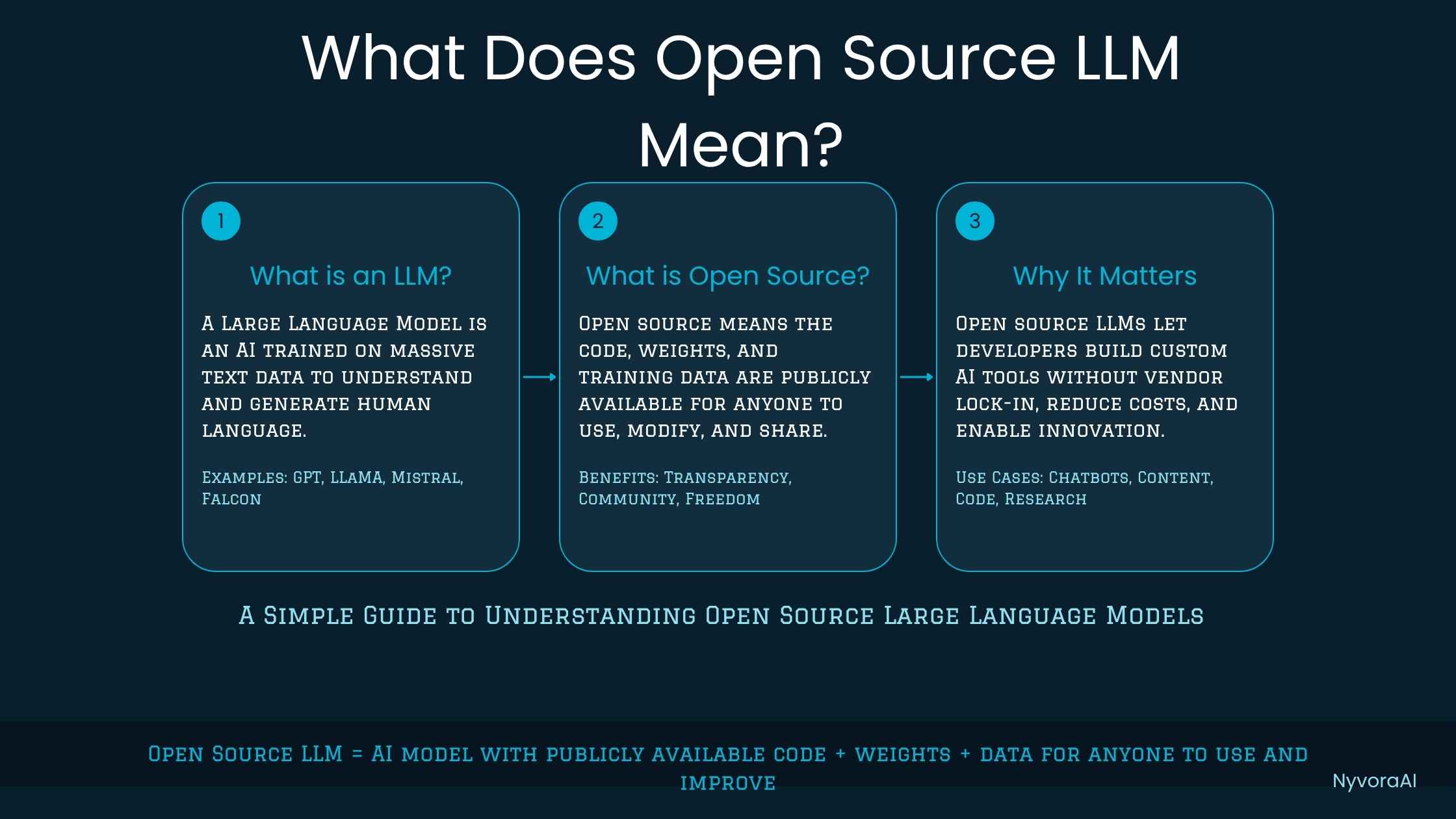
The short version: an open source LLM is a large language model where the creator has publicly released the trained model — usually the "weights," which we'll explain in a moment — so that anyone can download it, run it, and often modify it. This is fundamentally different from using ChatGPT or Claude through a browser, where you're talking to a model sitting on someone else's servers without ever getting access to the underlying AI itself.
- The basic definition: An open source LLM is a large language model whose trained weights are publicly released — meaning anyone can download the actual AI, not just use it through a website.
- What "weights" means: The weights are the billions of numbers that define what the model knows and how it behaves. Releasing them is like giving someone the recipe, not just the finished dish.
- What you can do: Download the model, run it on your own computer, train it further on your own data, build products with it, and use it offline in complete privacy.
- What you can't do with closed models: Inspect the model, run it privately, modify it, or avoid paying per query.
- Famous examples: Meta's Llama, Mistral, Qwen, Gemma, and DeepSeek are the biggest open source LLM families in 2026.
01 What Does Open Source Mean — and Why AI Is a Special Case
In software, "open source" traditionally means the source code is publicly available. Anyone can read it, audit it, suggest changes, and build on top of it. Linux, Firefox, and Python are classic examples. The idea behind this is transparency and collaboration — if the code is public, developers worldwide can find bugs, suggest improvements, and trust what the software is actually doing.
AI models are different from typical software, which is why the term gets complicated. An AI model isn't just lines of code. It's a mathematical structure — a neural network — whose behaviour is defined by billions of numerical parameters trained on enormous datasets. Those parameters are called the model's weights. When someone builds a large language model, the "secret sauce" isn't the code used to run it (that's often already open source), it's the trained weights themselves — the result of spending millions of dollars running data through that code for months.
So when people in AI say "open source LLM," they usually mean a model that has released its weights. Sometimes they also release the training code, the training data, and detailed documentation. Sometimes it's just the weights. The degree of openness varies, but releasing the weights is the part that matters most for practical use — because with the weights, you can actually run the model.
Technically, many models called "open source" are more accurately "open weight" — the trained model is released, but maybe not all the training code or dataset. For everyday purposes, this distinction rarely matters. What matters is whether you can download the weights and run the model yourself. If yes, the model is practically open source for your purposes, whatever the precise licence says.
02 Open Source vs Closed AI — The Core Difference
The clearest way to understand what "open source LLM" means is to compare it directly with the closed alternative.
| Feature | Open Source LLM | Closed LLM (e.g. ChatGPT) |
|---|---|---|
| Access to model weights | ✓ Download freely | ✗ Never released |
| Run offline / on your hardware | ✓ Yes | ✗ Cloud only |
| Cost per query | ✓ $0 after setup | ✗ Paid API or subscription |
| Data stays on your device | ✓ Fully private | ✗ Sent to provider servers |
| Fine-tune on your own data | ✓ Yes | ✗ Limited or unavailable |
| Audit model behaviour | ✓ Inspect weights and code | ✗ Proprietary black box |
| Works without internet | ✓ After download | ✗ Always requires connection |
| Provider dependency risk | ✓ None once downloaded | ✗ Price/availability changes |
The table above captures the practical meaning of "open source" in the AI world better than any definition. It's not primarily an ideological position (though some people treat it as one). It's a set of concrete capabilities: run it yourself, keep your data private, customise it, and avoid recurring costs. These are things you simply cannot do with ChatGPT, Claude, or Gemini as long as those remain closed models.
03 Model Weights — What They Are and Why They Matter
Since "weights" is the most important technical term in this discussion, it deserves its own proper explanation rather than a quick aside.
Imagine a large language model as an enormous mathematical function. You put text in, and you get text out. Inside that function are billions of individual numbers — each one a parameter that was adjusted during training to make the model better at predicting the next word. After training is complete, these numbers are "frozen" and saved to a file. That file is the model weights.
The weights are what carry the model's knowledge. When GPT-4 knows who wrote Hamlet, or how to write Python code, or the rules of chess — all of that is encoded, in a distributed and non-obvious way, in those billions of numbers. Releasing the weights is releasing that knowledge in a form that can run on your hardware without any further training.
04 Why Open Source LLMs Matter — Beyond the Hype
There's a version of this conversation that treats open source AI as inherently virtuous and closed AI as inherently bad. I don't think that framing is particularly useful. What's more interesting is understanding exactly which problems open source LLMs solve that closed models can't, because those are concrete and real.
The cost side of this story has become particularly significant in 2026. Our deeper look at why LLMs are getting cheaper in 2026 explains how open source releases have directly forced proprietary providers to lower their API prices — benefiting everyone, even people who never touch a local model.
05 Real Open Source LLMs You Can Use Right Now
The term stops being abstract the moment you look at specific models. Here are the main open source LLM families available in 2026 and what each one is known for.
If you want a ranked breakdown of which model to choose for specific tasks — coding, reasoning, multilingual work, or lightweight local use — our full guide on the best LLM for beginners in 2026 covers those comparisons clearly. And for a direct comparison between the major closed and open alternatives side by side, the GPT vs Claude differences guide is a useful companion read.
06 How to Actually Use an Open Source LLM
Knowing what open source LLMs are is one thing. Knowing how to actually run one is another. The good news is that it's gotten dramatically easier over the past two years, to the point where most people can have a local model running in under ten minutes with no technical background required.
Tools like Ollama and LM Studio have removed almost all the technical friction from running a local model. You download an app, click a model name, and start chatting. The days of needing to compile code from scratch or understand CUDA drivers just to try a local AI are largely behind us, at least for the most popular models and tools.
The three main tools for running open source LLMs in 2026 are Ollama (a command-line tool that works with a single simple command), LM Studio (a completely visual desktop app, no terminal required), and GPT4All (another beginner-focused desktop interface). All three are free, all three support the major model families, and all three handle the complexity of getting the model onto your machine and running correctly.
Our complete, step-by-step guide on how to run an LLM on your own computer covers the full setup process — hardware requirements, which tools to use, which models to start with, and what to do when things go wrong. If you want to go from "I understand what open source LLM means" to "I'm actually chatting with one locally," that's the next thing to read.
The trend is toward smaller, more capable models that run on increasingly modest hardware. In 2023, getting a useful local model running required a dedicated GPU. In 2026, a good 7B model runs acceptably on a MacBook with 16GB of RAM. In another year or two, genuinely capable AI running on a phone without any cloud connection at all is a realistic prospect. Open source is at the centre of that trajectory — because proprietary models won't run on your phone without sending data to a server, by definition.
07 Conclusion — What Open Source LLM Really Means for You
Strip away the jargon and the technical detail, and "open source LLM" means something pretty straightforward: it's an AI model where the trained result has been shared publicly, so you're not dependent on a company's servers, pricing decisions, or privacy policies to use it.
That matters in different ways depending on who you are. If you're a developer, it means zero per-query cost and full control over fine-tuning. If you're a business in a regulated industry, it means AI you can run on your own infrastructure without sending sensitive data anywhere. If you're a researcher, it means being able to study what the model actually learned rather than treating it as a black box. And if you're just curious, it means you can download one of the most capable AI models available, run it on your own laptop, and chat with it offline for free.
The open source AI ecosystem has grown remarkably fast. In early 2023, open models lagged noticeably behind frontier closed models. By mid-2026, the best open source models are genuinely competitive with GPT-4 class performance on most tasks, and the gap keeps narrowing. Whatever you decide to use day-to-day, understanding what open source LLMs are and what they can offer is genuinely useful knowledge for anyone navigating the AI landscape right now.
08 Frequently Asked Questions
What does open source LLM mean?
What is the difference between open source and closed AI models?
Are open source LLMs free to use?
What are the best open source LLMs in 2026?
Can I run an open source LLM on my laptop?

Written by Varun Lalwani
Varun writes about large language models, open-source AI, and making complex AI concepts genuinely accessible. Published July 2026. Questions? Contact the team or learn about our mission. Stay updated via our RSS feed.