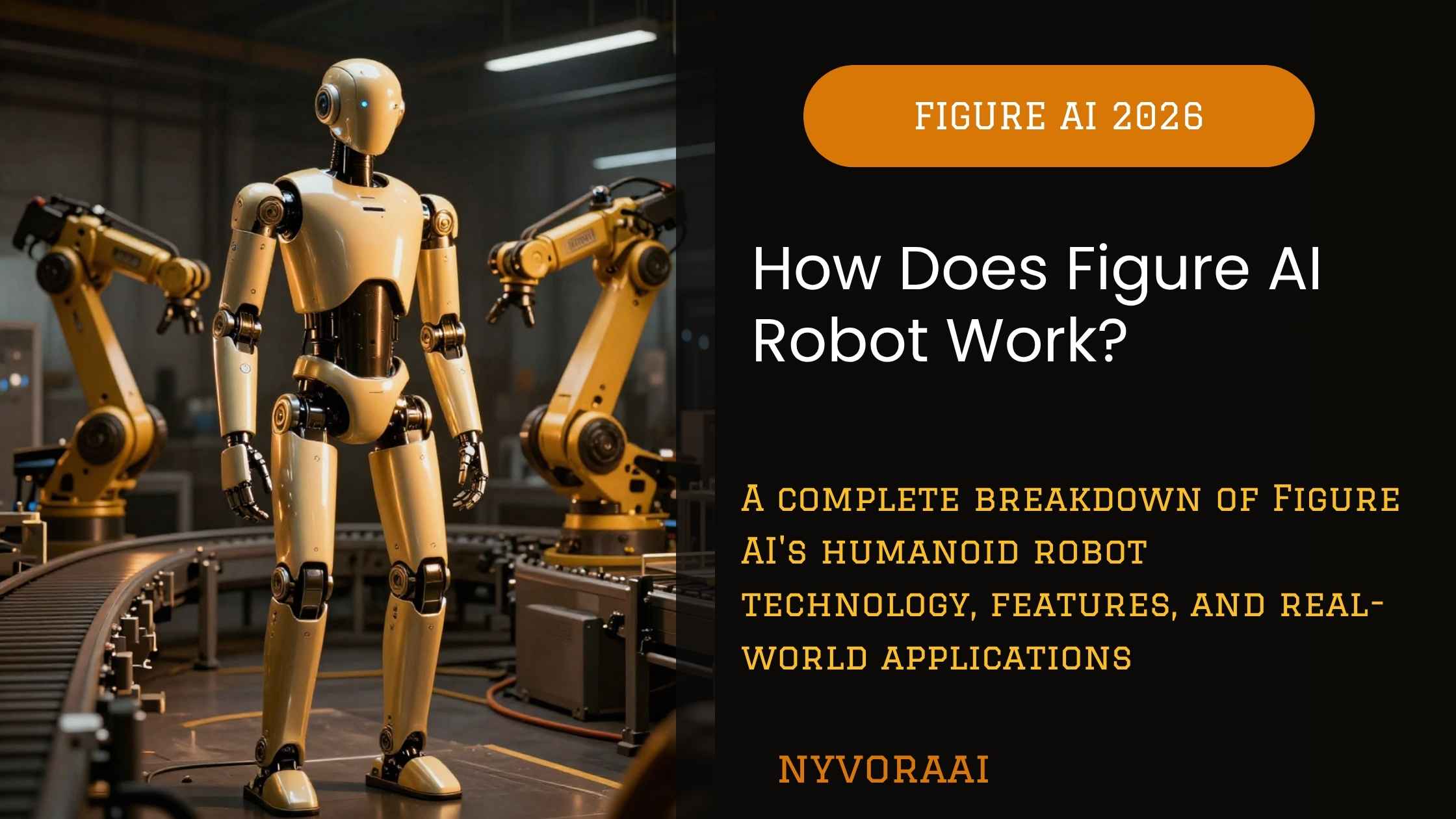
You’ve probably seen the clips: a sleek, white humanoid robot calmly sorting parts, picking up boxes, and navigating a bustling BMW factory floor. This is Figure 02, the flagship creation of Figure AI. But beyond the impressive viral demonstrations, a massive question remains for engineers, investors, and business owners alike: how does it actually function? How does a machine of metal, wire, and silicon navigate a chaotic factory floor without bumping into anything?
To truly understand the mechanics behind this marvel, you first need to grasp how AI and robotics are connected to create a seamless loop of perception and action. Today, we are pulling back the curtain on Figure AI. We will break down the hardware, the software, the sensory systems, and the machine learning models that allow this robot to perform complex physical tasks. By the end of this guide, you will know exactly what makes Figure 02 tick, and why it is widely considered one of the most advanced humanoid robots on the planet.
- The Brain: Figure 02 uses a combination of advanced neural networks and large language models (LLMs) to process visual data and make real-time, context-aware decisions.
- The Hands: Its hands feature 11 degrees of freedom and embedded tactile sensors, allowing it to handle delicate objects without crushing them.
- The Senses: A network of depth cameras and LiDAR provides a 360-degree, 3D map of its environment, updated multiple times per second.
- The Learning: Instead of being hard-coded for every single movement, the robot learns by watching human demonstrations and practicing millions of times in virtual physics simulations.
01 The Brain: Software and Neural Networks
The most critical component of Figure 02 is not its metal chassis; it is the AI software running inside it. Traditional industrial robots are essentially blind and deaf. They are programmed to repeat the exact same motion thousands of times a day. If a part is moved two inches to the left, the traditional robot will continue welding empty air. Figure AI completely shatters this model.
The robot is powered by advanced neural networks that act as its central nervous system. These networks take in massive amounts of sensory data, process it in milliseconds, and output precise motor commands. But what truly sets Figure AI apart is its groundbreaking partnership with OpenAI to integrate large language models (LLMs) with physical control systems. This means the robot can understand natural language commands. A floor manager can simply say, "Pick up the red bins and move them to the packing station," and the robot's AI will interpret the intent, identify the red bins visually, calculate the safest path, and execute the physical movement.
This level of cognitive ability requires immense computing power. While the robot has onboard processors for immediate reflexes and balance, heavy computational tasks are often offloaded to edge servers or cloud infrastructure via ultra-low latency 5G networks. This hybrid approach ensures the robot remains agile while still having access to massive, state-of-the-art AI models.
02 The Body and The Hands
Hardware matters just as much as software. A brilliant AI brain is useless if the physical body cannot execute its commands. Figure AI has spent years engineering a chassis that closely mimics human biomechanics. The robot stands about 5 feet 7 inches tall and weighs roughly 140 pounds. This precise weight distribution is crucial for maintaining balance while walking or reaching for heavy objects.
But the real triumph of Figure 02 is its hands. In the robotics world, hands are notoriously difficult to engineer. You need them to be strong enough to grip a heavy wrench, but sensitive enough to pick up a raw egg without cracking the shell. Figure AI solved this by designing hands with 11 degrees of freedom.
More importantly, these hands are packed with tactile sensors. When the robot grabs an object, it can feel the weight, the texture, and the slip. If it senses an object starting to slide from its grip, the AI instantly adjusts the grip pressure in a fraction of a second. This closed-loop feedback system is what allows Figure 02 to handle a wide variety of unpredictable objects on a busy factory floor.
03 The Senses: Vision and Spatial Awareness
To navigate a chaotic environment, the robot needs to see and understand the world exactly as we do. Figure 02 is equipped with a sophisticated array of sensors located in its head and torso.
First, there are high-resolution RGB cameras that provide standard visual data, allowing the AI to recognize objects, read text on boxes, and identify colors. But standard cameras cannot judge depth accurately. To solve this, Figure AI uses depth cameras and LiDAR (Light Detection and Ranging). LiDAR shoots out thousands of laser pulses per second, measuring the time it takes for them to bounce back. This creates a highly accurate, real-time 3D point cloud of the robot's surroundings.
By fusing all this data together—a process called sensor fusion—the robot builds a dynamic, 360-degree map of its environment. It knows exactly where the walls are, where the human workers are walking, and where the parts bins are located. If a human worker suddenly steps into the robot's path, the AI instantly recalculates its route to avoid a collision, ensuring a safe collaborative environment.
04 Real-World Application: The BMW Partnership
Theory is great, but how does Figure 02 perform in the real world? Figure AI has partnered with BMW to deploy its robots directly on the manufacturing floor in Spartanburg, South Carolina. This is not a sterile, controlled laboratory environment; it is a loud, busy, unpredictable factory where thousands of parts are moved every single day.
In this environment, Figure 02 is tasked with operating sheet metal cage welding stations. This involves picking up heavy parts, placing them into precise fixtures, and managing the workflow. The robot has to deal with glare from welding arcs, varying lighting conditions, and parts that are not always in the exact same position.
Seeing these robots work alongside humans naturally raises a critical question: can AI robots replace warehouse workers? The short answer from the BMW deployment is no, not entirely. The goal of Figure 02 is not to eliminate human jobs, but to take over the "3 Ds" of manufacturing: jobs that are dull, dirty, or dangerous. By handling the repetitive strain of lifting heavy metal cages, the robot allows human workers to focus on quality control, machine maintenance, and complex problem-solving. It is a collaborative model, often referred to as a "Centaur" workforce, where human intuition pairs perfectly with robotic endurance.
05 How It Compares to the Competition
Figure AI is not the only player in the humanoid robot space. If you are evaluating different options for your business, you need to know how Figure 02 stacks up against the giants. For a complete breakdown of the market, you should check out our guide on the best AI robot companies in 2026.
When compared to Tesla's Optimus, Figure 02 currently holds an edge in hand dexterity and proven deployment in complex automotive manufacturing. Tesla is focusing heavily on mass production and affordability, but Figure AI has spent more time refining the tactile feedback required for delicate assembly tasks.
Compared to Boston Dynamics' Atlas, Figure 02 is less about acrobatic mobility and more about industrial utility. Atlas can do parkour, but Figure 02 is designed to stand in one spot for eight hours, precisely inserting heavy parts into fixtures. They serve two very different, equally valuable purposes in the robotics ecosystem.
06 The Future of Figure AI Technology
The technology behind Figure 02 is evolving at a breakneck pace. The company is continuously collecting data from its factory deployments to train its neural networks. Every time the robot successfully picks up a new type of part, or successfully navigates around a new obstacle, that data is fed back into the central AI model.
This means that a Figure robot deployed today will be significantly smarter and more capable a year from now. The ultimate goal of Figure AI is to create a truly general-purpose humanoid robot. They want to build a machine that can walk into any environment—a hospital, a warehouse, a retail store, or even a private home—and figure out how to be useful without needing to be explicitly programmed for every single task.
To stay updated on all the mind-bending advancements coming from Figure AI and its competitors, be sure to follow the latest news in AI robots for 2026. The next 12 months will bring massive updates to battery density, actuator efficiency, and AI reasoning capabilities.
07 Frequently Asked Questions
How does Figure AI robot work?
How does Figure 02 learn new tasks?
What is the battery life of the Figure AI robot?
Can Figure AI robot understand voice commands?
Is Figure AI robot safe to work around?
How much does a Figure AI robot cost?

Written by the NyvoraAI Team
We break down complex robotics engineering into clear, actionable insights. This guide was updated in June 2026 with the latest technical specifications. Have questions? Contact our team or learn more about our mission.