Picture a hospital. When a patient walks in, they don't get examined by every single doctor on staff at once — that would be slow, expensive, and mostly pointless. Instead, a triage nurse looks at the symptoms and sends the patient to the one or two specialists who are actually relevant: a cardiologist for chest pain, a dermatologist for a rash. The hospital as a whole has enormous collective expertise, but only a small slice of it gets used for any single patient.
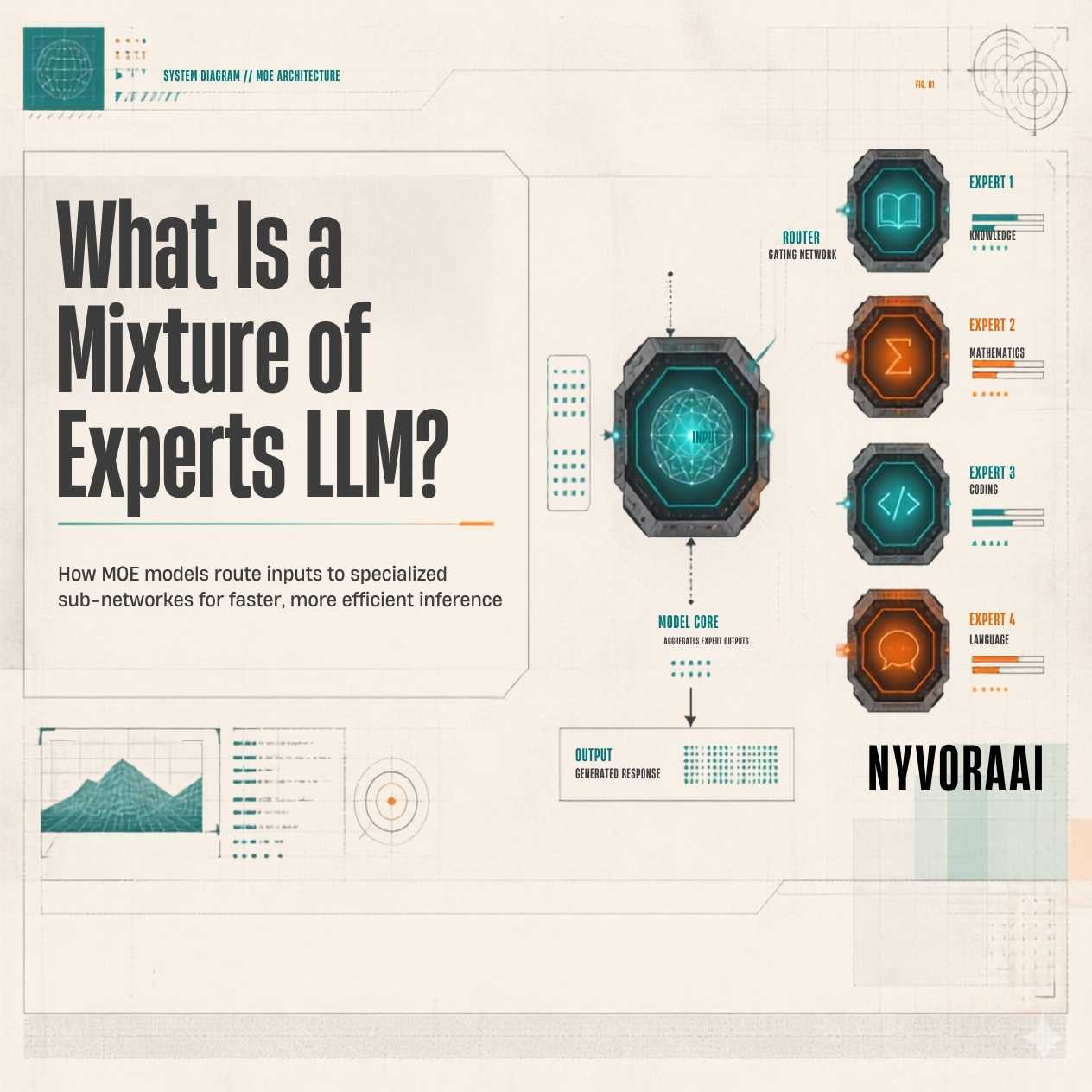
That's essentially what a Mixture of Experts LLM does with every single word it processes. Instead of running a prompt through one giant, monolithic neural network, an MoE model is split into many smaller "expert" sub-networks, and a lightweight router decides which few experts should handle each token. The result is a model that can be enormous in total size while staying fast and comparatively cheap to run — which is exactly why MoE has become one of the defining architecture choices in modern LLM design.
- The Core Concept: A Mixture of Experts (MoE) LLM replaces one giant dense network with many smaller "expert" sub-networks, plus a router that picks a few experts per token.
- The Analogy: It works like a hospital's triage system — the router is the nurse sending each case to only the relevant specialists instead of the whole staff.
- The Big Win: MoE models can hold a huge number of total parameters for knowledge and capability, while only activating a small fraction of them for each prediction, keeping inference fast.
- Real Examples: Mistral's Mixtral 8x7B and 8x22B, DeepSeek-V2/V3, and xAI's Grok models are all built on Mixture of Experts architecture.
- The Trade-Off: MoE models are harder to train, need more total VRAM to store all the experts, and can suffer from uneven "load balancing" between experts if not carefully managed.
01 What Exactly Is a Mixture of Experts LLM?
In a standard "dense" transformer model, every layer processes every token using the exact same set of parameters. If the model has 70 billion parameters, all 70 billion get touched, every time, for every word. That's straightforward, but it's also wasteful — a huge portion of those parameters are irrelevant to any specific input.
A Mixture of Experts LLM takes a different approach at specific points in the network, usually inside the feed-forward layers. Instead of one big feed-forward block, the model has several smaller feed-forward blocks sitting side by side — these are the "experts." A small neural network called the router (or gating network) looks at each incoming token and decides which one or two experts should actually process it. The other experts just sit idle for that token. If you're building foundational understanding here, it also helps to first get comfortable with what is an LLM in simple words, since MoE is really just a variation on the transformer architecture that underlies every modern language model.
This means the model's total parameter count can be huge — Mixtral 8x7B, for instance, has roughly 47 billion total parameters spread across its experts — but for any single token, only a fraction of those parameters (around 13 billion worth, in Mixtral's case) actually get used. You get the knowledge capacity of a much bigger model, at close to the inference cost of a much smaller one.
02 How the Routing Actually Works
The magic of MoE isn't really magic — it's a fairly elegant piece of engineering. Here's what happens as a token moves through an MoE layer.
Let's unpack that a bit further, because the details matter:
- Scoring: The router is a tiny neural network layer that outputs a probability score for each available expert, based on the current token's representation.
- Top-K routing: Instead of using every expert, the system keeps only the top K scores — commonly the top 2 out of 8, though this varies by model. This is what makes the model "sparse."
- Parallel expert computation: The selected experts each process the token independently, exactly like a normal feed-forward layer would.
- Weighted combination: The final output is a weighted sum of the chosen experts' outputs, weighted by how confident the router was in picking them.
- Load-balancing loss: During training, an extra loss term nudges the router to spread tokens more evenly across experts, so a handful of experts don't end up doing all the work while others sit unused.
That load-balancing step is more important than it sounds. Without it, the router tends to develop favorites early in training and keeps sending tokens to the same one or two experts, which defeats the entire purpose of having many specialists in the first place. Well-trained MoE models actively encourage the router to distribute tokens fairly, so each expert gets enough signal to genuinely specialize. This connects to a broader theme worth understanding — how do large language models learn from data — because the training dynamics of an MoE model are meaningfully different from a dense one, even though the end goal is the same.
03 Dense vs Sparse MoE vs Shared-Expert MoE
Not all Mixture of Experts designs are identical. As the architecture has matured, a few distinct variations have emerged, each with different trade-offs.
For most people evaluating models rather than building them, the label to look for is simply "MoE" versus "dense" in a model card. If you're choosing between models for a project, capability and price-per-token matter more than the exact routing scheme — but knowing an MoE model is under the hood explains why it might feel fast and capable at the same time.
04 MoE vs. Dense: What It Feels Like in Practice
Architecture talk can feel abstract, so let's ground it in a real scenario: a startup trying to pick a model to power a customer-facing coding assistant, comparing a dense model against an MoE model of a similar "class."
The Trade-off: Consistently strong quality, but every response — even simple ones — costs the same in compute and tends to be slower and pricier per token.
Verdict: Reliable, but compute cost never scales down with easy questions.
The Trade-off: Responses come back noticeably faster and cheaper per token, since only a fraction of the total parameters fire for any given prompt, while overall quality stays competitive with much larger dense models.
Verdict: Similar or better quality at meaningfully lower latency and cost.
This distinction — total size versus active size — is exactly why comparing raw parameter counts across models can be misleading. It's also worth understanding when you're weighing options like GPT vs Claude differences, since publicly disclosed architecture details vary widely between labs, and "bigger number" doesn't automatically mean "slower or more expensive to run."
05 Why Builders Choose Mixture of Experts
MoE isn't chosen just because it's trendy — it solves a very specific, very expensive problem: how do you keep scaling model capability without linearly scaling inference cost? Here's when the trade-off makes sense, and when it doesn't.
✅ MoE Tends to Make Sense When:
- You Need Scale Without Runaway Cost: You want frontier-level capability but can't afford the inference bill of a dense model with an equivalent number of total parameters.
- Workloads Are Diverse: Your traffic spans many different domains (code, legal text, casual chat, math), letting different experts specialize naturally rather than forcing one network to be good at everything equally.
- You Have the Infrastructure to Support It: You have enough total memory to host all the experts, even if only a few fire per token, and the engineering resources to handle distributed serving.
❌ MoE Is Probably Not Worth It When:
- You're Working at Small Scale: For smaller models, the overhead of routing logic and load-balancing complexity often isn't worth it — a dense model is simpler to train, tune, and deploy.
- Your Hardware Is Memory-Constrained: If you can't fit all the experts in memory at once, you lose the main practical benefit, since you still need to store the full model even though you only compute with part of it.
- You Need Maximum Training Stability: Dense models are generally easier to train predictably. MoE introduces extra hyperparameters (number of experts, top-K value, load-balancing loss weight) that need careful tuning.
06 Which Models Actually Use Mixture of Experts?
MoE isn't a theoretical curiosity — it's already powering some of the most talked-about models on the market. If you're trying to decide which model fits your use case, it helps to know which ones use this architecture under the hood.
One more practical thread worth pulling on: MoE is a big part of the story behind falling API prices industry-wide. Because sparse activation cuts the actual compute needed per response, providers can serve larger, more capable models at lower cost than a dense model of the same scale would require. If pricing trends interest you, this ties directly into why are LLMs getting cheaper in 2026 — MoE is one of several efficiency gains driving that curve downward.
07 Test Your Knowledge: The MoE Quiz
Think you've got a handle on Mixture of Experts models? Test yourself with this quick interactive quiz — no pressure, just click through the answers.
08 Conclusion: Bigger Doesn't Have to Mean Slower
Mixture of Experts represents one of the more elegant solutions to a problem that's been looming over AI for years: how do you keep making models smarter without making them prohibitively expensive to run? By splitting a network into specialists and letting a router pick only the relevant few for each token, MoE lets a model carry enormous knowledge capacity while keeping the actual computation for any single response lean.
You'll keep seeing this architecture show up — in open-weight releases, in research papers, and almost certainly inside several closed frontier models too. Understanding the basic idea of "many experts, one router, only a few active at a time" gives you a real edge when you're reading model cards, comparing benchmarks, or just trying to make sense of why some models feel faster than their size would suggest.
09 Frequently Asked Questions
What is a Mixture of Experts LLM?
How is a Mixture of Experts model different from a dense model?
Which AI models use Mixture of Experts?
What is the main advantage of Mixture of Experts?
What are the downsides of Mixture of Experts models?

Written by Varun Lalwani
Varun covers large language models, open-source AI, and the practical side of building with accessible AI tools. Published July 2026. Questions? Contact our team or learn about our mission. Stay updated via our RSS feed.