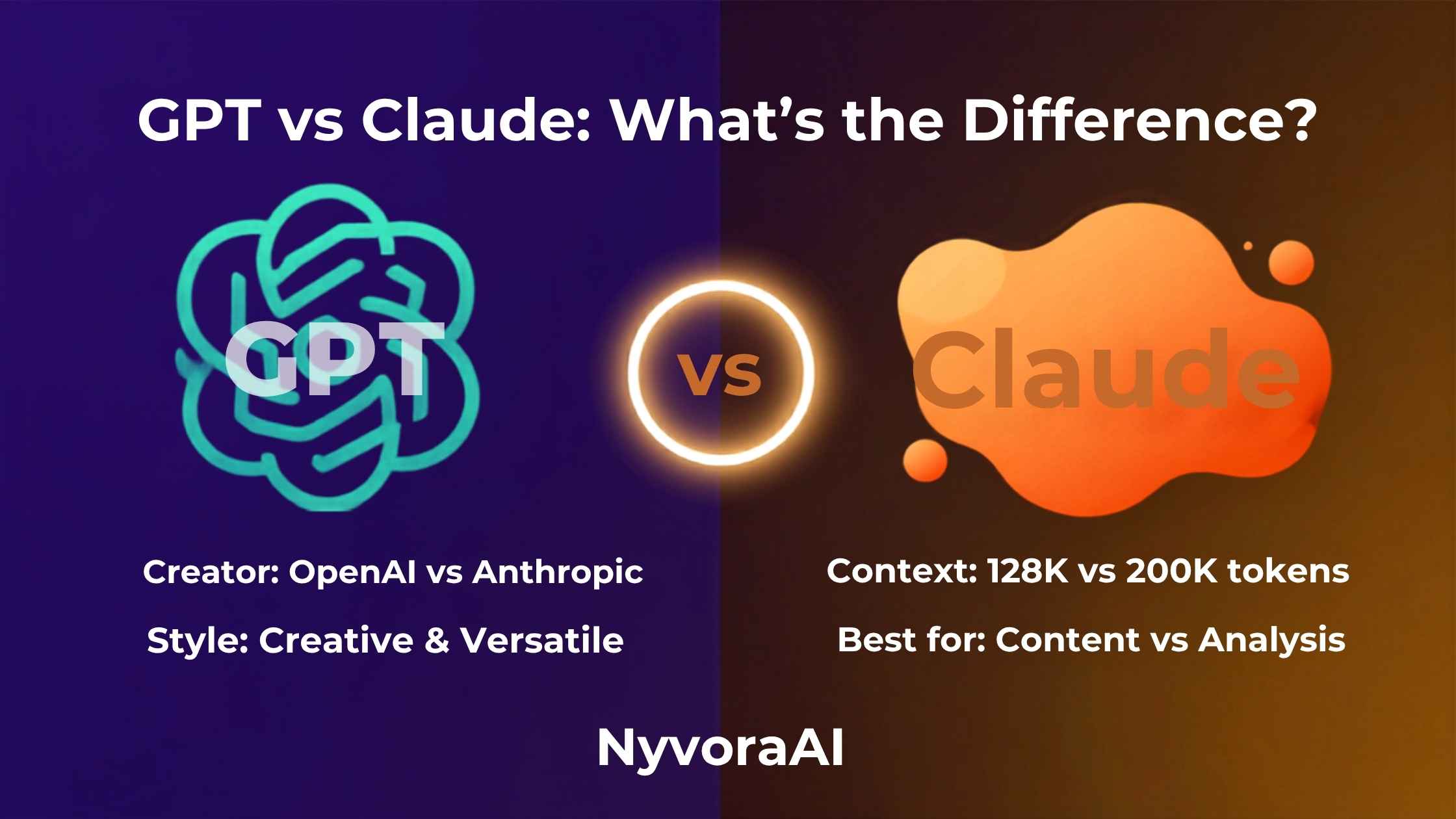
If you've been keeping up with the artificial intelligence boom, you've likely found yourself stuck in the same debate that dominates tech forums and office water coolers alike: what is the difference between GPT and Claude? On the surface, they look identical. You type a prompt, and they both spit out text. But spend ten minutes with each, and you'll realize they have distinct personalities, strengths, and weaknesses.
OpenAI's GPT (specifically the GPT-4o series) and Anthropic's Claude (now in its 3.5 and 4 iterations) are the two titans of the industry. Choosing the wrong one can mean the difference between a helpful assistant and a frustrating roadblock. In this guide, we aren't just looking at benchmarks; we're looking at real-world usability in 2026. If you're curious about how these models compare to Google's offering, you might also want to read how is Gemini different from ChatGPT for a broader perspective.
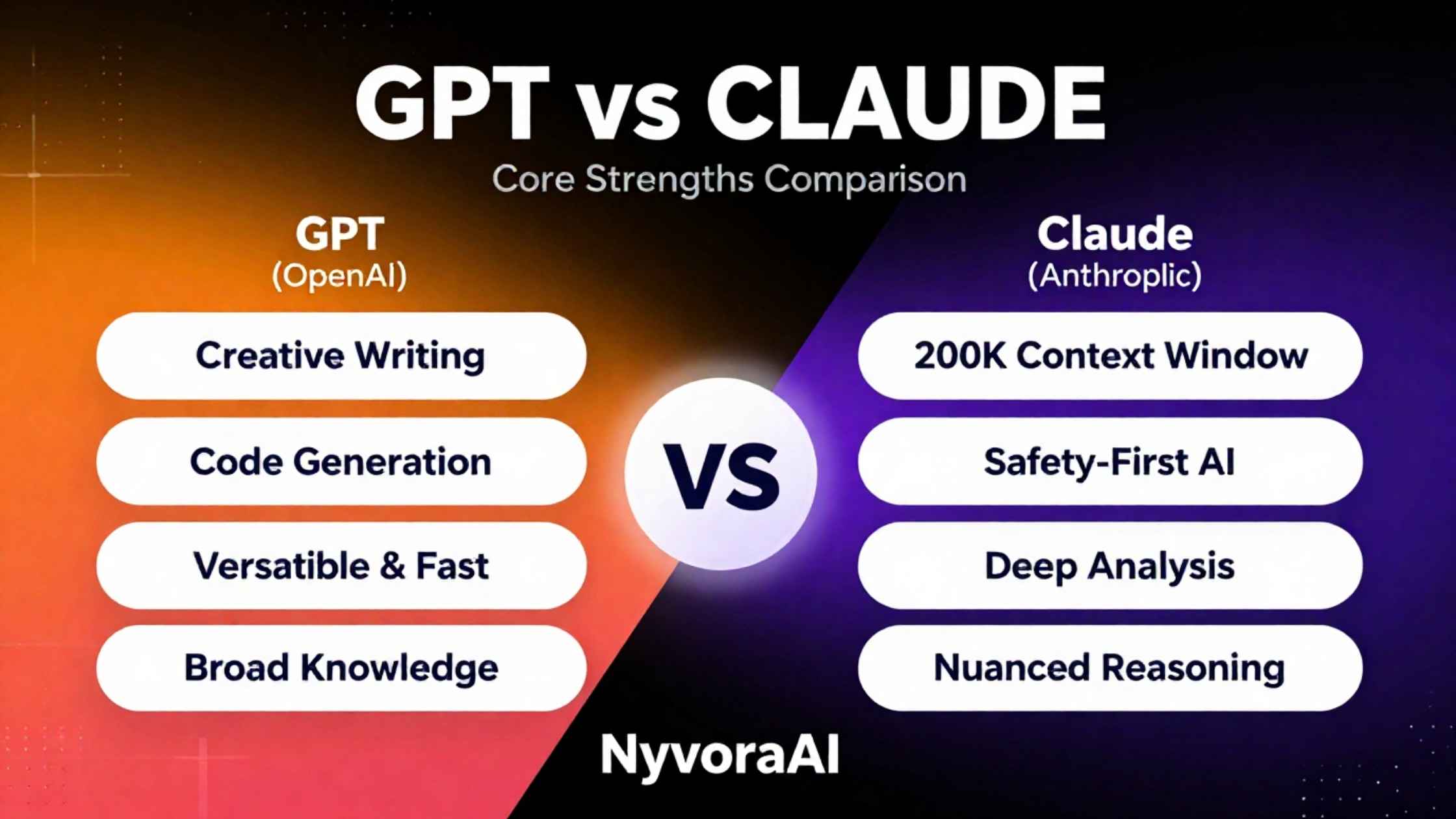
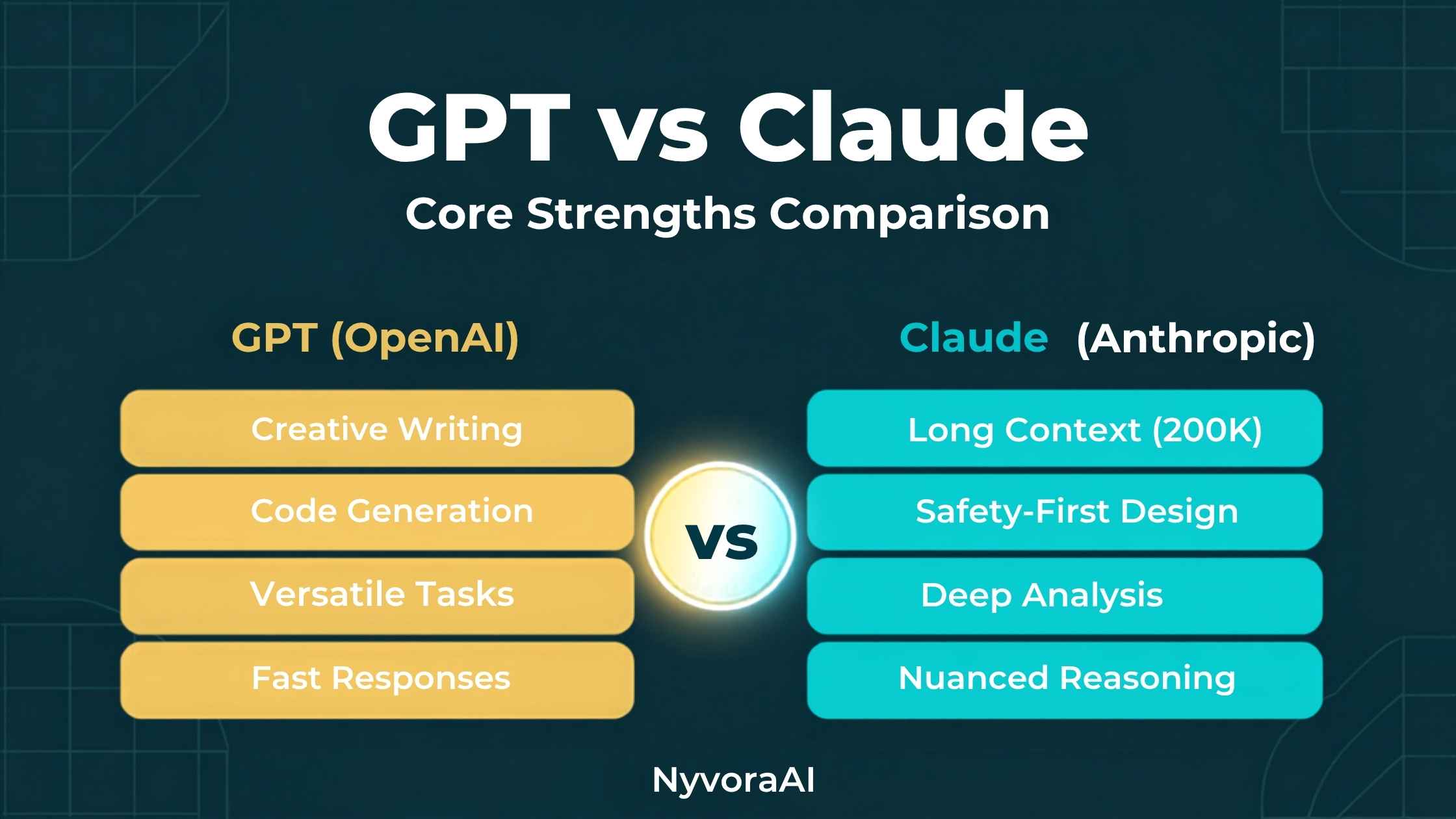
- GPT is optimized for versatility, speed, and multimodal tasks (like voice and image analysis). It's the "Swiss Army Knife" of AI.
- Claude is built with "Constitutional AI" principles, prioritizing safety, nuance, and massive context handling. It excels at coding, long-document analysis, and human-like creative writing.
- For coding: Claude 3.5/4 edges out GPT-4o for large codebases and complex debugging.
- For writing: Claude produces more natural, human-like prose with better emotional tone.
- For context: Claude handles 200k+ tokens better than GPT's 128k, making it superior for analyzing massive documents.
01 The Titans: A Brief Introduction
Before we dissect the differences, let's meet the contenders. Understanding who built them helps explain why they behave the way they do.
OpenAI's GPT (Generative Pre-trained Transformer)
OpenAI, backed by Microsoft, launched ChatGPT in late 2022, sparking the global AI revolution. GPT models are known for their raw power, vast knowledge base, and aggressive integration into everyday tools like Word, Excel, and Bing Search. If you want an AI that can do almost everything—browse the web, generate images, and speak to you—GPT is usually the default choice.
Anthropic's Claude
Anthropic was founded by former OpenAI researchers who wanted to take a different approach. They focused on "Constitutional AI"—training models to be helpful, honest, and harmless from the ground up. Claude doesn't try to be a jack-of-all-trades initially; it tries to be the best collaborator. It excels at reading between the lines and handling massive amounts of information without getting confused.
02 Core Philosophy: Speed vs. Nuance
To truly understand what is the difference between GPT and Claude, you have to look at how they "think."
GPT is engineered for efficiency. It wants to get you the answer fast. It's direct, sometimes to a fault. If you ask it a question, it will often give you the most statistically probable answer immediately. This makes it incredible for quick facts, brainstorming lists, or rapid-fire Q&A.
Claude takes a breath. It's designed to be more conversational and thoughtful. Anthropic trained Claude to refuse harmful requests more politely and to handle ambiguity better. When you talk to Claude, it feels less like a search engine and more like a junior colleague who actually read the brief. It's less likely to hallucinate (make things up) because it's tuned to be cautious when it doesn't know the answer. To understand why this happens, check out our detailed explanation of why do LLMs hallucinate facts.
03 Coding & Technical Tasks
This is where the battle gets intense. For years, GPT-4 was the king of code. But in 2026, the crown has slipped.
GPT-4o
Great for generating boilerplate code quickly. It integrates well with VS Code via Copilot. However, it can sometimes get stuck in loops if the logic is complex, requiring you to restart the chat.
Claude 3.5/4
Currently favored by many senior engineers. Its "Artifacts" feature allows you to preview code instantly. It's better at maintaining context over long coding sessions, meaning it remembers the function you wrote 50 messages ago.
If you are learning to code, both are excellent. But if you are debugging a massive legacy codebase, Claude's larger context window gives it a distinct advantage. It can "see" more of your project at once. For developers interested in customizing these models, understanding what is fine-tuning an LLM can help you adapt them to your specific coding needs.
04 Creative Writing & Tone
When it comes to prose, the difference is subtle but significant. GPT tends to write in a very "corporate blog" style. It loves words like "delve," "landscape," and "testament." It's clean, but it can feel robotic.
Claude, conversely, is often praised for its "human" touch. It varies sentence structure more effectively and understands subtext. If you ask Claude to write a sympathy note or a witty tweet, it usually nails the emotional tone better than GPT. For creative writers, Claude feels less like a machine and more like a co-author.
05 Context Window & Data Analysis
This is arguably the biggest technical differentiator. The "Context Window" is how much information the AI can hold in its "brain" at one time.
- GPT-4o: Has a large context window (approx. 128k tokens), which is enough for several books. It handles this well, but can occasionally lose track of specific details in the middle of massive documents.
- Claude: Built for massive context (200k+ tokens standard). It is incredibly accurate at retrieving specific facts from huge PDFs or code repositories. If you need to upload a 500-page legal contract and ask a question about page 412, Claude is your best bet.
06 Pricing & Accessibility
For most users, the cost is a major factor. Both companies operate on a "Freemium" model.
| Feature | GPT (OpenAI) | Claude (Anthropic) |
|---|---|---|
| Free Tier | Available (GPT-4o mini) | Available (Claude 3 Haiku/Sonnet) |
| Pro Subscription | ~$20/month (ChatGPT Plus) | ~$20/month (Claude Pro) |
| API Cost | Competitive, pay-per-token | Highly competitive, often cheaper for bulk |
| Availability | Global, widespread app support | Expanding, slightly fewer regions |
If you are a developer building an app, you should check the current API pricing pages, as they change frequently. For casual users, the $20/month subscription for either service is worth it if you use AI daily. For those interested in running models locally to save costs, check out how to run an LLM on your own computer.
07 Final Verdict: Which One Should You Choose?
So, what is the difference between GPT and Claude in the final analysis? It comes down to your workflow.
Choose GPT if:
- You want a true all-in-one assistant (Voice mode, Image generation with DALL-E 3, Web Browsing).
- You need quick, factual answers and data visualization.
- You are already deep in the Microsoft ecosystem.
- You prefer speed and directness over nuance.
Choose Claude if:
- You are a writer or editor who cares about tone and nuance.
- You are a developer working with large codebases.
- You need to analyze huge documents (PDFs, legal docs) with high accuracy.
- You prefer a more polite, less "robotic" conversation partner.
- You want fewer hallucinations and more cautious responses.
In 2026, many power users don't choose just one. They subscribe to both, using GPT for research and image creation, and Claude for writing and coding. To learn more about how these models actually process your data, check out our deep dive on how large language models learn from data.
08 Understanding the Technology Behind Both
Both GPT and Claude are built on Transformer architecture, but their training methodologies differ significantly. Understanding how do AI models get their training data helps explain why Claude tends to be more cautious while GPT is more adventurous.
OpenAI focuses on scale and breadth, training on as much data as possible to create a versatile model. Anthropic, conversely, emphasizes quality and safety, using techniques like Constitutional AI to ensure their model adheres to specific principles. This fundamental difference in philosophy explains why Claude often refuses requests that GPT might attempt to answer.
For those interested in advanced AI techniques, what is retrieval augmented generation (RAG) is a technique both companies use to enhance their models with real-time information, though they implement it differently.
09 The Open Source Alternative
While GPT and Claude dominate the commercial space, there's a thriving open-source community offering alternatives. If you're curious about non-proprietary options, our guide on the best open source LLM 2026 covers models like Llama, Mistral, and others that you can run locally or self-host.
These open-source models offer more control and privacy but typically require more technical expertise to deploy effectively. They're excellent for specific use cases where data privacy is paramount or when you need to customize the model extensively.
10 Frequently Asked Questions
Is Claude better than GPT for coding?
Which is cheaper, GPT or Claude?
Does Claude have internet access?
Can I use both GPT and Claude for free?
Which AI is safer for sensitive data?
Is Claude smarter than GPT-4?
Conclusion: The Best Tool for the Job
After extensive testing and real-world use, the answer to what is the difference between GPT and Claude isn't about which is objectively better—it's about which is better for you.
GPT remains the powerhouse for versatility and speed. If you need an AI that can do everything from generating images to browsing the web to answering questions quickly, GPT-4o is your champion. It's the reliable workhorse that gets things done.
Claude, however, has carved out a niche as the thoughtful collaborator. It excels when you need depth over breadth—when you're analyzing a complex document, writing something that needs to sound human, or debugging intricate code. Its larger context window and nuanced understanding make it invaluable for knowledge work.
My recommendation? Try both. Use the free tiers extensively. See which one clicks with your workflow. Many professionals I know keep both subscriptions active, using each for their respective strengths. In the rapidly evolving AI landscape of 2026, having both tools in your arsenal gives you maximum flexibility.
Whichever you choose, remember that these are tools to augment your capabilities, not replace them. The best results come from combining AI efficiency with human judgment and creativity.

Written by Varun Lalwani
Varun is a technology writer and AI researcher specializing in large language models and their practical applications. With a background in computer science and a passion for making complex AI concepts accessible, he helps readers navigate the rapidly evolving AI landscape. This comparison was updated in June 2026 with the latest model releases. Have questions? Contact Varun or learn more about our mission.