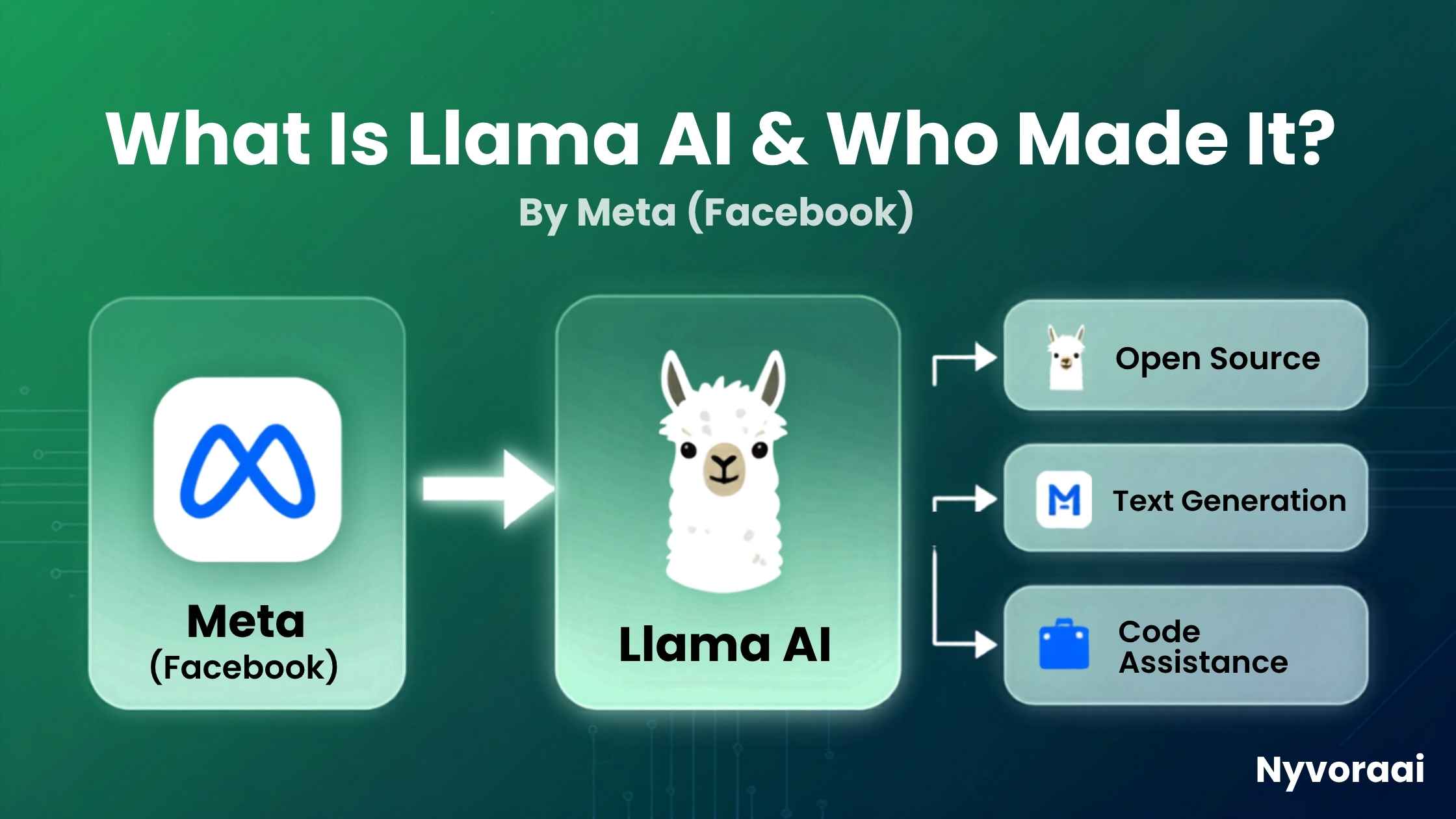
If you follow the AI space even loosely, you already know about ChatGPT. OpenAI's flagship product became a cultural moment — the thing that made millions of people suddenly realize that AI was real, that it was here, and that it was genuinely useful. What you might not know is that OpenAI isn't the only player shaping the future of large language models. Meta — yes, the company behind Facebook, Instagram, and WhatsApp — has been quietly building something equally significant. And in one crucial way, it's completely different.
While OpenAI keeps its most powerful models locked behind a paywall and a proprietary API, Meta released its Llama models to the world for free. Developers can download the actual model weights — the trained AI itself — and run it on their own hardware. They can modify it, fine-tune it on custom data, and build products with it. This open-source approach has made Llama one of the most widely used AI models in the world, powering thousands of applications across healthcare, finance, education, legal, and everywhere in between. Let's dig into exactly what it is and how it works.
- Made by: Meta AI, the artificial intelligence research division of Meta Platforms (formerly Facebook). The name stands for Large Language Model Meta AI.
- What it is: A family of open-source large language models (LLMs) — AI systems trained on massive amounts of text that can understand and generate human language.
- Why it's different: Unlike ChatGPT or Claude, Llama's model weights are publicly released, meaning anyone can download, modify, and run it — even on their own computer.
- Current version: Llama 3.x is the latest generation as of mid-2026, available in sizes from 8B to 405B parameters.
- Who uses it: Startups, enterprises, governments, researchers, and individual developers — anyone who wants powerful AI without paying per API call or sending data to a third party.
- Is it free? Yes, for most uses. Businesses with under 700 million monthly active users can use it commercially at no cost under Meta's Llama licence.
01 Who Made Llama AI? The Story Behind Meta AI
To understand Llama, you need to understand the organization that created it. Meta AI — officially the AI research wing of Meta Platforms Inc. — is one of the largest and most well-funded AI research organizations in the world. It's home to FAIR, the Fundamental AI Research team, which has published some of the most influential AI research papers of the past decade. These are serious, world-class AI researchers, not just engineers building products.
Mark Zuckerberg, Meta's CEO, made a deliberate and very public bet on open-source AI as the company's strategy. His reasoning was partly philosophical — he believed open-source AI would democratize access and produce better outcomes for the world — and partly competitive. By giving Llama away for free, Meta prevents any single company (including itself) from monopolizing the AI stack, and it benefits from thousands of developers worldwide improving and fine-tuning the model at no cost to Meta.
The first version of Llama was released in February 2023, initially to researchers under a restricted licence. Within days, the model was leaked publicly — which, ironically, accelerated its adoption far faster than Meta had planned. The second generation, Llama 2, launched in July 2023 with a more permissive commercial licence. Llama 3 followed in April 2024 with dramatically improved performance, and the Llama 3.x series has continued to iterate through 2025 and into 2026 as one of the most capable open-source model families available anywhere.
Llama stands for Large Language Model Meta AI. The llama animal imagery has become a beloved part of the model's branding in the developer community — you'll find llama emojis and memes across GitHub, Discord, and AI research forums wherever people discuss open-source language models. Meta has leaned into this playfully, and the community has embraced it wholeheartedly.
Understanding what Llama actually is under the hood is easier once you have a solid foundation in what large language models are more broadly. Our beginner-friendly guide on what an LLM is in simple words breaks down the core concept clearly — and if you want to understand how these models actually learn from data, our deep dive on how large language models learn from data explains the training process in plain English.
02 Every Llama Version Explained — From 1 to 3.x
Llama isn't a single model — it's a family that has evolved significantly through multiple generations. Here's how each version fits into the story.
03 How Does Llama Actually Work?
At its core, Llama is a transformer-based language model — the same fundamental architecture that underlies ChatGPT, Claude, Gemini, and virtually every powerful AI language system in existence today. The transformer architecture, invented by researchers at Google in 2017, is the technical foundation upon which the entire modern AI language revolution is built.
Pre-Training: Reading Everything
Llama 3 was trained on approximately 15 trillion tokens of text data — roughly equivalent to hundreds of thousands of books worth of human language. This training data includes web pages, books, academic papers, code repositories, forums, and more. During training, the model processes this data and learns to predict the next word in a sequence, over and over, billions of times. Through this process, it doesn't just memorize text — it builds rich internal representations of language, facts, logic, and reasoning.
The Architecture: Efficient Transformers
What made early Llama models surprisingly capable despite their smaller size was architectural efficiency. Meta's researchers used techniques like Grouped Query Attention (GQA), which makes the model faster and more memory-efficient without sacrificing quality. They also used a different tokenizer than GPT-4's, optimized for efficiency across many languages. These architectural choices meant Llama could achieve GPT-3-level performance with a fraction of the parameter count — and run on hardware that GPT-3 couldn't.
Instruction Tuning and RLHF
Base Llama models are powerful but not immediately useful for conversations — they just predict text. To make them helpful, safe assistants, Meta applies instruction tuning and Reinforcement Learning from Human Feedback (RLHF). Human raters evaluate model responses for helpfulness, safety, and honesty. These ratings are used to train a reward model that guides the AI toward better behavior. The result is Llama-Instruct or Llama-Chat — the conversational version that feels natural to talk to.
04 Why Open Source Changes Everything
The word "open source" gets thrown around a lot in AI. It's worth being precise about what it means for Llama specifically — and why it's genuinely significant, not just marketing language.
When Meta releases a Llama model, they release the actual model weights — the billions of numerical parameters that define the AI's knowledge and behavior. This is like releasing the actual recipe for a product, not just a cooked version of it. With the weights, you can run the model on your own infrastructure, modify it, fine-tune it on your own data, and integrate it into your products without ever sending a single query to Meta's servers. Your data stays completely private.
This shift toward open-source AI is also part of a broader trend making powerful AI dramatically more affordable and accessible. Our analysis of why LLMs are getting cheaper in 2026 explores how models like Llama are driving down the cost of AI access across the entire industry — not just for open-source users but for everyone.
Technically, Llama uses a custom Meta licence rather than a standard open-source licence like Apache 2.0 or MIT. The licence is very permissive — free for commercial use under 700M MAU — but it does have restrictions. Very large companies (think Meta's direct competitors in scale) need a separate arrangement. The AI community sometimes debates whether this qualifies as truly "open source" versus "open weights." In practice, for the vast majority of users and companies, the distinction doesn't matter — the model is free and accessible.
05 Who Uses Llama AI and What For?
Llama's open availability has led to an extraordinarily diverse ecosystem of users and applications. Here's a look at who's using it and what they're actually building.
06 Llama vs GPT vs Claude — Honest Comparison
This is the question everyone wants answered: how does Llama actually compare to the big proprietary models? The honest answer is nuanced. It depends heavily on the model size, the task, and — most importantly — whether you're comparing raw capability or total value including cost, privacy, and control.
| Factor | Llama 3.x (70B) | GPT-4o | Claude Sonnet |
|---|---|---|---|
| Cost to use | ✓ Free (self-host) | $$ Per token API | $$ Per token API |
| Data privacy | ✓ Fully private (local) | ✗ Sent to OpenAI | ✗ Sent to Anthropic |
| Can fine-tune? | ✓ Yes, full access | ~ Limited fine-tuning | ✗ No |
| General reasoning quality | ~ Excellent | ✓ Best in class | ✓ Best in class |
| Coding ability | ~ Very good | ✓ Excellent | ✓ Excellent |
| Runs offline / on-device | ✓ Yes | ✗ Cloud only | ✗ Cloud only |
| Customizable for your domain | ✓ Fully customizable | ~ Limited | ✗ Not available |
| Best for beginners | ~ Some setup needed | ✓ Very easy | ✓ Very easy |
The takeaway from that comparison isn't that Llama is "better" or "worse" — it's that these models serve genuinely different needs. If you're a developer who needs maximum reasoning performance and doesn't care about cost, GPT-4o or Claude are hard to beat. If you need privacy, zero ongoing cost, or the ability to deeply customize the model for your specific domain, Llama is in a class of its own. For a hands-on comparison of how the top proprietary models stack up against each other, our guide to GPT vs Claude differences covers that comparison in depth. And if you're just getting started with AI models and trying to figure out where to begin, our guide to which LLM is best for beginners in 2026 helps you choose the right tool for your situation.
Meta has committed publicly to continuing Llama development as a long-term open-source project. The roadmap points toward models that are faster, more efficient on edge hardware, increasingly multimodal (understanding images, audio, and eventually video), and capable of running even powerful AI directly on smartphones and laptops without cloud connectivity. Llama 4 is anticipated to push further into multimodal reasoning and agentic capabilities — where the AI doesn't just answer questions but takes actions and uses tools autonomously. The open-source AI ecosystem that has grown around Llama means that even Meta's own roadmap decisions are increasingly informed by what the global developer community discovers and builds on top of previous versions.
How to Run Llama Yourself — In Plain English
You don't need to be a machine learning engineer to run Llama. Tools like Ollama (a command-line tool that handles everything) and LM Studio (a visual desktop app) let you download and run Llama models in minutes with a normal user interface. If you have a modern Mac with Apple Silicon, a Windows machine with a decent NVIDIA GPU, or even a high-RAM CPU machine, you can run the Llama 3 8B model locally today. It won't be as fast as a cloud API, but it works, it's free, and your data never goes anywhere.
07 Frequently Asked Questions
What is Llama AI and who made it?
Is Llama AI free to use?
What is the difference between Llama and ChatGPT?
What is Llama 3 and how is it different?
Can I run Llama AI on my own computer?
Who uses Llama AI?

Written by the NyvoraAI Team
We cover large language models, open-source AI, and the future of accessible intelligence. Published June 2026. Questions? Contact our team or learn about our mission. Stay updated via our RSS feed.