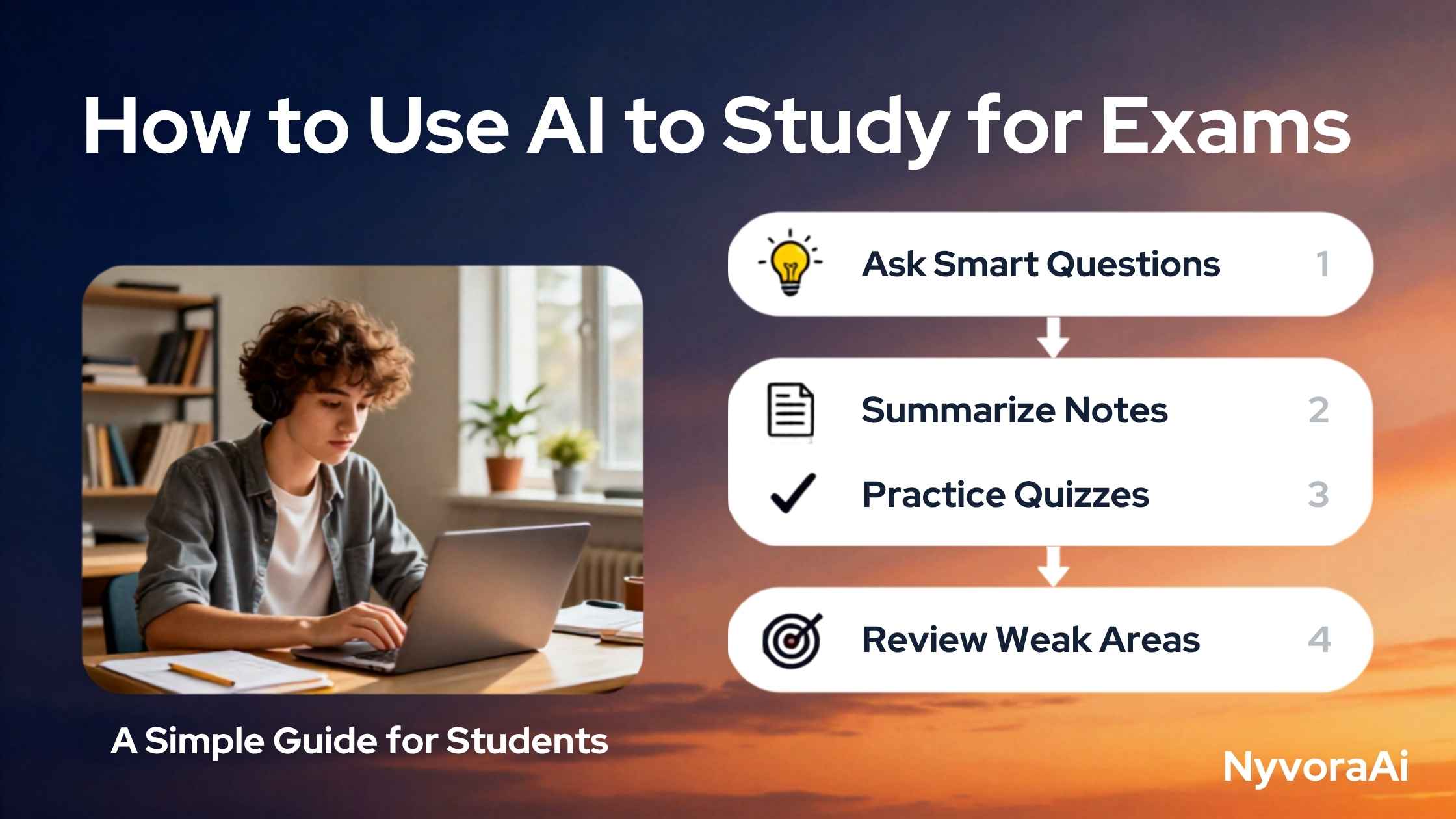
Let's be honest about something. Most of us studied the wrong way for years. We re-read notes, highlighted sentences in different colours, and then sat down in an exam room wondering why none of it came back when we needed it. Passive reading feels like studying. It isn't, really. The research on this is pretty clear — retrieval practice, spacing, and active testing are what actually move information into long-term memory. AI tools are remarkably well-suited to all three of those things, which is what makes them genuinely useful for exam prep rather than just a novelty.
This guide isn't about using AI to cheat. It's about using it the way a great tutor would — one that's available at 2am, never runs out of patience, can explain the same concept eight different ways without getting frustrated, and will quiz you on exactly the material you keep getting wrong. That's actually a pretty powerful study tool once you know how to use it properly.
AI doesn't make studying passive — when you use it right, it makes it more active than most traditional methods.
- Generate your own practice questions — better than re-reading notes by a significant margin
- Use AI to explain things differently when the textbook version isn't clicking
- Build a timed study schedule in minutes by telling AI your exam date and weak areas
- Get quizzed interactively — have AI ask you questions and correct your answers in real time
- Summarise dense material into digestible chunks before your first read-through
01The Quick Answer
Here's the short version if you're already two days out from an exam: open ChatGPT or Claude, paste in the topics you need to cover, and ask it to generate twenty practice questions across different difficulty levels. Answer them without looking at your notes. Check your answers and ask the AI to explain anything you got wrong. Repeat with the topics you struggled on. That single loop — generate, test, review weak spots — is more effective than hours of passive re-reading, and you can run it with any subject in minutes.
Everything else in this guide expands on that core idea. Different tools, different techniques, and a few things that look useful but quietly waste your time.
02Why AI Actually Changes How You Can Study
Before AI tools, getting good practice questions was genuinely hard. Past papers helped, but they ran out. Textbook questions were often too easy or too narrowly focused. Study groups were hit or miss. Private tutors were expensive and not always available when you needed them at odd hours.
What AI gives you is an inexhaustible question generator that understands context. You can give it a chapter of your biology textbook and ask for ten multiple-choice questions at exam difficulty. You can ask it to focus specifically on the parts you find hardest. You can tell it to explain an answer three different ways until one of them makes sense. None of that was practically possible before, at least not without significant cost or the right people around you.
It also removes something that stops a lot of students from asking for help — the embarrassment of not understanding something basic. You can ask an AI the same question five times in a row, admit you still don't get it, and ask for an even simpler explanation, without anyone sighing or making you feel slow. That matters more than it sounds.

03Build a Personalised Study Plan in Minutes
One of the more immediately useful things AI can do is build you a study schedule that actually accounts for your situation rather than giving generic advice. The key is being specific when you ask for it. Don't just say "make me a study plan." Tell it your exam date, every topic you need to cover, roughly how many hours per day you can study, and honestly where you're weakest. The more you give it, the more useful the output.
Once you have a schedule, treat it as a real plan rather than a suggestion. The act of having a concrete daily structure is itself part of what helps — it removes the daily decision fatigue of "what should I study today" which quietly eats into actual study time.
04Ask AI to Explain What Your Textbook Can't
Every subject has that one concept where the textbook explanation just doesn't land. You read it, you nod along, and then you realise a week later that you still have no idea what it actually means. AI is genuinely good for breaking those moments, because you can ask it to try again in a completely different way.
The most effective approach here is to tell AI exactly what you don't understand, rather than just saying "explain X." Something like "I understand that mitosis results in two identical cells, but I can't picture why the chromosomes have to line up in the middle first — can you explain what would go wrong if they didn't?" gives the AI something real to work with. The answer you get is usually much more useful than a textbook definition restated slightly differently.
You can also ask for analogies specifically. "Explain the electrical resistance of a wire using a water pipe analogy" or "explain opportunity cost using a real-life decision most teenagers face" often produce explanations that click immediately when the technical version didn't. This is one of those areas where AI genuinely outperforms a static textbook.
05Generate Flashcards From Your Own Notes
Flashcards work. The evidence behind spaced repetition is strong and consistent. The problem is that making good flashcards takes time — a lot of it, if you're trying to cover a whole subject. That's where AI saves you hours.
Paste a chunk of your notes or a textbook chapter into your AI tool and ask it to generate fifty flashcard pairs — question on one side, answer on the other. Then paste them into an app like Anki or Quizlet that uses spaced repetition to show you the cards you keep getting wrong more frequently than the ones you know well. You've now got a custom study deck in about five minutes that would have taken an hour to write by hand.
Paste your raw notes into AI
Include the chapter or topic — the more context you give, the better the cards will be at pulling out what actually matters rather than surface-level facts.
Ask for question-answer pairs
Be specific: "Generate 30 flashcard pairs from this, mix definition questions with application questions, and flag the five most commonly tested concepts."
Copy into a spaced repetition app
Anki and Quizlet both let you import text. Set the review schedule and let the algorithm decide which cards you need to see again — and when.
Review daily, not in cramming sessions
Ten minutes of flashcard review every morning is more effective than ninety minutes the night before an exam. Spread it out.
06Create Practice Tests on Any Topic, at Any Difficulty
This is the biggest practical advantage AI gives students. Practice testing is one of the most evidence-backed study techniques there is, but it only works if the questions are at the right difficulty and actually cover what your exam will test. Textbooks often have too few practice questions, and past papers run out eventually.
You can fix both problems by asking AI to generate them. The key is being specific about difficulty, format, and focus area. "Write ten multiple-choice questions on the causes of the First World War at A-level difficulty, with four options each, and provide an answer key with brief explanations" produces something genuinely testable — not a trivia quiz, but questions that require the kind of thinking your exam will actually demand.
07Use AI as an Interactive Quiz Partner
One of the more underused features of AI chat tools for studying is that you can have a back-and-forth conversation rather than just asking for content. Instead of generating a list of practice questions and working through them alone, you can ask the AI to quiz you interactively — ask a question, wait for your answer, tell you whether you're right, and explain what you missed.
Try something like: "Quiz me on the French Revolution. Ask me one question at a time, wait for my answer, tell me if I'm correct, and if I'm wrong explain why before moving to the next question. Start with broad overview questions and get more specific as we go." Then actually type your answers without looking at your notes. The feedback loop you get is close to what a good tutor provides — immediate, specific, and tied to what you personally got wrong rather than a generic explanation.
A Study Habit Worth Building
At the end of each study session, ask AI: "Quiz me on everything I covered today — just five questions." It forces retrieval from short-term memory at the moment it matters most, and it takes under three minutes. Students who do this consistently tend to retain significantly more than those who end sessions by re-reading.
08Summarise Dense Notes Before You Start Reading
Here's a technique that's a bit counterintuitive but works well. Before you read a dense chapter or a long set of lecture notes in detail, paste them into AI and ask for a high-level summary — the main points, the key terms, and what questions the material is trying to answer. Read that summary first. Then go back and read the original.
What this does is give your brain a framework to hang new information on as you encounter it. Instead of reading thirty pages and trying to figure out what's important as you go, you already know the structure and can focus your attention on understanding rather than just absorbing. It sounds small, but the difference in comprehension is noticeable, especially with technical material that doesn't have a clear narrative thread.
Understanding how to phrase your requests to the AI makes a real difference here — if the summaries you're getting feel too surface-level or miss what actually matters, the fix is almost always in how you're prompting. Our guide on how to write better prompts for AI tools covers the specific techniques that work for this kind of task.
09Mistakes That Quietly Waste Your Study Time
Not everything you can do with AI for studying actually helps. A few habits look productive but end up being a more sophisticated version of the same passive studying problem.
- Reading AI explanations without testing yourself afterwards. Reading feels like learning. It isn't unless you follow it with retrieval. Every AI explanation should end with you closing the tab and trying to explain it back in your own words.
- Asking AI to summarise something and calling it "studying." A summary prepared for you is not the same as understanding. Use summaries as a starting point, not an endpoint.
- Trusting AI-generated facts without checking them. AI tools can state incorrect details confidently, especially on specific dates, statistics, or technical definitions. For factual subjects, verify anything important against a real source before it goes into your notes. Our guide on how to fact-check AI-generated content covers the quickest ways to do this.
- Generating practice questions but skipping the ones you find hard. The ones you want to skip are exactly the ones you need to do. Ask AI to generate more questions specifically on your weak areas, not the comfortable ones.
- Using AI as a substitute for actual understanding. If you use it to get answers without working through the reasoning yourself, you'll understand the answers but not the underlying concepts — which is what the exam will actually test.
Important for Competitive Exams
For competitive exams with very specific syllabi — engineering entrance tests, medical entrance tests, bar exams, and similar — always cross-check AI-generated practice questions against an official syllabus. AI may include topics that are not on your specific paper, or miss nuances in how questions are typically phrased. Use it alongside official resources, not instead of them.
If you're building AI tools into your broader daily routine beyond just studying — for productivity, writing, or work tasks — our guide on how to build a daily workflow using AI tools covers how to structure that without letting it eat into the focused time studying actually needs.
And if you write essays or long-form answers as part of your exams, learning how AI can help you structure and draft those more efficiently is worth understanding too — our article on how to use AI to write long-form content faster has techniques that transfer directly to academic writing. For managing your full study and work schedule in one place, the step-by-step guide to using AI for content and planning workflows is also worth a look. If freelance writing or side work is also part of your life, see how AI helps with freelance writing jobs for time management ideas that work alongside a heavy study load.
10Frequently Asked Questions
Can AI actually help me study for exams?
Is using AI to study for exams cheating?
What is the best AI tool for studying?
How do I use AI to create a study plan?
Can AI help me understand concepts I find confusing?
11Conclusion
Using AI to study for exams isn't a shortcut — it's a better route to the same destination. The destination is actually understanding your subject well enough to answer questions you haven't seen before under pressure. AI gets you there faster when you use it actively: generating practice tests, getting quizzed interactively, asking for explanations until something clicks, and building a study plan that reflects your actual situation rather than some generic schedule.
The students who get the most out of it are the ones who stay in the driver's seat. They use AI to create the conditions for active learning rather than leaning on it to do the thinking for them. If you're two weeks out from an important exam right now, the single best thing you can do today is open a chat window, paste your weakest topic, and ask for twenty practice questions. Work through them. Then ask AI to explain the ones you got wrong. That's an hour well spent — and it'll do more for you than another read-through of your notes ever will.

Written by Varun Lalwani
Varun writes practical, beginner-friendly guides on AI tools for NyvoraAI. This article was written based on hands-on testing of AI study techniques across multiple subjects and exam types. Have questions about using AI for your studies? Contact us — happy to help.