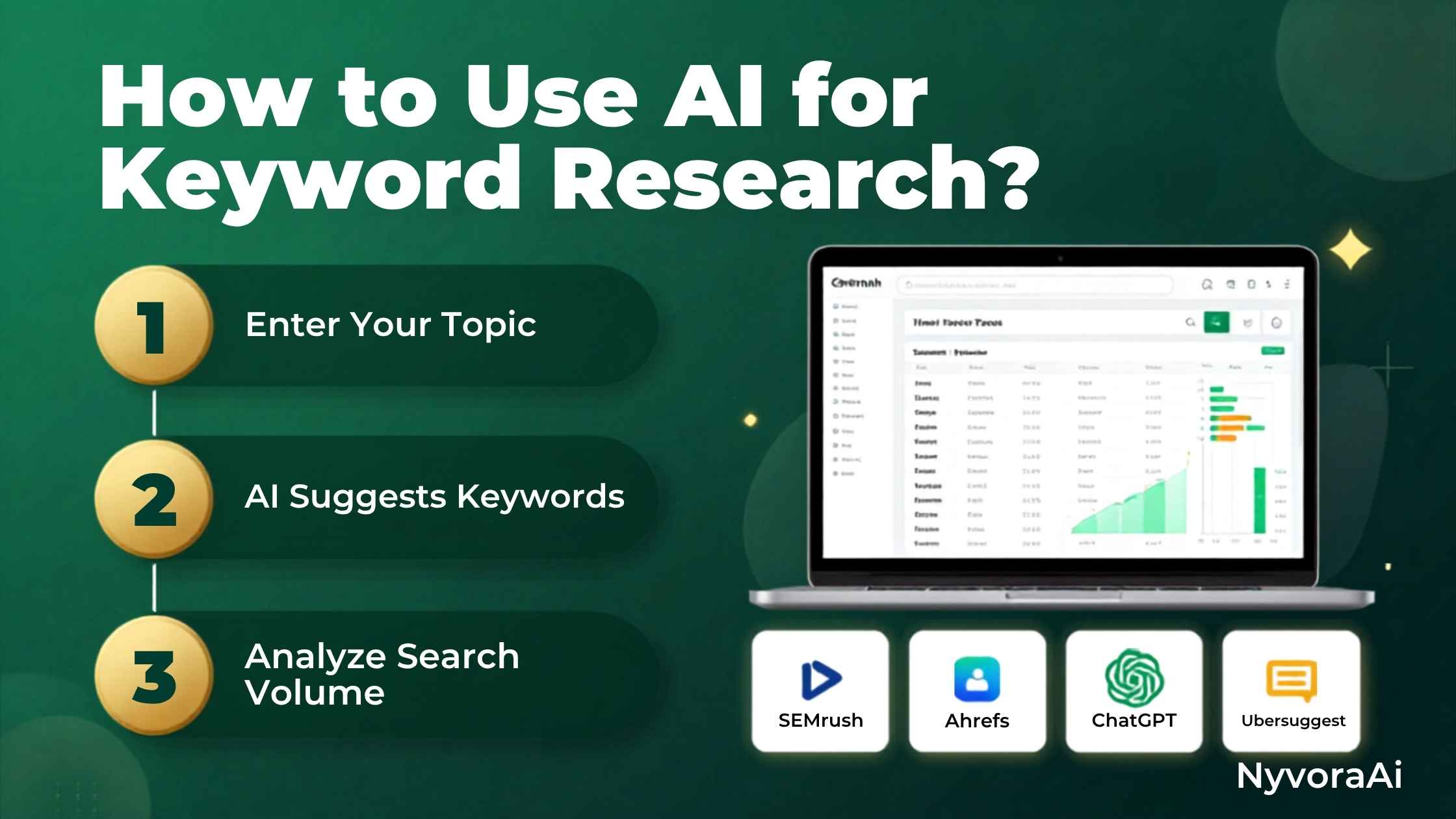
Remember the old days of keyword research? You would spend hours brainstorming seed keywords, manually checking search volumes, and hoping you found a golden nugget before your competitors did. It was tedious, time-consuming, and frankly, inefficient. But what if you could uncover hundreds of high-value keywords in minutes instead of hours? That is the power of knowing how to use AI for keyword research effectively.
AI has revolutionized how we discover what people are actually searching for. Instead of relying on guesswork or expensive tools alone, AI can analyze search patterns, understand semantic relationships, and predict emerging trends before they become obvious. If you are building a content strategy, understanding how to use AI tools for social media posts alongside keyword research creates a powerful content ecosystem that dominates both search and social platforms.
- Start Broad: Use AI to generate seed keyword ideas from a single topic or URL.
- Understand Intent: Ask AI to classify keywords by search intent (informational, commercial, transactional).
- Find Long-Tail: Use AI to expand short keywords into specific, low-competition long-tail variations.
- Cluster Topics: Group related keywords together to create comprehensive content pillars.
- Validate Data: Always cross-check AI suggestions with actual search volume and competition data.
- Analyze Competitors: Feed competitor URLs to AI and ask it to identify keyword gaps and opportunities.
01 Why AI Changes Everything for Keyword Research
Traditional keyword research tools are powerful, but they have limitations. They show you what people searched for in the past, but they do not always help you understand why they searched or what they really want. AI fills this gap by providing context, semantic understanding, and predictive insights.
1. Semantic Search Understanding
Google does not just match keywords anymore; it understands meaning. AI tools can help you identify semantically related terms, synonyms, and conceptually similar phrases that traditional tools might miss. This helps you create content that ranks for entire topic clusters, not just single keywords.
2. Search Intent Analysis
Understanding whether someone wants to learn, buy, or find a specific website is crucial. AI can analyze search queries and categorize them by intent with remarkable accuracy, helping you create content that matches what users actually want.
3. Competitor Gap Analysis
AI can rapidly analyze your competitors' content, identify which keywords they rank for, and highlight opportunities they have missed. This strategic intelligence would take hours to gather manually but takes minutes with AI.
02 The Step-by-Step AI Keyword Research Process
Ready to put AI to work? Follow this proven framework to discover high-value keywords that drive traffic and conversions.
Step 1: Generate Seed Keywords with AI
Start by asking AI to brainstorm seed keywords based on your niche, product, or service. Be specific about your target audience and value proposition.
Step 2: Expand with Long-Tail Variations
Take your seed keywords and ask AI to generate long-tail variations. Long-tail keywords are longer, more specific phrases that typically have lower competition and higher conversion rates.
Step 3: Analyze Search Intent
For each keyword, determine the search intent. Is the user looking for information, comparing products, or ready to buy? AI can help classify this at scale.
Step 4: Cluster by Topic
Group related keywords together to create content clusters. This helps you build topical authority and signals to Google that you are an expert in your field.
Step 5: Validate with Data
Use traditional SEO tools to validate search volume, keyword difficulty, and competition. AI generates ideas; data validates them.
Fill in the details below, and we will generate a powerful AI prompt to help you discover high-value keywords.
03 Best AI Tools for Keyword Research in 2026
Not all AI tools are created equal when it comes to keyword research. Here are the top performers that combine AI intelligence with SEO data.
- Excellent for brainstorming seed keywords
- Analyzes search intent and semantic relationships
- Generates long-tail variations quickly
- Can analyze competitor content strategies
- Free to use for basic research
- AI-powered content editor with keyword suggestions
- Semantic keyword clustering
- Real-time SERP analysis
- Content score optimization
- Integrates with Google Search Console
- AI-driven topic modeling
- Competitive content analysis
- Content gap identification
- Automated content briefs
- Enterprise-level keyword intelligence
- AI-powered topic research
- Question and answer extraction
- SERP analysis and clustering
- Content optimization suggestions
- Automated content briefs
When you are ready to present your keyword strategy to clients or stakeholders, you might need the best AI tool for presentations to create stunning, data-driven slides that showcase your research findings and content strategy.
04 Advanced AI Keyword Research Strategies
Once you have mastered the basics, these advanced techniques will help you uncover hidden opportunities and dominate your niche.
1. The "People Also Ask" Expansion
Feed Google's "People Also Ask" questions into AI and ask it to generate related questions, subtopics, and content angles. This helps you create comprehensive content that answers every possible query.
2. Competitor Content Gap Analysis
Paste your top 3 competitors' URLs into an AI tool and ask: "Analyze these websites and identify keyword opportunities they have not targeted yet." AI can spot patterns and gaps that manual analysis would miss.
3. Trending Topic Prediction
Ask AI to analyze emerging trends in your industry and predict related keywords that will gain search volume in the next 3-6 months. This helps you get ahead of the competition.
4. Voice Search Optimization
With the rise of voice assistants, conversational queries are crucial. Ask AI to convert your target keywords into natural, conversational questions that people would ask Siri or Alexa.
05 Common AI Keyword Research Mistakes to Avoid
Even with powerful AI tools, mistakes can derail your SEO strategy. Here is what to watch out for:
1. Blindly Trusting AI Suggestions
AI can hallucinate or suggest keywords with zero search volume. Always validate AI-generated keywords with actual data from Google Keyword Planner, Ahrefs, or SEMrush before investing time in content creation.
2. Ignoring Search Intent
Just because a keyword has high volume does not mean it is right for your goals. A keyword with commercial intent will not convert well on an informational blog post, no matter how much traffic it brings.
3. Over-Optimization
AI might suggest stuffing your content with keywords. Resist this temptation. Write for humans first, search engines second. Natural language and user experience should always come before keyword density.
4. Neglecting Long-Tail Keywords
Beginners often chase high-volume, competitive keywords. AI can help you find the "hidden gems"—long-tail keywords with lower competition but higher conversion rates.
If you are working on a technical project and need to implement keyword research automation, knowing what AI tools help with coding for beginners can help you build custom scripts to automate your keyword tracking and analysis.
06 Your AI-Powered Keyword Research Checklist
As you build your content around these keywords, you might wonder about different AI assistants. If you are curious is Claude AI free to use for your keyword research workflows, the answer is yes for basic usage, making it an excellent free alternative to paid tools.
For the most comprehensive results, knowing what is the best AI chatbot in 2026 can help you choose the right conversational AI for different stages of your keyword research process, from brainstorming to analysis.
07 Frequently Asked Questions
How to use AI for keyword research effectively?
What are the best AI tools for keyword research?
Can AI replace traditional keyword research tools?
Is AI keyword research accurate?
How do I find long-tail keywords using AI?
Can AI help with competitor keyword analysis?

Written by the NyvoraAI Team
We test and review AI tools to help you rank higher and faster. This guide was updated in June 2026. Have questions about AI keyword research? Contact our team or learn more about our mission.