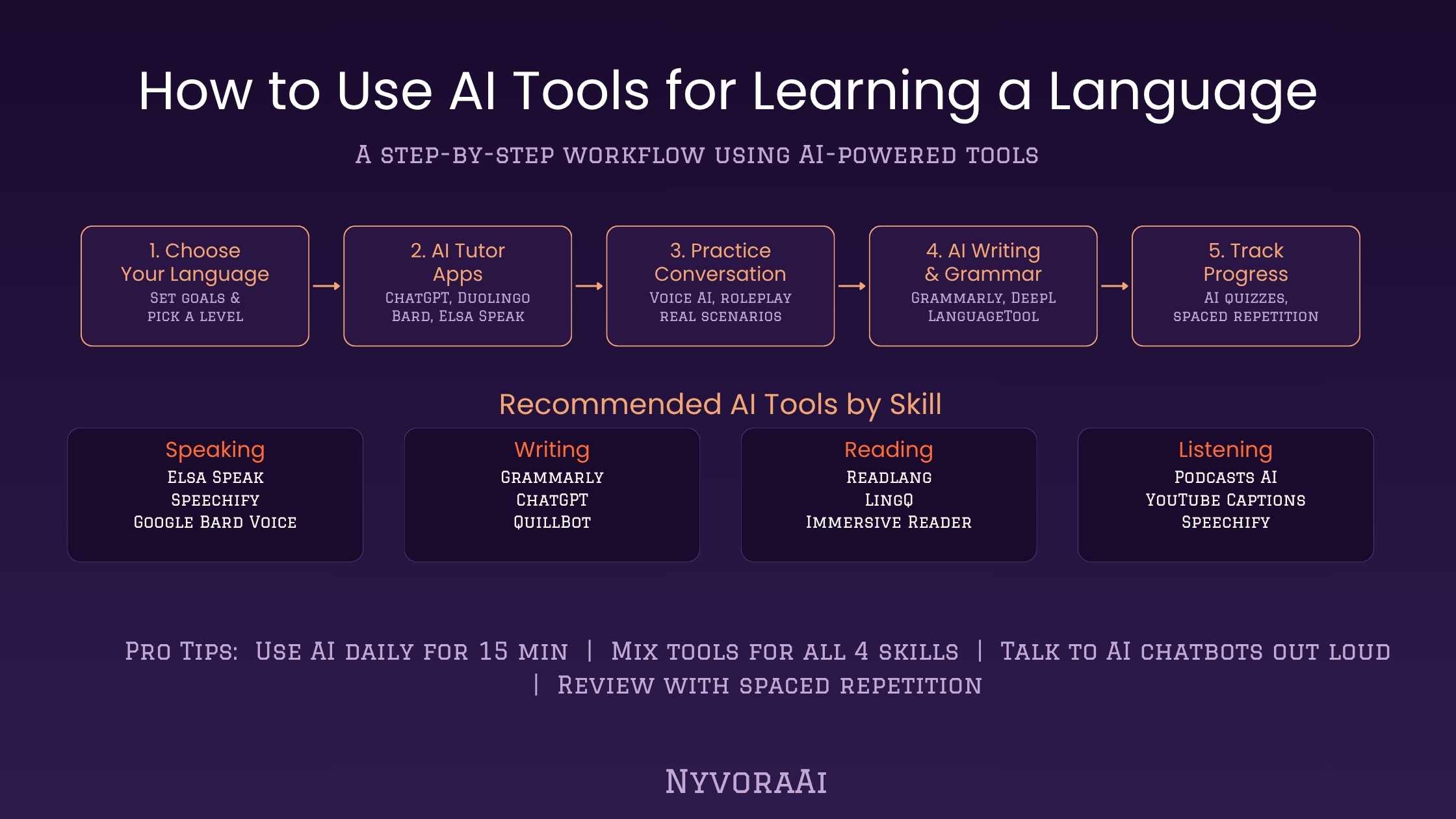
Most people who try to learn a language give up somewhere between the "I can order coffee" phase and actual fluency. Not because they lack ability — but because the methods they're using don't match how language learning actually works. You get progress through consistent, active use. Lots of it. And historically, getting enough of that has been expensive, time-consuming, or just difficult to arrange around a normal life.
AI tools solve the availability problem in a real way. You now have access to an infinitely patient conversation partner available at any hour, a grammar tutor who never sighs at the same mistake twice, and a vocabulary coach who can tailor exercises to exactly what you're working on — all for the price of a basic subscription or, in some cases, free. The question isn't whether AI helps with language learning anymore. The question is how to use it in the ways that actually accelerate progress instead of just making you feel like you're making progress.
AI is most useful for language learning when you use it actively — producing language, not just reading about it.
- Conversation practice is the single highest-value use — do it daily
- Ask AI to explain grammar in context, not from a textbook definition
- Generate vocabulary from things you actually want to talk about, not random word lists
- Write something in the target language every day and ask AI to correct it
- AI supplements real immersion — it does not replace it entirely
01The Quick Answer
If you only do one thing with AI for language learning, make it this: have a ten-minute conversation in your target language every day. Open an AI chat tool, tell it to respond only in the language you're learning, set a simple topic, and start writing. When you make a mistake, ask it to correct you and explain why. That loop — produce, get corrected, understand — is how language actually gets stored, and you can run it every single day without scheduling a tutor, finding a language exchange partner, or doing anything complicated.
Everything else in this guide builds on or enhances that core practice. But if time is short, the daily conversation is the one thing to protect.
02Why AI Actually Changes Language Learning
Traditional language learning has two big bottlenecks: not enough opportunities to actually use the language, and not enough feedback when you do. A class gives you feedback once a week, maybe. A language exchange partner depends on schedules aligning. A tutor costs money and has limited hours. The result is that most learners spend far too much time reading and listening passively and not nearly enough time producing — actually speaking or writing in the target language.
That imbalance is what holds most people back. Reading vocabulary lists doesn't build fluency. Being able to recognise a grammar rule doesn't mean you can use it naturally under pressure. Active production — trying to express something and getting corrected when it comes out wrong — is what builds the neural pathways that eventually feel automatic. AI tools give you that kind of active practice on demand, as much as you want, whenever you want it, without any social pressure about getting things wrong.
The "getting things wrong" part matters more than people think. One of the quieter advantages of practising with AI is that there's no embarrassment. Most language learners are far too cautious about mistakes when talking to native speakers. With AI, you can write something terrible, get corrected without judgment, and do it again immediately. That willingness to produce imperfect language and learn from it is actually the fastest path to improvement.

03Conversation Practice — The Core Use Case
The most impactful way to use AI for language learning is as a conversation partner. The setup is simple: tell the AI which language you're learning, your current level (beginner, intermediate, etc.), and what kind of conversation you want to have. Then ask it to respond only in that language, correct any errors you make, and keep the vocabulary roughly within your level.
A few topic suggestions that work especially well for AI conversation practice: ordering food and describing preferences, planning a fictional trip, talking about your daily routine, discussing a book or show you're familiar with, or describing your work or studies. The common thread is that these are all things you'd actually talk about with a native speaker, which means the vocabulary you pick up this way actually gets used again.
04Grammar Help That Actually Explains Things
Grammar textbooks have a problem. They explain rules in isolation, with example sentences that feel like they were written specifically to illustrate the rule rather than to say something real. AI can explain grammar differently — in the context of something you actually wrote, using your mistake as the example.
The most useful way to get grammar help from AI is to ask about a specific thing that confused you, not to ask for a general explanation of a tense or structure. "Why is it 'fui' and not 'iba' when I'm describing going to a party last Saturday?" gets a much more useful answer than "explain the preterite vs imperfect tense in Spanish." The specific question forces a specific answer tied to a real scenario, which means the explanation has context to stick to.
You can also ask AI to test you on grammar you're working on. "Ask me ten sentences where I have to choose between the preterite and imperfect, then tell me why I got each one right or wrong" is a better use of ten minutes than reading three pages of grammar explanation. Applying the rule yourself — even imperfectly — builds understanding faster than passive reading every time.
05Building Vocabulary in a Way That Sticks
Random vocabulary lists are one of the least effective ways to build usable language knowledge. You memorise thirty words, recognise them when you see them, but the moment you're trying to actually say something, they don't appear. The reason is that words learned without context — without a sentence, a situation, an emotion attached to them — don't get stored in the same place as words you actually use.
AI helps you learn vocabulary the way it actually sticks. Instead of asking for a list of fifty words on "food vocabulary," try asking for the fifteen words you'd most likely need to talk about cooking something specific, or to order food in a restaurant scenario that then gets turned into a short conversation you practice. Alternatively, describe something you want to say and ask AI to give you the vocabulary you're missing — that way, the words you're learning are immediately connected to a real communicative need you have.
- Topic vocabulary by situation: "Give me the 20 most useful Spanish words for talking about public transport in a city, and use each one in a short example sentence."
- Filling vocabulary gaps: "Here's a paragraph I tried to write in French — flag the words I seem to not know and teach me them with examples."
- Flashcard generation: "Generate 25 flashcard pairs for Italian food vocabulary, with the Italian word, English meaning, and a short example sentence on each card."
- Colloquial language: "Teach me five informal phrases a native Portuguese speaker would actually use when greeting a friend, and explain when each one is appropriate."
06Using AI to Support Reading Comprehension
Reading in your target language is one of the most powerful inputs for building fluency — but it only works if you're reading material at a level where you understand most of it and can look up what you don't. Too easy and you're not learning anything. Too hard and you're just looking up every word, which is exhausting and discouraging.
AI solves the level-matching problem. You can ask it to generate a short text on any topic at a specific difficulty level — a two-paragraph news story about a topic you're interested in at B1 level, for example, or a short story at A2 level that uses mostly present tense and common vocabulary. Reading AI-generated content at the right level consistently is more useful than struggling through native-speaker material that's well beyond where you are, and it lets you stay engaged with subjects you actually care about rather than the artificial scenarios most textbooks use.
When you hit words or structures you don't understand in a text, ask AI to explain them in the context of where they appeared rather than in isolation. "In this sentence — [paste sentence] — what does this word mean and why is the verb in that form?" gets you an explanation that helps you understand that specific usage, which is more immediately useful than a dictionary definition.
07Daily Writing Practice With Instant Feedback
Writing something in your target language every day, even a few sentences, and getting it corrected is one of the highest-impact habits you can build. It forces active recall of vocabulary and grammar, it creates a record of your progress you can look back on, and the feedback loop is immediate enough that corrections actually get noticed and remembered.
Write three to five sentences in the target language
Pick a topic you'd naturally think about today — what you had for breakfast, what you're planning this weekend, something you saw. Don't look anything up first. Write what you know and guess the rest.
Paste it into AI and ask for corrections
Ask it to fix every error and explain each correction briefly. Ask it to note if there's a more natural way to phrase something, even if your version wasn't technically wrong.
Rewrite it incorporating the corrections
Don't just read the corrected version. Rewrite it yourself from memory with the corrections in mind. That active rewriting is where the learning actually happens.
Ask it to expand the topic into a conversation
Turn your sentences into the start of a conversation. Now you've moved from writing practice into conversation practice on the same topic, reinforcing the same vocabulary in a different mode.
08Building a Daily Practice That Actually Sticks
Consistency beats intensity in language learning — that much is well-established. Twenty minutes every day for a month produces more progress than one four-hour Saturday session. The challenge is building the habit when daily practice competes with everything else in a real day.
The simplest system that holds up: decide on a fixed time slot and a fixed prompt to start from. Same time every day, same opening line to the AI — something like "Let's do our daily Spanish session, continue from where we left off, here's what I want to talk about today." Removing the friction of deciding what to do each session means you're less likely to skip it. If you've already built workflows around AI tools in other areas of your life, our guide on how to build a daily workflow using AI tools covers how to structure habits around AI assistance in a way that actually sticks.
A Small Habit That Makes a Big Difference
At the end of each AI language session, ask it to give you three things to remember from today's practice — a vocabulary word, a grammar point, and a phrase that came up. Write them down somewhere visible. That three-minute recap at the end dramatically increases how much of each session you retain the next day.
One thing worth knowing about how AI produces language: understanding why AI tools are so good at generating natural-sounding text in dozens of languages is genuinely interesting and helps you trust — and also be appropriately sceptical of — their output. Our guide on how to fact-check AI-generated content is relevant here: AI can occasionally make errors in idiomatic or formal usage, especially in less common languages, so checking anything you plan to use in a real context is worthwhile.
09What AI Cannot Fully Replace
It would be dishonest to end without talking about where AI falls short for language learning, because there are real gaps and pretending otherwise sets people up for frustration.
Pronunciation. Most text-based AI tools give you no feedback on how you sound. Spoken output varies in quality and isn't a substitute for working with a native speaker or a good pronunciation course on sounds that don't exist in your first language. If accent and comprehension matter for your goals, pronunciation practice needs its own dedicated approach outside of AI text chat.
Genuine unpredictability. Conversations with AI are more predictable than conversations with real people. A native speaker changes topic unexpectedly, uses slang you haven't seen, drops context you have to infer, and has real opinions that require real responses. AI practice builds the foundation, but real conversation has a chaos to it that you need exposure to separately.
Cultural nuance at depth. AI can teach you that a phrase is informal or formal, but it doesn't have genuine lived experience of what it feels like to use the wrong register in a real social situation, or how specific regional dialects actually differ in practice. That kind of cultural and contextual knowledge comes from immersion — media, real conversations, time spent with native speakers.
Use AI to build the foundation and remove the barriers to practice. Use real media — films, books, podcasts, music, social content — to build the cultural layer on top of that. And find real people to speak with, even occasionally, because those conversations will accelerate everything else in a way that AI practice alone cannot.
If you find that prompting the AI well makes a significant difference to how useful your language practice sessions are — which it does — our guide on how to write better prompts for AI tools covers the formula in detail. For language learners specifically, the principles around role prompting and giving context apply directly to setting up a productive conversation session. For those combining AI language learning with other productivity goals — writing, content creation, or side work — the techniques in our guide on using AI for freelance writing and on using AI for social media pair well with daily AI practice sessions.
10Frequently Asked Questions
Can AI tools really help you learn a new language?
Which AI tool is best for language learning?
Can I become fluent in a language using only AI?
How much time per day do I need to use AI for language learning?
How do I get AI to correct my grammar without making me feel bad about mistakes?
11Conclusion
The core thing AI changes about language learning is access — to practice, to feedback, to explanations, and to the kind of patient repetition that actually builds fluency. None of the individual techniques in this guide are magic. Conversation practice, grammar correction, vocabulary in context, and daily writing have always been effective. What AI does is make all of them available on demand, at no additional cost, with no scheduling friction and no social pressure about making mistakes.
Start with the daily conversation habit. Even five or ten minutes in your target language, with corrections, is more progress per minute than most other study methods. Build the writing practice in alongside it. Use AI to explain the grammar points that come up in your actual sessions rather than studying grammar in the abstract. And remember that AI is the scaffold, not the whole building — real immersion, real media, and real people are still where the deeper layers of fluency get built. AI just removes the barriers that stopped most people from practising enough to get there.

Written by Varun Lalwani
Varun writes practical, beginner-friendly guides on AI tools and learning for NyvoraAI. Updated June 2026 based on hands-on testing of AI language learning techniques across Spanish, French, and Japanese. Questions about your language learning setup? Contact us — we're here to help.