Running a small business in 2026 feels like juggling flaming swords while riding a unicycle. You are the CEO, marketing department, customer service rep, accountant, and IT support all rolled into one. Sound familiar? Here is the good news: artificial intelligence has leveled the playing field. You no longer need an enterprise budget to access tools that can transform how you operate. Learning how to use AI to grow a small business is not about replacing you, it is about giving you superpowers.
I have seen solo entrepreneurs use AI to handle the workload of a five-person team. Local shops using chatbots to provide 24/7 customer service. Consultants automating their content creation to focus on high-value client work. The question is no longer whether small businesses should use AI, but how quickly you can implement it before your competitors do.
- Start Small: Pick one repetitive task (like customer emails or social media posts) and automate it first.
- Customer Service First: AI chatbots can handle 80% of routine inquiries, freeing you for complex issues.
- Content Creation: Use AI to draft marketing copy, then add your personal touch.
- Data Analysis: Let AI spot trends in your sales data that you might miss.
- Quick Wins: Most businesses see ROI within 30-60 days of implementation.
01 Why Small Businesses Need AI in 2026
Let me be honest with you: your competitors are already using AI, or they will be within the next six months. The small business landscape has genuinely shifted. Work that used to require hiring staff or grinding through 80-hour weeks can now get done with the right AI tools and a few hours of setup time.
The Reality Check
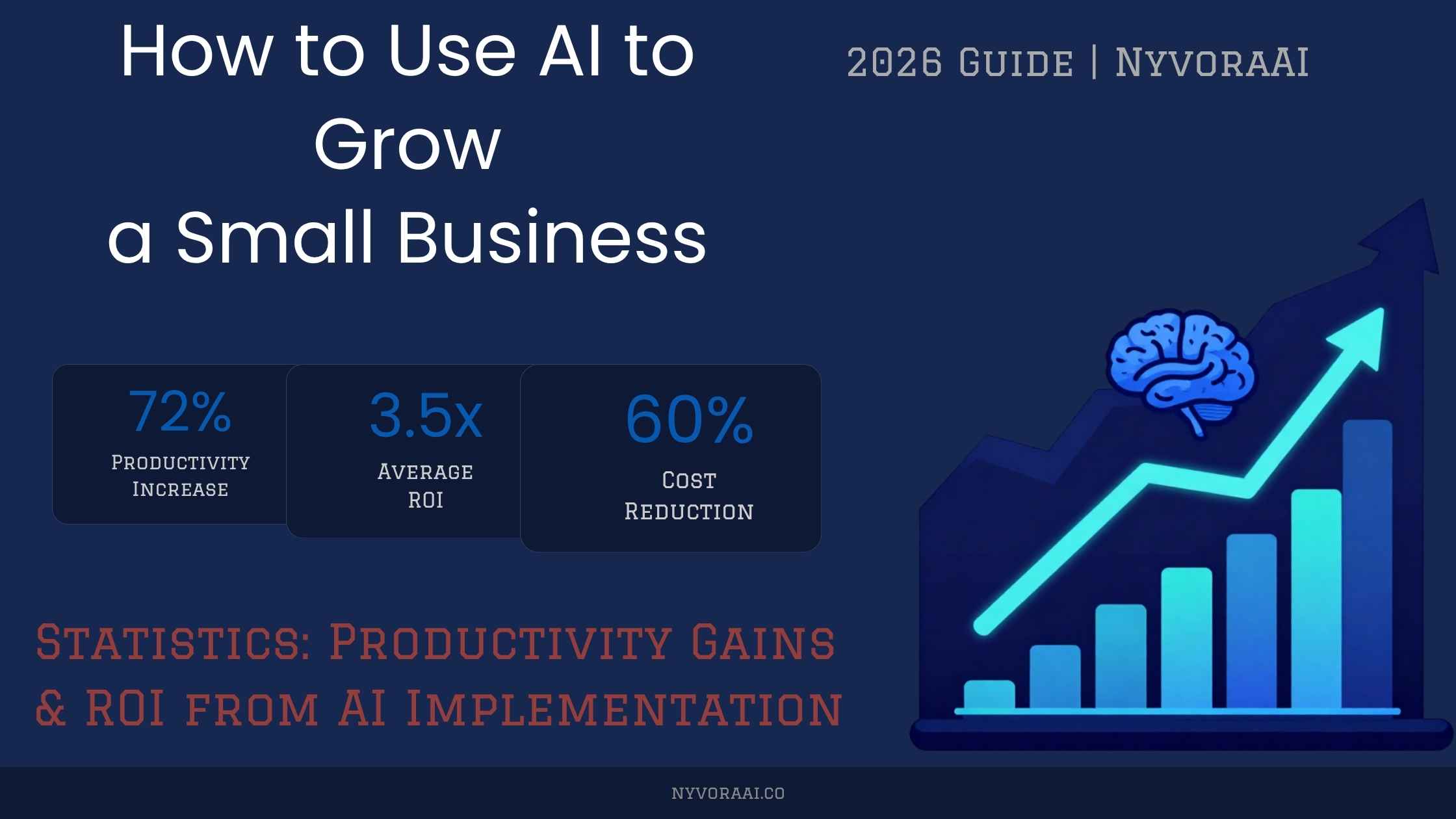
Small businesses that adopt AI tend to see a meaningful bump in productivity within the first quarter, and the pattern shows up in official research too. The U.S. Small Business Administration now runs a dedicated program to help owners adopt AI responsibly, and it is worth bookmarking as a plain-language, no-sales-pitch reference: Using AI for Your Small Business (SBA.gov). But beyond the numbers, AI solves the three biggest problems small business owners face: time scarcity, limited resources, and the need to compete with larger companies.
If you want to understand the broader landscape, our guide on how small businesses are using AI in 2026 provides comprehensive market insights that will help you position your business strategically.
02 7 Proven AI Strategies to Grow Your Business
I am not going to give you vague advice like "use AI to be more efficient." Let us get specific. Here are seven concrete strategies that small businesses are using right now to drive real growth. This lines up with what international researchers are finding too — the OECD reports that early workplace data shows generative AI tools can lift performance on specific tasks by roughly 20 to 40 percent, which tracks closely with what small business owners report once a tool is actually dialed in:
Deep Dive: Customer Service Automation
Customer service is where AI delivers the most immediate impact for small businesses. Think about it: you probably answer the same questions every day. "What are your hours?" "Do you ship internationally?" "What is your return policy?" An AI chatbot handles these instantly, 24/7, without you lifting a finger.
For a comprehensive breakdown of tools and implementation strategies, check out our detailed guide on what AI tools help with customer service. You will discover specific platforms, pricing, and setup guides.
Content Creation That Does Not Sound Robotic
Here is what most people get wrong: they ask AI to write their content, copy-paste it, and hit publish. That is a recipe for generic, soulless content nobody reads. The winning formula is different: use AI for the first draft, then inject your personality, your stories, your unique take. The result is content that still sounds like you, but takes 30 minutes instead of 3 hours.
03 Your 30-Day AI Implementation Plan
Overwhelmed by where to start? Do not be. Here is a step-by-step 30-day plan to implement AI in your business without disrupting your current operations:
04 Best AI Tools for Small Businesses
You do not need to break the bank. Here are the most effective AI tools for small businesses, categorized by function:
- Content creation
- Customer communication
- Idea generation
- Email drafting
- Research assistance
- AI chatbots
- Lead qualification
- Customer support
- CRM integration
- Analytics
- Workflow automation
- App integration
- Data syncing
- Task automation
- No coding required
- Real-time translation
- Website localization
- Customer support
- Content translation
- High accuracy
For businesses looking to expand internationally, understanding the best AI tools for translation is crucial. These tools can help you serve customers in their native language without hiring translators.
05 Common AI Implementation Mistakes to Avoid
I have watched dozens of small businesses implement AI, and the same handful of mistakes keeps repeating. Avoid these pitfalls:
Mistake #1: Trying to Automate Everything at Once
This is the fastest path to burnout. Pick ONE area, master it, then move to the next. Rome was not automated in a day.
Mistake #2: Set It and Forget It
AI needs supervision, especially in the beginning. Review chatbot conversations. Edit AI-generated content. Check automated decisions. Gradually reduce oversight as you build confidence. If you want a structured way to think about this instead of winging it, the U.S. National Institute of Standards and Technology publishes a free, vendor-neutral AI Risk Management Framework (NIST.gov) that is genuinely usable even at small-business scale, not just for big enterprise IT teams.
Mistake #3: Losing the Human Touch
AI should enhance your humanity, not replace it. Use AI for routine tasks so you can spend MORE time on high-touch customer relationships, not less.
Mistake #4: Ignoring Training
Your AI is only as good as the information you feed it. Spend time training chatbots with accurate FAQs. Provide AI writing tools with your brand voice guidelines. Garbage in, garbage out.
06 Frequently Asked Questions
How can small businesses use AI to grow?
What AI tools are best for small businesses?
Is AI expensive for small businesses?
How long does it take to see results from AI implementation?
Do I need technical skills to use AI in my business?
Can AI help my small business compete with larger companies?
What is the first AI tool I should implement?

Written by the NyvoraAI Team
We help small businesses leverage AI for real growth. This guide was updated in June 2026 with the latest tools and strategies. Have questions? Contact our team or learn more about our mission.